admin
admin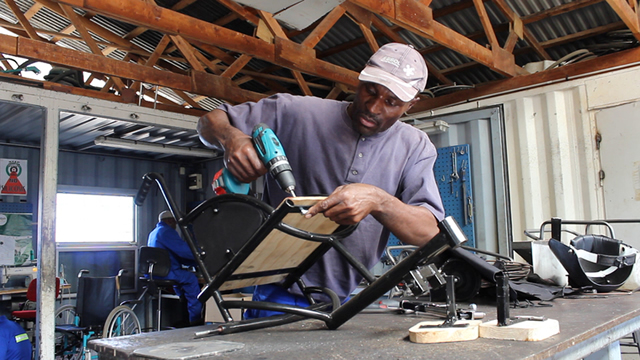

Tapfuma Machakaire
DONATIONS of unprescribed wheelchairs and other devices to people with disabilities that are generally regarded as an act of benevolence can result in worsening of the condition of particular individuals and in some cases can even cause premature deaths especially in children. Prior to the establishment of the Local Rehabilitation Workshop (Lorewo) in Zimbabwe’s second largest city, Bulawayo, in 1999 which is manufacturing prescribed wheelchairs and other gadgets for people with disabilities, hundreds of disabled Zimbabweans who received wheelchairs as donations may have received wrong appliances that did not suit their particular situations and could have been harmful to their health.
Lorewo was established with support from the United Nations Development Programme and is transforming the lives of people with disabilities by providing services that are crucial for their well-being.
The main services of the workshop, which is situated at the National Council of Disabled Persons of Zimbabwe (NCDPZ) Headquarters adjacent to Mpilo Central Hospital, are manufacturing of wheelchairs and tricycles, adapting wheelchairs to fit the individual user, service, repair and conditioning of wheelchairs and other mobility devices, assisting in the development of solutions for people with special needs, offering training courses for professionals who work in the field of rehabilitation and creating awareness of technical solutions that can support independent living for people with disabilities.
Emmanuel Majole, the workshop manager, said before the establishment of the workshop, wheelchairs were being issued out willy-nilly without looking at somebody’s disability.
“That wheelchair can cause more harm than its intended use and even death. In assessing the need of an individual disabled person we call in physiotherapists and occupational therapists then we manufacture the gadgets according to specifications.”
Majole said the workshop is, however, still ordering some wheelchairs from other countries but before they are sold or issued out, adjustments are made to suit the requirement of particular individuals.
“Most of the wheelchairs that we purchase from other countries especially from South Africa are for children who are severely handicapped,” he said.
Majole said Lorewo wheelchair technologists were trained at the Tanzania Training Centre for Orthopaedic Technologists (TATCOT) with additional training received from experts from Norway and South Africa in technical skills and principles of service delivery systems.
The nine-men team, eight of whom are disabled, manufacture the special gadgets using locally available materials which makes it easy for repairs to be carried out locally unlike the situation in the past, where once the imported appliances broke down they had to be dumped as they could not be repaired.
Majole said the workshop was also manufacturing commodes which are special toilet seats for people with disabilities in rural areas who have difficulty in using pit latrines. He said a local NGO had ordered 800 commodes from the workshop that they intend to distribute to rural areas.
Obadiah Moyo, president of NCDPZ and Board Member of Lorewo, described the project as one of the best wheelchair and appliances workshops in the Sadc region.
He said the Lorewo board had given the green light for the project to be expanded to other parts of the country and was encouraging government and various service organisations to support the expansion project.
“The project is producing quality wheelchairs that are in demand and various institutions including hospitals, the National Social Security Authority (NSSA) and Institutions for disabled people such as Jairos Jiri Association have continued to order appliances from Lorewo.”
Ironically, the workshop is still unable to reach out to most people with disabilities in rural areas due to resource constraints that include transport.
Under its expansion programme, the organisation is hoping to establish satellite workshops at district and provincial hospitals across the country.
“We’ve been able to provide wheelchairs to areas such as Tsholotsho but generally, people in rural areas don’t have access to such services and we feel we should have extension programmes to link up with district hospitals to identify persons with disabilities who need such facilities,” said Moyo.
Robert Mukhozho, acting executive director of NCDPZ, said people with disabilities are seen by communities as a burden or people who are useless and cannot do anything in society but in reality they can be very productive if given the opportunities and resources.
“As an organisation with over 50 branches all over the country, we’re trying to empower people with disabilities by engaging them in income generating projects such as the Lorewo project where they make gadgets for people with disabilities.” said Mukhozho.
Everjoice Kambarami, who runs a catering business with two other women with disabilities at the NCDPZ headquarters, was one of the first beneficiaries of the project after getting a tricycle which she uses to carry goods for the business from the city.
She said before she got the tricycle, the business was losing lots of cash through hiring taxis to transport foodstuffs from the city.
“I’m able to carry up to 40 kilogrammes of goods on the tricycle and these include mealie-meal and meat that we purchase from the city for our business,” said Kambarami.
Irene Moyo, an A-Level graduate who is a vendor in the city, received a wheelchair which was specifically designed for her after undergoing an assessment by specialists. She said before she got the wheelchair from Lorewo, she had been using one that was donated by a well-wisher in Europe.
“The wheelchair wasn’t comfortable and I could hardly push myself but with this new chair I’m able to go and collect my orders daily from the market.”
Moyo said she had since referred three people to Lorewo who managed to get wheelchairs.
Ratidzo Tomu, who was involved in a road accident in 1999, had been using crutches when she discovered the workshop.
She said she has also benefited from a special sporting wheelchair and has been taking part in disabled sporting competitions. “I only got involved in sport after receiving a sporting wheelchair in 2013. I’m looking forward to being selected for the All Africa Games next year and I’m training very hard,” said Ratidzo.
Lorewo also manufactures and fits hand controls for vehicles used by disabled people. Without the hand controls not many people with disabilities would have been able to drive themselves even if they may have managed to buy cars.


 Online Reporter