


 Online Reporter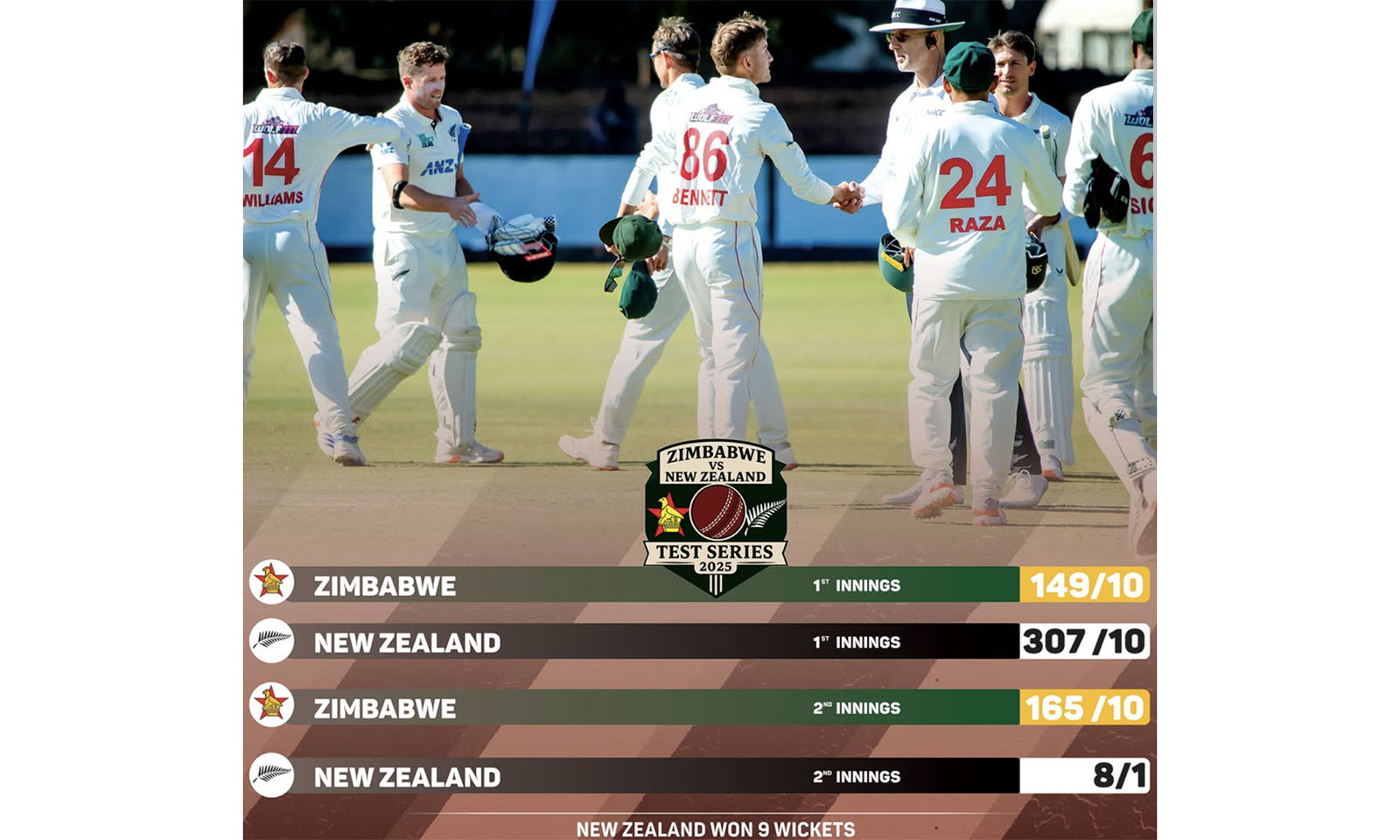
Eddie Chikamhi-Zimpapers Sports Hub
IT IS a Friday afternoon at Queens Sports Club in Bulawayo, and the stands are thinning fast.
Zimbabwe have just lost, again. This time, New Zealand are walking off with an eight-wicket Test victory, leaving Zimbabwe with their seventh loss in eight games this year.
For the fans who keep showing up, this is more than defeat. It is exhaustion. Disappointment. A familiar script that has worn thin.
Over the past seven months, Zimbabwe’s national teams, across formats and age groups, have played more games than most International Cricket Council (ICC) full members. But the scoreboard keeps telling the same story: heartbreak.
The Chevrons have stumbled through a bruising season, and the gap between them and quality opposition is growing.
The women’s side were swept in both the One-Day International (ODI) and Twenty20 International (T20I) formats on their recent tour of Ireland.
The Under-19 men’s team, gearing up for next year’s ICC Under-19 World Cup, have not won a match in the triangular series they are hosting in Harare.
Losses to Bangladesh and South Africa have come with alarming ease.
These are not close games. They are collapses. And fans are feeling the weight.
Zimbabwe’s Test against New Zealand ended with two days left on the calendar.
And that has happened before — against Bangladesh, England and twice against South Africa.
A format that is supposed to reward grit and endurance has exposed Zimbabwe’s lack of both.
Even in white-ball cricket, the pattern holds. Zimbabwe lost all four matches in the T20I tri-series with New Zealand and South Africa.
Coach Justin Sammons did not hide from the numbers, but clung to the belief that these beatings will build something.
“The bottom line is, I think this is probably the most Test cricket Zimbabwe has played in a period in their history and it’s against high-quality opposition,” said Sammons.
“If we, as Zimbabwe, aren’t quite at our best, the results are going to end up like they are. So, for us to change that, and it can, we’ve got to be at our best continuously.
“We know it’s hard. The public wants to win. We want to win. But this period is going to hold these players in good stead down the line. When that shows, we’re not sure, it might show in the next game, in a year, in a month. But it is going to show.
“These experiences are so important for their development. You may struggle now, but these lessons will sink in. Zimbabwe cricket is going to be in a better place for it. It just requires some patience while you’re playing this type of opposition.”
Patience, though, is in short supply.
“This five-day Test cricket isn’t for the boys. ICC must let us play one-and-a-half or two-day matches . . . people are paying for five-day games and only get two,” said Kelvin Tendai Chinyundo, a fan.
“At this point, we can’t keep reviewing the last 23 years. We’ve been in the game long enough to at least lose by two or three wickets, not nine, especially at home.”
Another supporter, Moses Junior Chitapa, said: “We need bold moves. Let’s give players like Alistair Frost, Jayden S and Brad Evans a real chance. The current crop isn’t delivering.”
Others saw the bigger picture.
“New Zealand are renowned for punching above their weight and being resourceful. They’ve won the World Test Championship, the ICC Knockout Trophy and whitewashed India in India,” wrote Shane van Der Nelson on Facebook.
“This is a strong Black Caps team missing only Kane Williamson and Tom Latham. Zimbabwe played very well against a top cricket team. Hope they’ll do better in the second Test.”
Still, optimism is fleeting.
Zimbabwe’s only Test win this year came in Sylhet, against Bangladesh, in April.
Their batting since then has been fragile.
Sean Williams and Brian Bennett have shown flashes, but the top order often crumbles for under 200.
Even when Richard Ngarava and Blessing Muzarabani bowl their hearts out, it is rarely enough.
This is not just about the men’s team. The women’s squad, under-19s, and even the development pipeline reflect the same strain, one that goes beyond form. It is structural.
Top teenage talent is being rushed into franchise and international cricket without mastering basics.
Selection processes feel opaque, and players often do not know why they are in, or out, of the team. Accusations of favouritism have surfaced, most notably from former seamer Tendai Chatara, who later retracted his public criticism of selectors.
Zimbabwe Cricket convenor of selectors David Mutendera was unavailable for comment. But national T20I captain Sikandar Raza offered a rare window into how selections are made.
“I think Marumani needed some time off. He’s only 23. He’ll be back,” said Raza, addressing Tadiwanashe Marumani’s omission despite strong domestic stats.
“People compare domestic and international stats to fit narratives, but that’s not how selection works. The criterion is franchise cricket. When it resumes, everyone will have a pathway to get in, or back in.
“Sometimes people ask why one player is there and another isn’t. You’ve got to look at who’s already in. Is there a spot? Take Trevor Gwandu, seven or eight wickets in three games, and people still questioned his place.
“Newman Nyamhuri was identified as a real prospect early on. We trust Charles Langeveldt’s eye for talent. Newman is with us for development reasons. When his time comes, we’ll give him a go.”
That long view is hard to sell when the scoreboard keeps saying otherwise.
This is the same squad that beat Ireland 4-1 in a youth ODI series in April, but up against South Africa and Bangladesh, they have turned from promising to pummelled.
The current tri-series is meant to prepare them for the 2026 Under-19 World Cup, which Zimbabwe and Namibia will co-host. But preparation only goes so far without support.
Zimbabwe’s problems are layered. They do not play enough bilateral series against top teams. They rarely feature in major ICC events. That lack of exposure makes it harder to adapt under pressure, and the cracks show in second innings collapses and missed follow-on opportunities.
Funding is another choke point.
Chronic shortfalls have forced tour cuts and left support staff stretched. There is no national academy with full-time coaching. There are no district academies that can refine young talent. There are few indoor nets. Players are then thrown in unready, and it shows.
Still, there is a nucleus to build around — Raza, Williams and Ervine. Maybe even a returning Brendan Taylor, who could help mentor the next generation.
The pieces are there, but they need time, investment and the kind of vision that lasts longer than a series or two.
Until then, the fans who buy tickets for five days of cricket will keep leaving after two, wondering when hope turns into something more.



