admin
admin
Jeffrey Gogo Climate Story
CONTRARY to widespread assertions, the industrialised countries of the European Union have just proved it is not impossible, and certainly not unviable, to achieve economic growth and respond to climate change simultaneously.
In the last 25 years, the 28-member bloc of rich countries has cut greenhouse gas emissions by 19 percent below 1990 levels, but achieved GDP growth twice as much as the cuts, at 45 percent.
That’s what the European Commission president Manuel Barroso told the UN climate summit in New York on September 23.
Most of the emission reductions were achieved as countries dumped fossil fuel based energies and switched to renewable ones.
Backed by such economic evidence, it is difficult to understand why the EU and its fellow Western accomplices have been reluctant to speed up climate action at the pace needed to control climate damage while the time is still there?
Why only $2,3 billion of the promised $100 billion was pledged in New York for capitalising the crucial Green Climate Fund (GCF), from which dozens of developing countries should benefit?
Why no industrialised country announced any ambitious plans to take on deep emission cuts of up to 40 percent as early as 2017 and 95 percent by 2050, as Africa has for many years advocated?
European Commission president Mr José Barroso promised the EU targets to reduce its emissions by 40 percent below 1990 levels by 2030. That is greatly inadequate. It means the EU commitments cover only 14 percent of all global emissions.
The margins are significantly lower than what is actually needed to help cap global temperature rise at 2 degrees Celsius, the limit considered by scientists as safe for a liveable world.
United States president Barack Obama, the world’s second biggest emitter after China, reiterated his country’s already inadequate plans to limit emissions by 17 percent below 2005 levels by 2017.
At that rate, the US is effectively cutting an insignificant 5 percent of emissions below the 1990 base year.
Instead of falling, GHG emissions are expected to grow by 10 percent in Canada over the next few years and Australia committed to reduce emissions by just 5 percent by 2020.
Australian Foreign Affairs minister Julie Bishop claimed that there will be a 22 percent reduction from business-as-usual scenario levels.
If it is not selfishness, then such inactions can only be interpreted as deliberate, calculated neglect of historical responsibility for fuelling climate change.
For there is no moral justification for wealthy nations, whose industries have since the 18th century spewed soot into the atmosphere, to deny posterity a safer world by continuously deferring urgent climate action to the future.
If climate change was precipitated by the actions of a few nations, actions now causing worldwide suffering, by the same principle, those few nations must take the lead reversing the damage they have caused.
That’s what makes their responsibility historical, and indeed, current. By demanding that the Paris 2015 deal compel all countries, rich or poor, to commit is clearly unfair and immoral of developed countries.
The question of morality will be adequately answered when rich nations fulfil the $100 billion per year promise until 2020 to fund mitigation and adaptation in the developing world.
As far as Africa is concerned, fairness is when industrialised states agree to cut 95 percent of emissions by 2050, avail funding, support technology transfer and stop asking for and expecting binding commitments from poor nations.
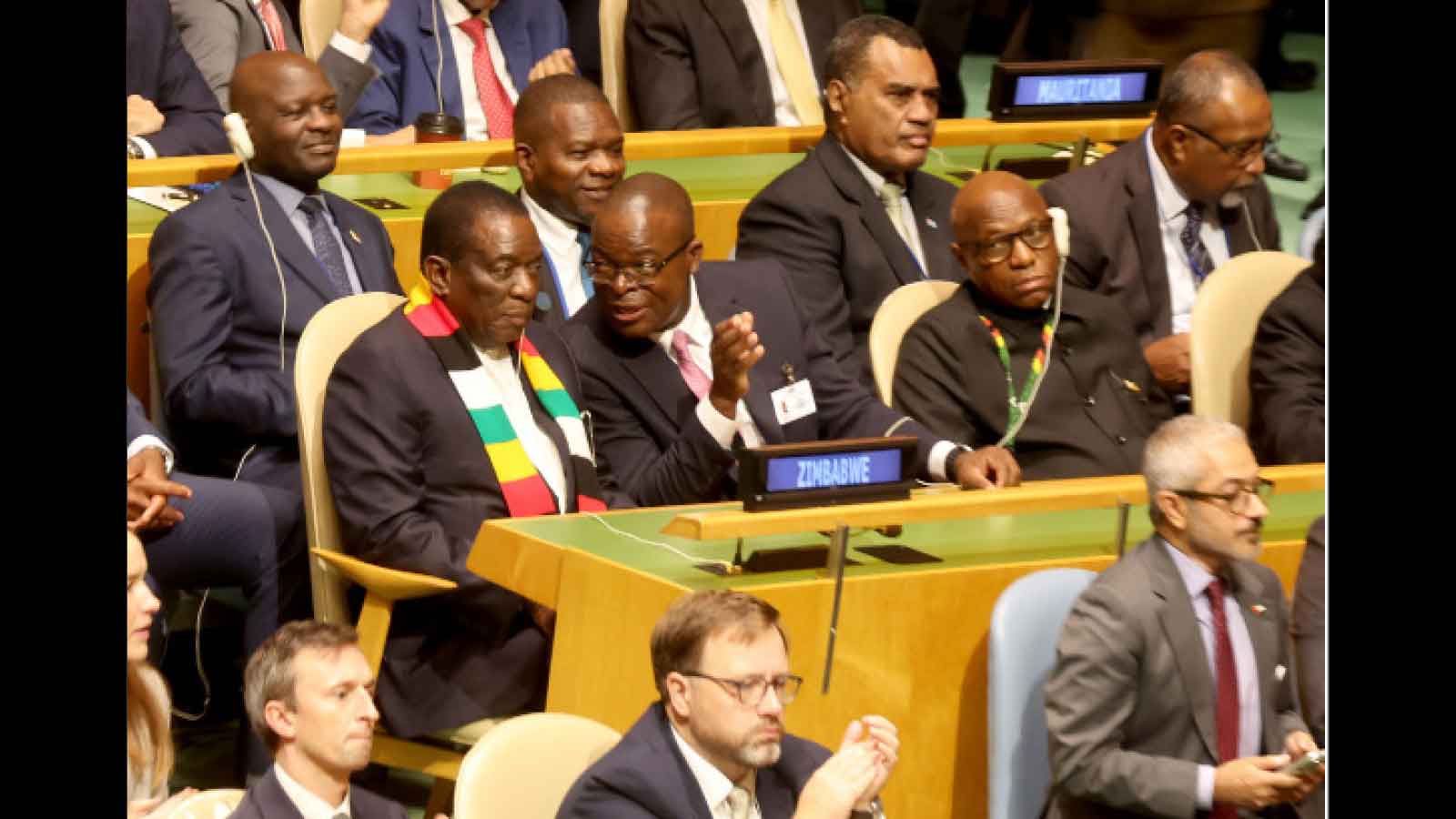
Zimbabwe alone will need $10 billion to finance mitigation and adaptation within the next five to 10 years. Yet, it is one of the many countries expected to “benefit” from the Green Climate Fund.
In allowing the GCF to remain under-capitalised at a time it ought to be “over-capitalised”, rich countries are saying developing countries should scramble for the limited funds; those favoured by fate will survive.
Speaking for the Committee of African Heads of State and Government, President Jakaya Kikwete of Tanzania told the New York summit financial support was key to climate change mitigation and adaptation in Africa, where over 60 percent of people are dependent on agriculture.
The sector faces the most severe strain from climate change, disrupting food production and security.
Now, as Paris draws nearer, it’s become clearer Africans will have to do much more to get the industrialised countries of the West to fulfil in an effective and verifiable manner funding obligations under the GCF.
In New York, Germany and France made the highest pledges yet to the Fund – $1 billion each – and Korea, where the GCF is head quartered, pledged US$100 million.
There is a global meeting in November where detailed pledges towards capitalising the Green Climate Fund will be heard.
After that meeting, it will become clearer how far developed nations are willing to go to help developing nations cope with climate change, from a funding perspective.
We now know when industrialised countries refuse to accommodate demands to raise ambitions and initiate stronger climate action they are doing it not so much for economic reasons, but to serve own interests.
This, also, will be confirmed or disproved next year in March when countries announce national commitment plans for tackling climate change; plans critical in shaping a new global agreement with legal force to replace the Kyoto Protocol.
The new treaty will first have to be adopted at the Paris climate summit in 2015 before entering into force five years later.
God is faithful.


 Online Reporter