admin
admin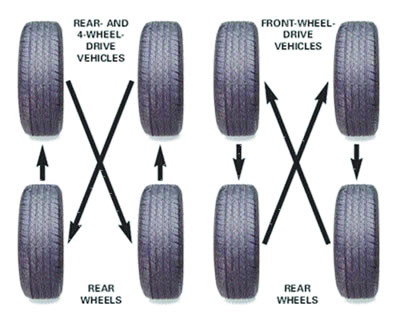
In this article I will try and point out these details and hopefully this will save you time and money.
One of the most important issues is tyre rotation. Tyre rotation is vital to achieving even tread wear and long tread life. Rotation is necessary because of the uneven wear characteristics of each wheel position on the vehicle.
A good example is front wheel drive vehicles, which places braking, steering and driving forces on the front axle tyres.
Rear axle tyres only receive braking forces resulting in a much faster wear rate for the front axle tyres. The reverse happens in a rear wheel drive vehicle.
Tyre rotation for these vehicles therefore becomes very important for optimum tyre life.
Normally tyre rotation should be undertaken every 5 000 km to 8 000km even if there is no sign of uneven wear.
When rotating your tyres you should adopt the cross rotation or pattern method.
The “cross pattern” provides the best results and can be performed on any front or rear wheel drive vehicle.
It entails swapping rear and front wheels in a cross with the right front wheel swapping positions with the left rear wheel and the left front wheel swapping with the right rear wheel.
During the next rotation you do a straight rotation by simply replacing the front tyre with the rear and rear tyre with the front.
After that you then return to the cross pattern and you continue like that until you replace your tyres.
Shocks and struts can wear out very quickly and this wear and tear can go unnoticed until it develops into a major problem or when the car or vehicle is no longer
absorbing bumps in the case of shocks.
One way of detecting wear and tear in struts and shocks is by checking your tyres.
If you notice any then you should realise that there can be a number of seemingly unrelated components causing the bad wear patterns on your tyres.
One example that your shocks or struts are going bad is when your tyres get a cupped type pattern worn into the tread, and this will make the car vibrate or hum at certain speeds.
If this cupping is bad enough you will hear noise at almost any speed. This will show up across the entire tread if the shocks or struts are causing problems.
So check the shocks and struts, and if they look like there has been a leak, or if they rattle or squeak, it may be time to replace them.
Something as simple as a bad shock can prematurely wear out your tyres. Other items that can wear out unnoticed are tie rod ends, and ball joint bushes.
These normally do not wear out very often, but you can see signs of this when you look at the outer edge of the tyre tread.
If it is scalloped or lumpy in any kind of pattern, then it is likely that your tie rod ends are shot.
These only last so long, and even with periodic greasing they are wearing down a little bit every time you use the vehicle.
You can check the tie rods and ball joints when the car is elevated by literally kicking the tyres.
If you see any loose play in the wheels, then you can safely assume that something needs to be replaced.
It is probably the tie rod ends that have become dry, and are wearing out due to excessive friction.
One thing to consider regarding the tie rod ends is that these will be working during the entire time you will be driving the car. They come under a lot of stress when you turn the wheels to the extreme end and it also damages them when you turn the wheel while the vehicle is not in motion.
Ball joints are a little trickier to inspect, but when you elevate the car, you can do a visual inspection by looking for cracked rubber seals.
You can also try to pull the tyre in and out on the top and then again on the bottom to see if there is excessive play in them.
Proper lubrication is important on the chassis just as it is everywhere else.
The problem for most people is figuring out where all of the grease fittings are located if you have not done this on your specific vehicle before.
Look very carefully at every sliding, spinning, or rotating member to see if there is a small recessed or raised bump style insertion point for the grease gun tip.
Once you locate these, clean them off to get all the dirt off, and then fill them with grease by squirting in three to four good pumps. Do not overfill this since you can damage the boot if it is not already torn.
We sometimes go for many weeks without ever needing to run the wipers, but then when it does rain, and you sometimes find that the blades have stuck to your windshield or something worse.
The simple thing is to check them while you are filling up the fuel tank, and replace them right away if they are really worn out. Keeping a spare blade in the car is a good idea since you never know when you might need one.
In summary it is wise to keep records of the type of maintenance that has been carried out on your vehicle and it would be very helpful to get a shop manual specific for your car.
Record keeping will come handy one day when you decide to sell the vehicle. Stay blessed and be safe.
- Fact D. Jeke is a motoring enthusiast who has attended auto shows, rallies and has written for various publications in the region for the last decade. She can be contacted via email on [email protected] or on Facebook; torque with Fact Jeke



 Online Reporter