

 Chronicle Editor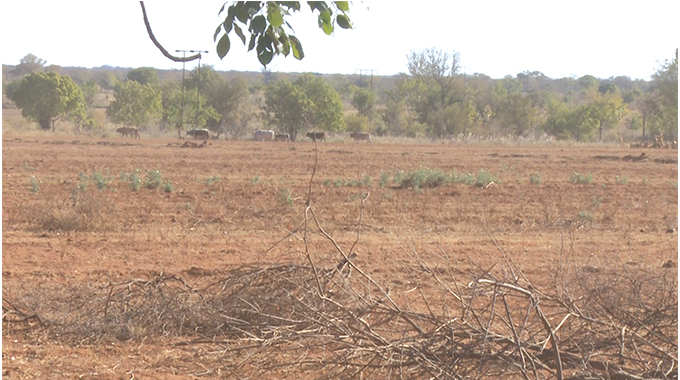
Sukulwenkosi Dube-Matutu, Gwanda Correspondent
THE sight of vast amounts of bare land cannot be missed as one drives past what was once the pride of Makwe area, Ward 8 in Gwanda.
All villagers can do now is narrate how the land, which is now lying idle, once housed their once vibrant 200-hectare irrigation scheme. The irrigation which is the largest communal irrigation in Gwanda District has been lying idle for the past two years. Established in the 1960s, Makwe Irrigation Scheme was once the bread basket and major source of income for the villagers and ever since it shut down has left many in despair.
Obsolete equipment, theft of electricity cables at the irrigation scheme coupled with challenges which were faced by farmers to raise money to pay electricity and water bills saw operations at the irrigation gradually come to an end. Because of these challenges farmers operating at the irrigation reduced the amount of land which they planted up until their operations came to an end.
An elderly villager from the area, Mr Brighton Ncube (67) recalls how the irrigation once played a crucial role in sustaining families.
“I have watched over the years as this irrigation scheme has been fading right before our eyes. It was established in 1964 and we used to grow a variety of crops in this irrigation and we knew that we didn’t have any problems with food. We would keep some of the produce we realised for consumption at our households while we used to sell some of the produce. This irrigation was a source of livelihood for many of us.
“We used to plant wheat, maize, beans, vegetables and a wide variety of crops. We had a very large market. We used to supply local hospitals and schools and people knew that they could rely on us. Our neighbouring villagers also used to come and get their supplies from us. When this irrigation scheme was established I was still young and my parents were working in it. They used the money which they realised after selling their produce to send me and my siblings to school,” he said.
Mr Ncube said when he had a family of his own he also worked in the irrigation scheme and used the money he realised after selling his produce to fend for his family and send his children to school.
He said the irrigation played a crucial role in the lives of Makwe Villagers and there was need to revive it soon.
“We used to take so much pride in this irrigation as it once did well in produce and we would realise good yields. I recall the beauty of the crops whenever they were ready for harvesting. People would pass by and admire our crops that would have filled that entire 200 hectares of land. Sadly now it’s just a big space of empty land, whenever I walk past the irrigation scheme I really feel saddened,” he said.
The councillor of Ward 8, Clr Rachael Ncube said their area has not been doing well in terms of yield as it required a lot of rain. She said the irrigation scheme had played a huge role in ensuring food security within the community.
Clr Ncube said they started experiencing serious problems in 2016 as animals were straying into the irrigation scheme which forced a number of farmers to pull out as they were eating up the crops. She said the perimeter fence had become too old which made it difficult to keep livestock out of the irrigation.
She said in 2017 they had planted wheat, maize and onions but some of the electricity cables were stolen and farmers suffered a great loss which made more to pull out of the project.
Clr Ncube said following the destruction of the perimeter fence farmers moved away from the periphery in order to avoid losing their crops to livestock.
“The irrigation scheme was established a long time back and the equipment there is now obsolete and needs to be replaced. Most of the perimeter fence is gone which was now making it difficult to keep animals out of the scheme. We were struggling to water our crops because of an obsolete pipe system. We were constantly experiencing burst pipes and leakages which was making it difficult to draw water from the dam which is about 12 kilometres away.
“The engines were also constantly breaking down and couldn’t pump water to the irrigation. With time the irrigation couldn’t operate at full capacity because of these challenges which in turn made it difficult for farmers to pay their water and electricity bills as they were not getting much after selling their produce. As a result the bills accumulated and we are struggling to clear the bill even up to now. The irrigation scheme started off with about 470 farmers but gradually the number dropped to less than 200. When it started we were planting the entire scheme but gradually it’s capacity dropped up until we could only plant about 50 hectares,” she said.
Matabeleland South acting provincial irrigation engineer, Mr Shepard Mpotekwa said Makwe Irrigation Scheme is the largest communal irrigation within Gwanda District and hence had a huge role in ensuring food security. He said the entire scheme needed to be rehabilitated.
Mr Mpotekwa said plans were underway to have it rehabilitated under the Smallholder Irrigation Revitalisation Programme (SIRP) which is a Government-led programme funded by International Fund for Agricultural Development (IFAD). He said the target was to have the irrigation project rehabilitated by end of next year.
“Infrastructure at the irrigation is dilapidated such that pumps are not working. The irrigation has five pumps and only two were working with constant breakdowns when the farmers stopped operating. All of the pumps are worn out and farmers have had to constantly send them for repairs in Bulawayo since around 2008.
“The pipe system also needs to be replaced. Before the electricity cables were stolen farmers had seized to operate because of constant breakdown of the pipe system. Some sections of the canals are also damaged and this was leading to loss of water and water logging. There is also need for a new perimeter fence,” he said.
Mr Mpotekwa added: “As the Department of Irrigation working with Agritex we have identified Makwe Irrigation as one of the schemes that will be rehabilitated under the SIRP programme.
There is need for a feasibility study to identify all the problems being faced at the irrigation scheme and how they can be solved. We have engaged a consultant to conduct this feasibility study.
“While our desire as the Department of Irrigation is to have solar systems in all our irrigations it will be difficult to install one at Makwe Irrigation Scheme due to its size as funds won’t permit so we will maintain the existing system,” he said. — @DubeMatutu



 Online Reporter