Kuda Bwititi
Politics, Foreign Affairs and Opinions Editor
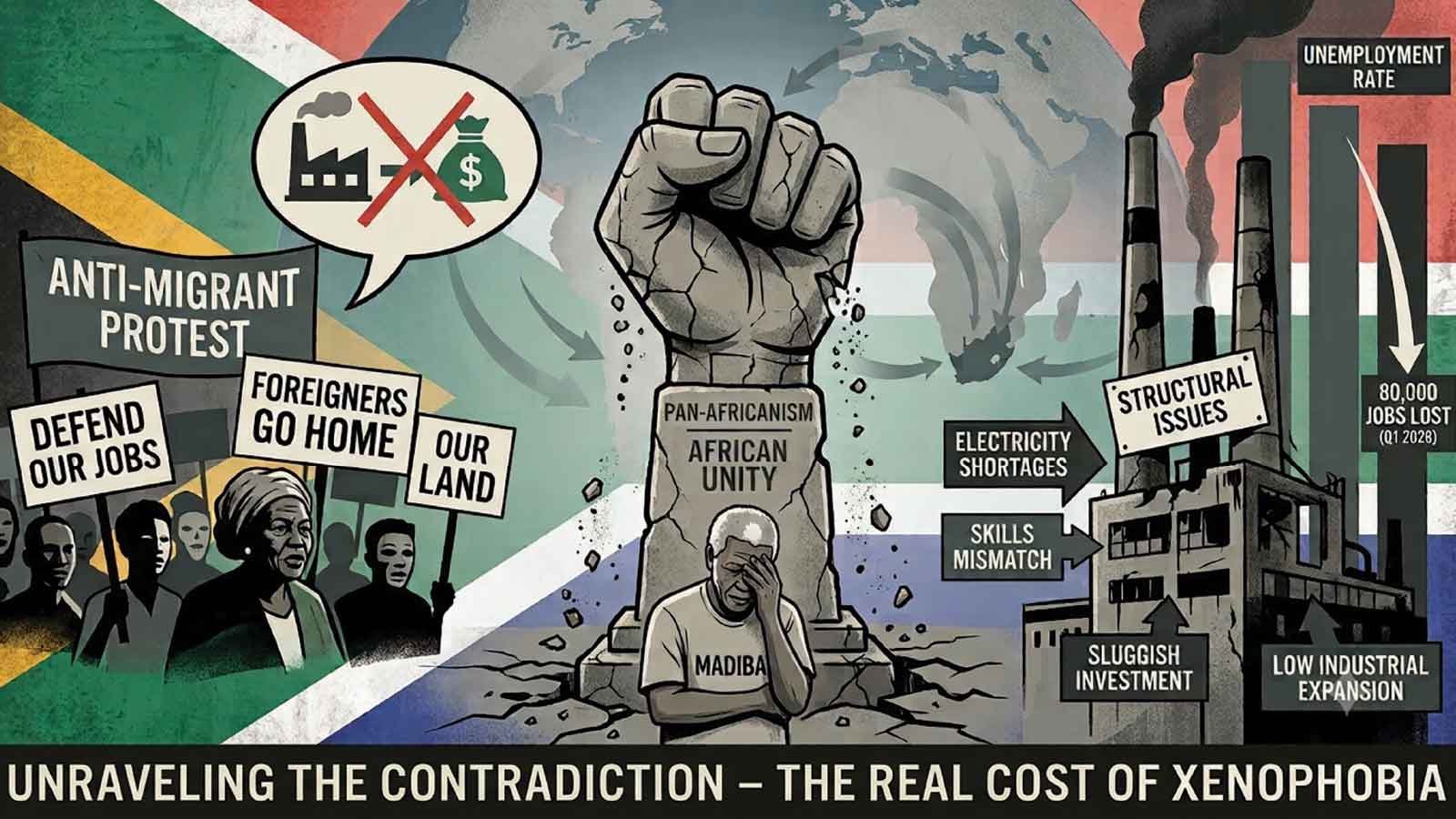
THE June 30 March and March anti-migrant protests in South Africa, led by former radio personality Jacinta Ngobese-Zuma, once again exposed one of the country’s most enduring contradictions.
A nation whose democratic struggle drew solidarity from across Africa now finds itself grappling with growing hostility towards fellow Africans seeking economic opportunities within its borders.
While the organisers argue they are defending scarce economic opportunities for South Africans, the broader consequences extend far beyond domestic politics.
The marches are damaging South Africa’s carefully cultivated image as Africa’s economic powerhouse and champion of human rights. More importantly, they are unlikely to solve the structural challenges that continue to frustrate millions of ordinary South Africans.
South Africa’s unemployment rate remains among the highest globally, particularly among the youth. Rising living costs, inequality and slow economic growth have created fertile ground for populist narratives that blame foreigners for social and economic hardships.
However, the arithmetic simply does not support such arguments.
The country’s unemployment crisis stems largely from structural economic weaknesses, sluggish investment, electricity shortages, skills mismatches and low levels of industrial expansion. Removing migrants cannot magically create millions of jobs where economic growth itself remains subdued.
As anti-migrant marchers took to the streets on Tuesday, blaming foreign nationals for South Africa’s economic woes, the timing could hardly have been more ironic. On the very same day, the latest Quarterly Employment Statistics (QES) released by Statistics South Africa revealed that the country’s economy shed 80,000 jobs in the first quarter of 2026.
The figures laid bare the real drivers of South Africa’s employment crisis. Businesses employed 121,000 fewer people in March than they did a year earlier, while 80,000 jobs disappeared in the first three months of 2026 alone as companies trimmed their workforce, reduced bonuses and cut overtime in response to a difficult economic environment. None of these losses was attributed to foreign workers, underscoring the reality that South Africa’s unemployment crisis is rooted in broader structural economic challenges rather than the presence of migrants.
Similarly, crime has become another rallying point for anti-migrant campaigns. While individual foreign nationals have indeed been implicated in criminal activities, available evidence has consistently shown that criminality cuts across nationality. Generalising an entire migrant population based on isolated incidents risks fuelling dangerous stereotypes that undermine social cohesion.
Even more perplexing is that, since the anti-migrant campaign gathered momentum, several incidents of violence have been directed at foreign nationals by South Africans. These have included killings, assaults, robberies and the looting of migrant-owned businesses. The contradiction is striking: while foreign nationals are frequently accused of fuelling crime, many have themselves become victims of criminal acts, highlighting how xenophobic sentiment can fuel lawlessness rather than enhance public safety.
History offers sobering lessons. South Africa has witnessed repeated waves of xenophobic violence since 2008. Businesses have been looted, innocent lives lost and families displaced. Each outbreak has drawn widespread condemnation from across Africa and beyond.
Every episode chips away at South Africa’s soft power. South Africa has long projected itself as a defender of African unity, regional integration and the ideals of Pan-Africanism. Successive administrations have championed initiatives under the African Union and the Southern African Development Community (SADC), advocating freer movement of people, trade and investment across borders.
Yet images of African migrants fleeing violence on South African streets present a stark contrast to these aspirations.
International investors also take notice. Political stability and social harmony remain key considerations for investors evaluating long-term commitments. Frequent anti-foreigner protests create perceptions of instability that may discourage investment, particularly in sectors dependent on regional labour mobility and cross-border commerce.
South Africa’s tourism industry also bears potential reputational costs. Visitors often seek destinations perceived as welcoming and secure. Negative international headlines surrounding attacks on foreign nationals inevitably influence travel perceptions, even when incidents remain localised.
Within the SADC region, migration has never been a one-way street. South Africans themselves live, work and invest across neighbouring countries, including Zimbabwe, Botswana, Namibia, Zambia and Mozambique. South African companies dominate retail, banking, telecommunications, mining and manufacturing sectors throughout the region.
Zimbabwe, in particular, has historically welcomed South African investment. Major South African corporations continue to operate successfully within Zimbabwe, creating employment and contributing to economic development.
This reciprocal relationship underscores why regional integration cannot flourish where hostility towards foreign nationals becomes normalised.
Migration itself is not unique to Southern Africa. Across the world, labour mobility supports economic development. Developed economies increasingly depend on migrant workers to fill shortages in agriculture, healthcare, construction and technology.
Africa’s own continental integration agenda, embodied in the African Continental Free Trade Area (AfCFTA), similarly recognises that freer movement of people complements freer movement of goods and services.
Closing borders or intimidating migrants therefore risks undermining broader continental ambitions.
Zimbabwe also has a direct stake in ensuring stability within South Africa. The two countries share deep historical, economic and social ties. South Africa remains Zimbabwe’s largest trading partner, while thousands of Zimbabwean families depend on remittances sent home by relatives employed across the border.
Any deterioration in bilateral relations or worsening hostility towards Zimbabweans inevitably carries economic consequences for households on both sides of the Limpopo.
That does not mean concerns over illegal migration should be dismissed.
Every sovereign nation retains the right to regulate its borders and enforce immigration laws. Illegal entry, document fraud and organised criminal networks facilitating unlawful migration require firm and lawful responses.
However, there is an important distinction between enforcing immigration legislation and encouraging public hostility towards entire communities based solely on nationality.
Effective migration management requires stronger border controls, efficient documentation systems, regional cooperation and expanded legal migration pathways rather than inflammatory rhetoric.
Zimbabwe and South Africa have already demonstrated that constructive engagement can produce practical solutions. Bilateral discussions on documentation, labour mobility and border management remain more productive than public confrontation.
The challenge also calls for deeper regional cooperation under SADC. Migration pressures are often symptoms rather than causes of broader developmental imbalances. Expanding investment, industrialisation and employment opportunities across the region would gradually reduce the economic incentives driving irregular migration.
Ultimately, sustainable solutions lie not in blaming vulnerable migrants but in addressing the underlying economic conditions affecting both host communities and countries of origin.
South Africa’s liberation struggle was built on principles of solidarity that transcended borders. Countries such as Zimbabwe, Zambia, Tanzania and others paid significant economic and political costs in supporting the anti-apartheid movement.
That shared history carries moral weight. While no country can absorb unlimited migration, neither can it afford to abandon the spirit of African solidarity that shaped its democratic journey.
For South Africa, preserving its international reputation requires demonstrating that it can balance legitimate immigration enforcement with respect for human dignity, the rule of law and regional cooperation.
Anti-migrant marches may generate headlines and satisfy short-term political frustrations.
They do not create jobs. They do not attract investment. They do not strengthen regional partnerships.
And they certainly do not enhance South Africa’s standing as the continent’s leading economy and advocate for African unity.
The greatest casualty of recurring anti-migrant mobilisation is not only the foreign national living in fear, but South Africa’s own reputation as a nation that once inspired the world through its commitment to justice, equality and human dignity.
One cannot help but conclude that Nelson Mandela would be turning in his grave. The founding father of democratic South Africa dedicated his life to building a nation anchored on reconciliation, human dignity and the belief that all people, regardless of race or nationality, deserved equal respect.
Mandela also never forgot the solidarity that African countries, including Zimbabwe, extended to the liberation struggle against apartheid by providing sanctuary, training facilities and diplomatic support to the African National Congress and other liberation movements.
The recurring spectacle of African migrants being vilified, attacked or forced to flee for their lives stands in stark contrast to the values he championed. Rather than embodying the Pan-African solidarity that Mandela espoused, such scenes risk diminishing the moral legacy upon which post-apartheid South Africa built its global reputation.