Nqobile Bhebhe recently in Mvuma
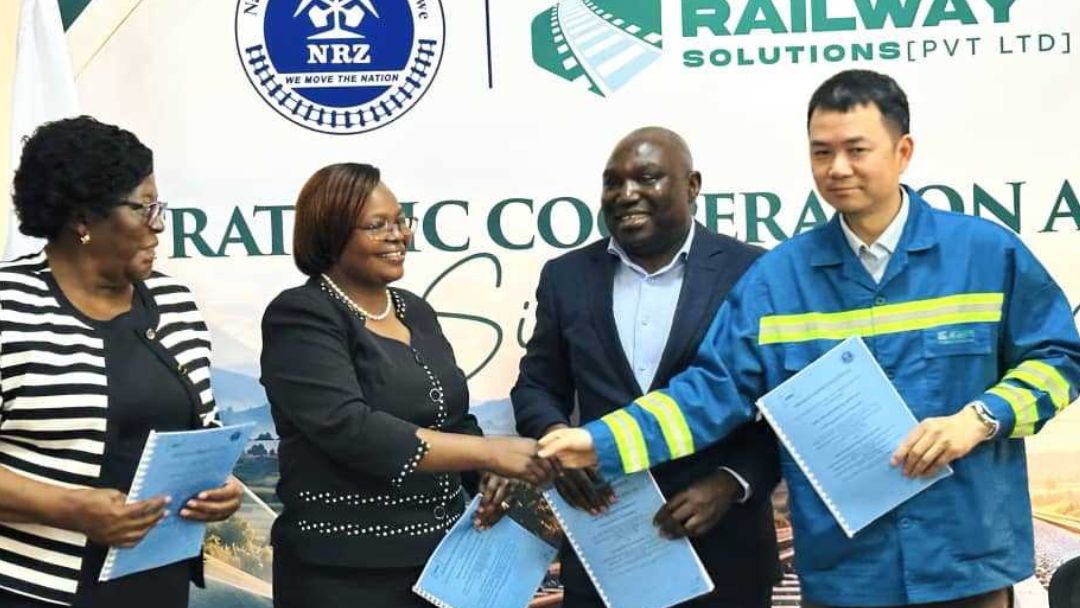
A STRATEGIC rail partnership between the National Railways of Zimbabwe (NRZ), Dinson Iron and Steel Company (Disco) and Grand Railway Solutions (GRS) could unlock the full operationalisation of Zimbabwe’s Commodity Exchange while providing the freight backbone needed to expand the Manhize steel project and drive industrialisation.
The agreement, signed in Mvuma on Monday, brings together rail infrastructure, industrial production and private-sector logistics in a model that could link commodities traded through the exchange to physical warehouses, rail corridors and regional export markets.
The development is important as the Commodity Exchange, established through the Victoria Falls Stock Exchange (VFEX), requires reliable physical logistics alongside its digital trading platform to enable producers and buyers to transact with greater certainty.
GRS founder and director Mr Linos Masimura said rail and warehousing had been among the key missing links to the full operationalisation of the exchange.
“Operationalisation of the Commodity Exchange by VFEX was awaiting rail and warehouses to start the exchange,” he said.
Mr Masimura said the exchange was intended to transform the way Zimbabwe’s commodities were priced and traded by connecting producers directly with international markets.
“The commodity exchange is a product of Victoria Falls Stock Exchange. So, the intention of the commodity exchange is to help Zimbabwe determine the price of its minerals,” he said.
“So they do give producers access to the international market and also give international clients access to the direct suppliers of products.”
However, Mr Masimura said the physical availability and movement of commodities remained critical to the credibility and efficiency of the trading platform.
“So, the exchange relies on physical presence of commodities plus an online presence of commodities,” he said.
Mr Masimura said the rail partnership would enable the development of warehousing and logistics infrastructure to support commodity trading.
“So, with the coming in of rail, we are now able to build warehouses where consignment stock, secured stock is going to be stored.
“With reliable rail, we will now be able to give assurance of movement of such commodities,” he said.
This means buyers securing large commodity parcels through the exchange could have greater certainty that their cargo can be moved when required.
“If someone has purchased a 10 000 tonne parcel, when there is a rail, they know what time it can be moved,” said Mr Masimura.
“And with our partnership with the NRZ, we’re also going to develop the ports to enable us to ship the commodities at the time they are required.”
At the centre of the arrangement is the Manhize steel project, which Dinson chief executive officer Mr Benson Xu described as an industrial ecosystem rather than simply a steel plant.
“Dinson is proud to be the anchor customer of NRZ and the industrial partner. Manhize is not only a steel plant, it is also an industrial park, a centre of production, processing, value addition and export,” said Mr Xu.
He said for that hub to succeed, reliable, efficient and competitive rail logistics were essential.
Mr Xu said the scale of the Manhize development meant rail would be integral to its ability to move raw materials into the complex and finished products to domestic and international markets.
“Rail is the backbone of heavy industry. It moves bulk cargo at scale. It reduces costs, ease road congestion, improves safety, lowers emissions and connects production centres through regional and international markets,” he said.
The scale of the Manhize project provides NRZ with the type of predictable bulk freight volumes that have increasingly been identified as critical to the revival of the railway network.
At the recent Zimbabwe Economic Development Conference (ZEDCON), delegates called for NRZ rehabilitation to begin with bankable corridors supported by sufficient freight demand and credible repayment models.
Mining and heavy industry were identified as natural anchors because of their substantial bulk transportation requirements.
The Dinson partnership provides a practical application of that model, with Manhize generating cargo while rail infrastructure is developed around actual industrial demand.
GRS plans to construct a 50km railway line connecting Mvuma to the Manhize Steel Plant while rehabilitating and upgrading the Mvuma-Dabuka section.
GRS projects that about 1,2 million tonnes being transported by road will shift to rail during the first year, increasing to 3,2 million tonnes in the second phase.
The arrangement provides NRZ with a potential anchor customer and cargo base around which investment in a strategic corridor can be structured.
NRZ acting chief executive Mrs Ainah Dube-Kaguru said the partnership was expected to have an impact beyond the immediate movement of materials.
“It is not just the materials that you are going to see happening, but it’s a great story that is going to revive the industry. We are going to be saving industry and commerce more effectively,” she said.
Mrs Dube-Kaguru said combining the capabilities of the three partners would strengthen the railway’s ability to respond to the economy’s transport requirements.
“So, by combining complementary capabilities, the partnership will enhance it, strengthen operational capacity and respond more effectively to the transport needs of the economy. That is how important this agreement is to us,” she said.
Mr Masimura said the longer-term objective was to position Zimbabwe as a regional logistics hub by developing commercially viable rail corridors rather than attempting to rehabilitate the entire network at once.
“We want to make Zimbabwe the logistics hub for SADC based on our location by upgrading and expanding infrastructure, working with NRZ one corridor at a time by providing viable cargo and suitable investments,” he said.
The model could also support alternative financing and localisation of railway equipment and infrastructure.
He said the longer-term ambition includes locomotive manufacturing and the development of local railway engineering capabilities.