Online Reporter
Amos Mpofu, [email protected]
IN an unusual natural occurrence, a swarm of locusts descended upon the Bulawayo city centre on Thursday night, a rare sight for an urban environment. Strangely, the insects have been seen engulfing the Chicken Slice building at the junction of 9th Avenue and Fort Street.
This unexpected event has sparked considerable curiosity among residents, many wondering how the locusts had found their way into the heart of the city. Typically, locusts are associated with agricultural regions, where they feed on the foliage and grains of crops such as sorghum and millet. The sight prompted some to jokingly wonder if the insects were somehow finding sustenance on the city’s concrete jungle.
Scores of people were observed collecting the insects, considered a delicacy by some. Many filled 2kg plastic bags, while others filled them partially, quipping that “God has blessed us this year with a good harvest of isitshwala, and now He is giving us relish too.”
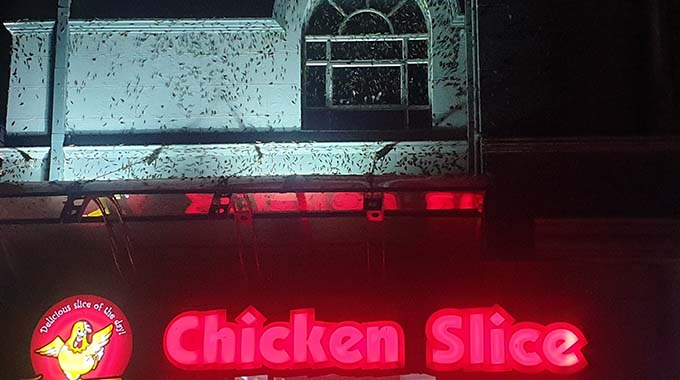
However, while some saw a culinary opportunity, the appearance of such a significant swarm in the central business district left many feeling uneasy. Some interpreted it as an omen, suggesting it could foretell an impending natural disaster, although others dismissed such concerns.
Residents from rural and farming communities who had recently come to town confirmed that these locusts had also been seen on their farms, particularly in fields of sorghum and millet.
Even a seasoned local bank security guard, who has lived in the city for decades, stated she had never encountered anything remotely similar.
“I’ve lived in Bulawayo for over 20 years, and this is the first time I’ve seen something like this in the city. I’m still trying to understand what it could mean. What puzzles me is how these locusts managed to get to the city centre.
They don’t fly long distances like birds; they land after just a few metres. So how did they end up here where there’s no grass or farmland? Could it be the lights that attracted them? That might be the only explanation,” said the woman, who asked not to be named.
This unusual incident comes shortly after an unprecedented tick infestation in Harare’s Mbare suburb. This marks two peculiar and unrelated infestations in Zimbabwe’s major urban areas, a first for both cities.
In Bulawayo, alongside the apprehension, some residents viewed the locust swarm through a cultural lens. Solomon Ndlovu, a long-time resident of Makokoba who was collecting the insects, shared his traditional beliefs about locusts.
“We grew up knowing that when locusts appear in large numbers, it means the country will have a bumper harvest. But this time, the locusts are coming when farmers are already harvesting. That confuses me. It doesn’t fit what we were taught, especially since they’ve appeared in a place where you wouldn’t expect them.”
Despite his uncertainty, Ndlovu welcomed the locusts for another reason — nostalgia and food.
“These ones are a delicacy. We grew up eating them. They’re so fat you don’t even need cooking oil. I haven’t had them in years, and now I’ll be enjoying isitshwala with them for days,” he said with a smile.