

 admin
admin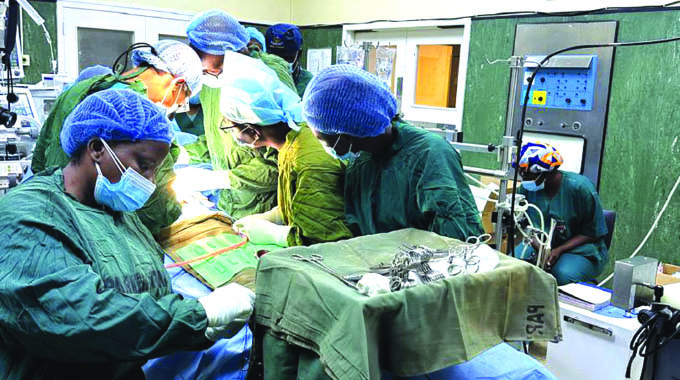
Sifelani Tsiko, Innovations Editor
A TEAM of Zimbabwean cardiac specialists at Parirenyatwa Group of Hospitals in Harare has achieved a milestone by conducting a successful and complex procedure on an eight-year-old boy with a hole in his heart, also known as a sinus venosus atrial septal defect with anomalous blood return.
Veteran cardiovascular and thoracic surgeon, Dr Wilfred Muteweye, told The Herald yesterday that the surgery lasted for hours, but everything went as smoothly as possible.
“I am happy to inform you that on Thursday our team successfully operated a boy with a hole in the heart. This is the first time we are doing such a procedure in six years. The last time we did such procedures was in July 2018 with a visiting team from Italy (called Mission Bambini) led by Dr Stefan Marianeschi,” he said.
Dr Muteweye said the procedure was done by a wholly Zimbabwe team of cardiac surgeons, cardiac anaesthetists, theatre nurses and perfusionists showcasing the team’s distinction and outstanding competency.
The lead surgeons were Doctors Kudzai Kanyepi and Simukayi Machawira supported by cardiac anaesthetists Dr Shield Kajese and Dr Emerson Mutetwa, cardiac theatre nurse Sister Sipiwe Mandipa and perfusionist — Patricia Zhande.
“The wholly Zimbabwean team demonstrated leadership and competence in this complex surgery which required outstanding and innovative medical procedures. The boy is in ICU and feeling much better,” Dr Muteweye said.
“He is now feeding and is no longer on life support. Tomorrow he will be moving out of the ICU. The boy had a complex hole and there was mixing of blood, leading to complications in his health.
“We didn’t just close the hole, but we had to divert the blood flow. We used the traditional method (that involves creating an incision in the middle of the chest cavity) and other innovative procedures to successfully perform this life-saving open-heart surgery on the boy.”
The boy had suffered from this condition for four years.
Zimbabwean cardiac specialists are targeting to perform 60 free open-heart surgeries this year as they scale up efforts to significantly reduce the backlog of people needing treatment.
Last year, the team conducted 22 open-heart surgeries. Out of this, three patients died while 19 recovered well.
“Cases of such complexity can only be achieved with help from different specialists. I want to thank all the members of the team for their valuable contribution to making this case a success,” Dr Muteweye said.
“We want the boy to be able to grow and run and play just like any other kid. We will keep monitoring him. We want him to be able to play and go to school with no limitations.”
The ventricular septal defect, commonly known as hole in the heart, is a type of congenital heart defect in which there is an abnormal opening in the wall between the main pumping chambers of the heart (the ventricles).
Explains Dr Muteweye: “The holes occur during the formation of the heart when the baby is in the womb. They are due to abnormalities in the formation of a wall or septum which divides the right sided heart chambers from the left sided chambers. The exact cause of these holes is unknown.
“Usually small holes close over time or do not cause health or clinical problems. However, large holes (our patient’s hole was about 3cm, which is large) cause shunting of blood from the left sided chambers of the heart to the right sided chambers.
“This causes the right sided chambers to swell. In addition, lungs can become congested with blood and fluids causing shortness of breath. If the problem is not addressed, the heart will eventually fail and death ensues.”
The existence of a hole in the septum can disrupt the smooth flow of blood in the human body.
Symptoms of the disease include shortness of breath, swollen legs, persistent cough and stunted growth among others.
One in every 100 babies born in Zimbabwe are diagnosed with a congenital heart disease (a disease found at birth) and a septal defect is one of the most common.
Zimbabwe has about 4 000 children born every year who need some sort of open heart surgery for them to be able to survive.



 leeroy
 Online Reporter