Online Reporter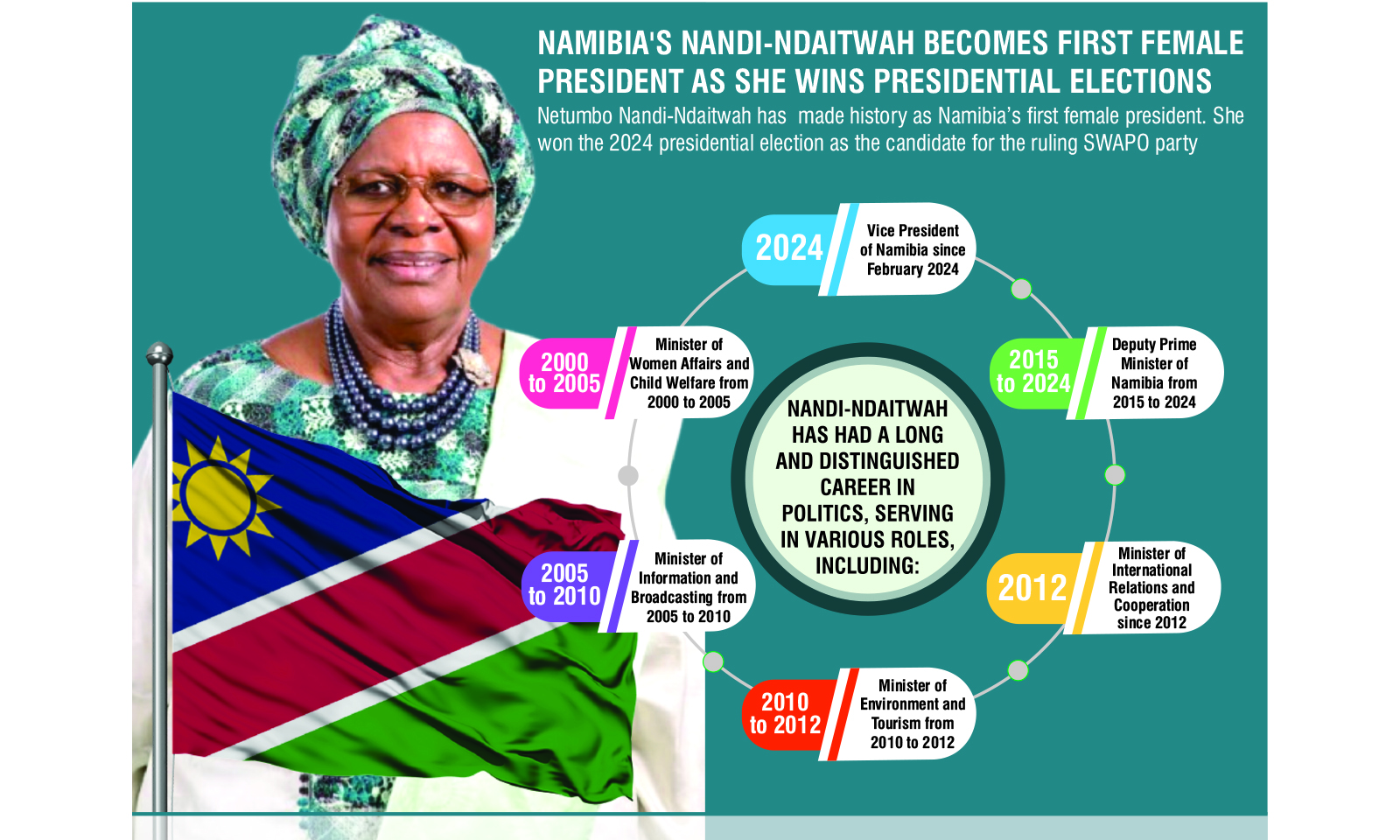
Phyllis Johnson
NETUMBO NANDI-NDAITWAH is a leader, and her entire life has prepared her for the next assignment as president of the Republic of Namibia.
She and her party, the South West Africa People’s Organisation (SWAPO), won the national elections in Namibia on November 27-30, 2024, and she was the president-elect until her inauguration as president on March 21, 2025, which coincided with the 35th anniversary of Namibia’s independence.
She is the first woman elected to that position, but that is not the story.
She is not a woman leader — no adjective is required — she is a leader.
She has been a leader since the age of 14 when she joined SWAPO inside the country, then called South West Africa and controlled by apartheid South Africa.
Netumbo Nandi was born to Justina and Petrus Nandi on October 29, 1952 in Oshana region, in the north of the country, next to Ohangwena, which borders on Angola and Omusati region, where SWAPO started the liberation war in 1966.
She joined SWAPO at that time, and was already a regional chairperson of the Youth League when she left Namibia for exile in 1974, aged 21.
She worked on assignments at the headquarters of the liberation movement in Lusaka, Zambia, before being appointed deputy representative there in 1976.
The tall, articulate, confident young woman was soon appointed chief representative.
She was a member of the SWAPO central committee from 1976 to 1986.
She represented the party from 1976 in key posts for the liberation war — in Zambia for four years, and in Tanzania as chief representative for Eastern Africa and the Liberation Committee, 1980-1986.
That was the period when Julius Nyerere, the Tanzanian president and chairperson of the Front Line States, used to call Netumbo Nandi “Mama SWAPO” when she represented the liberation movement, based in Dar es Salaam, from the age of 28 to 34.
This was not just a light-hearted gesture.
Mwalimu Nyerere was more strategic than that.
He sought to communicate her status to his colleagues that yes, she was a woman, and the official representative of her party, and must be respected as such.
She learned many other things about leadership in those six years, working in Tanzania with Mwalimu, a title that is a Kiswahili word for “teacher”.
Her earliest education was through her family and village — her father was an Anglican cleric — and at St Mary’s Mission in northern Namibia.
She continued to study in exile, gaining a diploma in youth engagement from the Higher Komsomol School in the Soviet Union, and a post-graduate diploma in public administration and management from Glasgow College of Technology.
She studied in the United Kingdom prior to independence, achieving a post-graduate diploma in international relations and a master’s degree in diplomatic studies, both from Keele University.
She has been an elected member of the National Assembly since 1990 and a Cabinet minister since 2000.
After independence on March 21, 1990 until 1996, she served as deputy minister of International Relations and Cooperation, and in this period she was also elected president of the National Women’s Organisation (NANAWO), 1991-1994.
She was director-general of Women’s Affairs in the Office of the President from 1996, before being assigned that portfolio as minister for Women Affairs and Child Welfare in 2000.
This followed the Fourth World Women Conference in Beijing in 1995, and she played a key role in implementation in the region, and in the response of the Southern African Development Community (SADC), developing the framework for the progress and protocols achieved to date, through the initial SADC Declaration on Gender and Development.
She continued to provide leadership in a range of ministerial posts, serving as minister of Information and Broadcasting from 2005 to 2010, and then minister of Environment and Tourism from 2010 until a Cabinet shuffle in 2012 when she was appointed minister of Foreign Affairs, which has since been renamed International Relations and Cooperation.
From 2015, she was minister of International Relations and Deputy Prime Minister.
She is a member of the SWAPO central committee and politburo.
She was the first woman to be elected vice president of SWAPO, at the 2017 party congress, and re-elected in 2022.
After independence, she married Lieutenant-general Epaphras Denga Ndaitwah, who later served as commander of the Namibia Defence Force (NDF).
And now, Netumbo Nandi-Ndaitwah is the president of independent, 35-year-old Namibia.
Phyllis Johnson is a founding director of the Southern African Research and Documentation Centre (SARDC), a regional knowledge resource centre based in Harare.