Online Reporter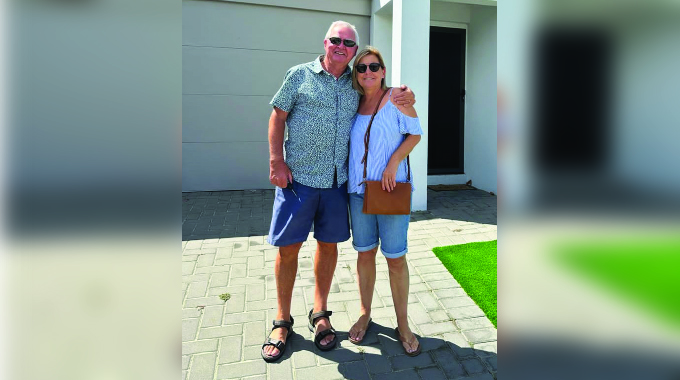
“NOTHING like a cold beer after a game!” That’s how Mickey Trader, now 79 and living in Canada, remembers the glory days of Zimbabwean football in the late 1960s.
A German-born striker with a wicked shot and a taste for adventure, Trader arrived in then Rhodesia at a time when the national league was just finding its feet, and the country was simmering politically.
Before Highlanders and Zimbabwe Saints became the Bulawayo giants we know today, the city’s football scene was ruled by teams like Bulawayo Rovers and Bulawayo Sables. Rovers were serial champions, while Sables, backed by Rhodesia Breweries (now Delta Beverages), made their mark by winning the national title in 1968 and 1969.
Trader was part of that title-winning Sables side. He came into the country via South Africa, where he’d worked and played semi-professional football. At the time, the Rhodesia National Football League was just beginning to move from local zones to a national format, introducing promotion and relegation.
“Most teams were from Bulawayo and Harare, but we had one team from Wankie (Hwange) and one from St Paul’s Mission in Mashonaland,” said Trader from his base in Canada.
That St Paul’s side once featured future greats like the Nxumalo brothers, Josiah and James, as well as George Shaya, Jawet Nechironga (father of Francis and George of CAPS United fame), and Paul Tsumbe, one of the country’s most lethal strikers.
Trader remembers the Hwange stadium fondly.
“Wankie had a great stadium. They were the club with floodlights, I think. Great place to play,” he said. But there was a catch.
“They had one problem, all the water pipes to the stadium were above ground. And it really gets hot in Wankie. You couldn’t have a cold shower after the game, the water was boiling,” he laughed.
Despite the era’s politics, footballers played across racial lines and shared genuine camaraderie.
“We always stayed at the Jameson Hotel on Jameson Street (now Samora Machel Avenue), one of the best hotels in the city (Harare) at the time,” said Trader.
“We had our meals, drinks together and had a good time, always. Again, I do not recall one incident of racial disturbances. We just had fun and hoped to beat Dynamos or Arcadia or whoever.”
He continued: “I always thought the Rhodesian blacks were a great people, mostly polite and even enthusiastic to us whites if we had a good game.”
That spirit carried over to the stands too. Sables played many of their matches in township stadiums, in front of packed, all-black crowds.
“I do not recall even one incident of misbehaviour in all that time, even though the spectators would come to the game with Chibuku (opaque beer). I don’t recall a big police presence either and I was never scared. All we wanted was to play the best football,” said Trader.
Even respected figures like Gibson Homela and Silas Ndlovu often remark that football brought people together, despite the growing political situation off the pitch.
Sables was one of the first mixed race teams in the league, and their financial backing allowed them to travel in comfort.
“We were sponsored by the Rhodesian Breweries. We always flew everywhere in style,” said Trader.
But that didn’t stop them from pushing the boundaries of fun.
“On one of our winning cup games, we all decided to have a few extra beers in the bar of the Salisbury Airport (now Robert Gabriel Mugabe International Airport) and forgot about time. The next thing, the pilot came to the bar and gave us a lecture, told us to get on the plane immediately or he’d leave without us,” he recalled.
The team’s fondness for beer didn’t go unnoticed by the air hostesses either.
“They knew us. The moment we were in the air, they were serving us cold beers. Nothing like it after a game!”
Sables had their own pre-match rituals too, including a “team witch doctor.”
“We had our own ‘witch doctor’ who was always present. That was the only time we white guys weren’t included in the rituals he performed with our black teammates before every game,” said Trader.
“But he always put some ‘muthi’ in my socks to improve my goal scoring.”
And score he did. Trader’s sharp eye for goal helped make Sables a top team in the Rhodesia National Football League.
After six years with Sables, he moved to Old Miltonians, where he played alongside Neil Boonzaier and Greg Faasen. In 1976, he left for South Africa after refusing to serve in the Rhodesian army, eventually settling in Canada.
Now retired from football, he spends his days on the golf course. But the memories remain strong. He has two sons and a daughter, Caroline Smith, who is a teacher in Bulawayo.
From township stadiums and boiling showers in Hwange to beers in the sky and muti in his socks, Mickey Trader’s journey through Zimbabwean football is a vivid reminder of a time when the beautiful game united people against all odds.