admin
admin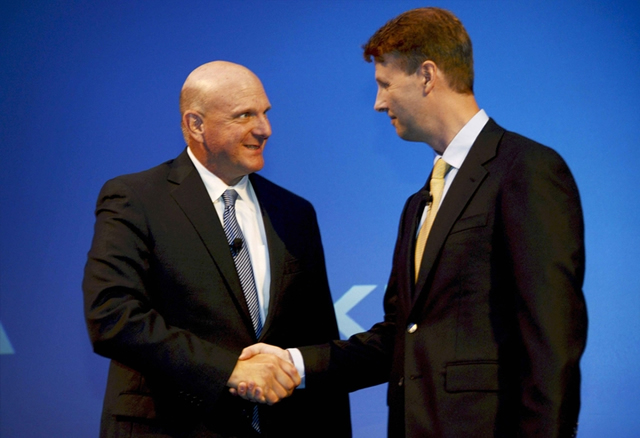
HELSINKI. - Nokia said yesterday it was selling its beleaguered mobile phone unit to Microsoft for 5,44 billion euros (US$7,17 billion) as the US tech giant tries to fight back against rivals Apple and Google. Investors cheered the news, as Nokia’s share price soared by 45 percent in opening trading on the Helsinki stock exchange to 4,3 euros.
Nokia, once the world’s leading mobile phone maker, will grant the US software giant a 10-year non-exclusive licence to its patents and will itself focus on network infrastructure and mapping services, which it called “the best path forward for Nokia and its shareholders”.
With yesterday’s announcement, Microsoft is following in the footsteps of its internet rival Google, which already invested in hardware when it bought US phone manufacturer Motorola.
Nokia and Microsoft entered into a partnership in 2011 to create Nokia smartphones using Microsoft’s Windows Phone software.
Microsoft chief executive Steve Ballmer told reporters the Nokia acquisition “will accelerate our success in smartphones”.
He said Windows Phone was “the fastest growing smart platform today, growing by 78 percent last year”.
Analysts saw yesterday’s move as a bid to compete with Google and Apple.
“The trigger behind this is without a doubt the current restructuring of business at Microsoft in which the tech giant attempts to stem the decline in global product sales,” ETX Capital analyst Ishaq Siddiqi said in a comment.
Microsoft “is still behind Apple and Android-based handset devices in the global mobile phones market share but under this deal, Microsoft can start to take control of the operation and turn Nokia’s declining handset business into a formidable competitor in a competitive market,” he said.
Nokia also announced the immediate departure of chief executive Stephen Elop, who was hired from Microsoft in 2010 to turn the company around. He will be replaced in the interim by Risto Siilasmaa, Nokia’s chairman of the board.
Elop will take over Nokia’s mobile phone unit, and will transfer back to Microsoft once the deal is completed, Nokia said, triggering speculation that he could take over as head of Microsoft after Ballmer’s scheduled retirement within the next 12 months.
“We expect Elop becomes a more viable candidate for Microsoft chief executive, given the obvious importance of devices,” Citi Research said in a comment.
Nokia dominated the mobile phone market for 14 years, until it was overtaken by Samsung in 2012 as the top-selling brand, as it struggled to establish winning business models and mobile devices amid increasing competition from Apple’s iPhone and Samsung’s Galaxy.
Rumours of a Nokia sale have swirled in recent months.
Nokia dramatically changed its strategy in February 2011 when Elop warned the company was “standing on a burning platform” and needed to shift course immediately.
The shake-up involved phasing out Nokia’s Symbian platform in favour of the partnership with Microsoft, and Nokia bet its future on its new line of Lumia smartphones.
But yesterday’s announcement marks the end of Nokia’s days as a phone manufacturer.
“Management concluded that there was no improvement in sight anytime soon. From that point of view, the sale could be a wise decision,” Pohjola bank analyst Hannu Rauhala told the online edition of business daily Taloussanomat.
Some 32 000 Nokia employees are expected to transfer to Microsoft, including some 4 700 people in Finland, the company said.
The operations affected by the transfer generated approximately 14,9 billion euros in 2012, or almost 50 percent of Nokia’s net sales, it added.
Nokia will book a gain on the sale of some 3,2 billion euros, which will “clearly strengthen our financial position and it will provide a solid basis for future investment in Nokia’s continuing businesses”, Siilasmaa said. – AFP.


 Online Reporter