admin
admin

Samson Bhuza
Having worked directly under the late National Railways of Zimbabwe general manager, Retired Air Commodore Mike Tichafa Karakadzai for seven years, I write this article to say farewell to him by discussing his leadership style which I sum up as “servant leadership.”
I start by noting that servant leadership is a fairly new concept in the study and practise of leadership but is fast becoming a subject of expanding interest and popularity in other parts of the world.
According to extant literature on the concept, the term “servant leader” was first coined, at least in organisational contexts, by Dr Robert Greenleaf in 1970 in his essay The Servant as Leader. In the essay, Greenleaf admits that the idea of the servant as leader came to him out of reading a short story Journey to the East by Hermann Hesse in which among a band of men on a mythical journey is Leo. Leo is the central figure and a person of extraordinary presence who accompanies the party as the servant who does their menial chores, but who also sustains them with his spirit and his songs.
The journey progresses smoothly until the servant Leo disappears. Without him the group falls apart and the journey is abandoned. The story teller, one of the party, after some years of wandering, finds Leo and takes him into the Order that had sponsored the journey. Then he discovers that Leo, who he had known first as servant, was in fact the titular head and chief sponsor of the Order.
As was portrayed by Leo in the story the servant leader is servant first. Unlike the traditional trait, behavioural, contingency and situational leadership theories which are based on power, hierarchy and status, servant leadership is based upon the central concept that serving others (employees, customers and the community at large) should be the leaders’ number one priority.
The style is follower-centric. In advancing Greenleaf’s ideas, later scholars such as Larry Spears (1995) and Kathleen Patterson (2003) proffered characteristics that servant leaders should possess. This article will focus more on the characteristics developed by Spears and will, where appropriate, blend the discussion with attributes advanced by Patterson.
In the context of the key characteristics of servant leaders, I will now demonstrate why I argue that Mike Karakadzai was a servant leader.
The first characteristic of servant leaders identified by Spears is that of listening. Servant leaders listen receptively to their followers. Unlike most of us, servant leaders listen in order to understand and not in order to respond.
They are able to serve others because they listen to and understand their concerns and/or suggestions. In illustration of his listening strength, Mike (like Leo) accompanied by a small team of selected managers, for instance, undertook line tours on a railway motor trolley at the beginning and at the end of every year.
During these system-wide tours he would, among other things, address and afford employees a chance to discuss pertinent issues with him. I recall at one out station, where he endured listening and responding to 68 questions posed by staff. What made Mike an even more effective listener was his sharp memory.
When you have a leader with a very sharp memory for obvious reasons, you get to learn to stick to the truth — nothing but the truth. Mike was one such leader who did not believe that good ideas were the preserve of management and would therefore give audience to anyone.
The characteristic of listening discussed above is related to Patterson’s attribute of humility. Servant leaders demonstrate their humility, through listening, being sociable and being approachable. This they do because they believe they owe it to and are accountable to their followers.
Historians will tell of some former general managers of NRZ who would not share an elevator with subordinates (I gather that this still happens in nother organisations) while statisticians will be interested in comparing the average annual number of people that accessed the 13th floor of the NRZ headquarters during different former NRZ general managers’ tenures.
When an employee(s) of whatever level met him say in an elevator Mike would not wait to be greeted, he would greet the employee(s) and start a conversation.
When being chauffeured Mike would sit in the front seat not at the back like most chauffeured executives do. It is fortunate that NRZ drivers wear uniforms otherwise telling who the boss or the owner of the car is would have been difficult with Karakadzai. This is how humble he was!
Spears argues that servant leaders rely on persuasion, rather than on one’s positional authority in making organisational decisions. Instead of coercing followers into compliance, servant leaders seek to convince them.
The writer of this article by virtue of his office was involved in drafting most of the papers, letters, and so on for the general manager’s office and as expected the drafts would sometimes carry views that did not converge with his. Mike Karakadzai would not reject my views without asking me to come forward to discuss them.
When we discussed, he would either accept my ideas (in other words he was capable of being convinced by others) or I would leave his office persuaded that his line of thinking was the right one. Because of his use of persuasion instead of coercion or instruction, he was a mentor and not a boss to me.
What I consider to be the anchor attribute of servant leaders is Spears’ commitment to the growth of people. This attribute is closely related to Patterson’s altruism. Servant leaders recognise the intrinsic value of followers beyond their tangible contributions as workers.
The servant leader is committed to the implementation of everything within his/her power and organisation’s capacity to nurture the personal and professional growth of followers.
In order to afford equal growth opportunities to his divisional heads to take over leadership of the organisation one day, Mike introduced a rotational acting system.
Through a schedule maintained and administered by his personal assistant, the organisation’s five divisional heads superintended over the organisation on a rotational basis whenever Mike was away.
During his tenure the NRZ also introduced a number of measures indicative of his commitment to the growth and welfare of employees and these, among others, included the procurement of staff buses.
Of late, a management development programme run in conjunction with one of the local universities has been introduced. The programme targets senior supervisors who are precluded from applying for managerial positions due to lack of relevant academic qualifications.
The next point that I will discuss requires some bit of background. It is common knowledge that NRZ is struggling financially.
While certain circles in their wisdom or lack of it prefer to attribute this unfortunate position to poor leadership by Mike, those who are alive to the economic hardships the country has been facing over the last decade or so, will vouch that the challenges NRZ is facing are not peculiar to the entity alone.
Back to my point, when the NRZ started to experience cash flow challenges at the onset of the multi-currency regime in the country, there was consensus within his senior management that the situation called for staggering of salaries’ payment. Mike however shocked his senior managers when he suggested that the salaries payment will be done starting with the lowest grades with senior management and of course himself being paid last.
I vividly remember how he responded to the managers’ grumblings, “Eheka, ndizvo zvinoita kutonga. Kutonga uchi hune ivhu. Iri ndiro ivhu racho.” (This is what leadership also entails. You make difficult decisions and subordinate your personal welfare for your juniors).
Involving followers in decision-making is key in “growing” them.
The late Mike believed in collective decision making. He would call his management executive team at short notice whenever key decisions had to be made.
This, apart from “growing” the followers also inculcated team spirit in them. Mike Karakadzai also introduced “Monday Briefings Sessions”. These sessions are attended by divisional, functional and section heads and he used them to check on progress in the implementation of the organisation’s plans.
The sessions were very unpopular during the first days that they were dubbed “the GM’s parades”. Sooner rather than later, managers began to realise that the meetings, in addition to the specified intention, actually afforded them an opportunity to participate in higher level decision making especially on issues pertaining their functions and also empowered them as they got to know what was happening in other functions of the entity.
A characteristic which was advanced by Patterson which is closely linked Spears’ commitment to grow people is that of empowerment. Servant leaders share power by entrusting their followers with certain critical roles of an entity. Case in point, the NRZ system is divided into the headquarters and three regions (or areas).
Before Mike joined the NRZ, the areas were operating as semi-autonomous only in theory as for instance, the area managers did not have full power over the specialist functional management teams in their respective areas.
The teams viewed the area managers’ supervisory role over them as ceremonial and would get directions from their functional heads at headquarters. Mike corrected this anomaly and the area managers are now fully empowered.
They are now mini-general managers as he liked to call them. The same empowerment concept was also extended to stations where station masters are now fully in charge of all activities and staff at their stations.
According to Spears servant leaders have a great foresight and are good at conceptualising issues. These two characteristics are related to Patterson’s proposal of vision.
While the traditional leader is consumed by the need to achieve short-term operational goals, the servant leader thinks beyond the day-to-day realities and challenges of the organisation. Because of Mike’s conceptual thinking and foresight he easily blended with the two boards of directors that were appointed during his tenure.
Needless to observe, the entity operated without a board for a period of about two years and thanks to Mike’s strategic thinking the void was not so apparent.
As a visionary leader, after attentively listening to and thoroughly interrogating a presentation byone of his senior managers advocating for the introduction of the balanced scorecard system in the NRZ, Mike quickly embraced the idea and implemented it.
Servant leaders recognise the need for self healing and healing of relationships with others. In a work situation and for varying reasons, many people suffer emotional hurts and broken spirits and servant leaders recognise their role in making them whole. Mike would not make emotional decisions or actions and was always ready to provide emotional mending to his followers.
The last attribute of servant leaders that this article will discuss is that of stewardship. As stewards, servant leaders believe that organisations they lead exist so as to make positive differences to the society at large. Because of Mike’s stewardship mentality, at the height of economic woes in the country in the 2007/8 period he introduced five new intercity passenger train routes.
This idea was not viewed positively by some of his senior managers but he reasoned with them that the resources NRZ use belonged to the taxpayer and the same taxpayer should derive some direct benefit from them especially under such trying times.
As I end this article, I find it befitting to say rest in eternal peace Mike Tichafa Karakadzai — a strategist par excellence, mentor, emotional healer, steward, freedom fighter and servant leader. I also challenge the NRZ management to advance Mike’s dreams for the organisation and to emulate his leadership style.
Finally I call upon the country at large, as it emerges out of the doldrums, to join the world in embracing the emerging concept of servant leadership. As Patterson observes, a glaring strength of servant leadership is that it “encourages everyone to actively seek opportunities to serve and lead others, setting up the potential for raising the quality of life throughout society.”
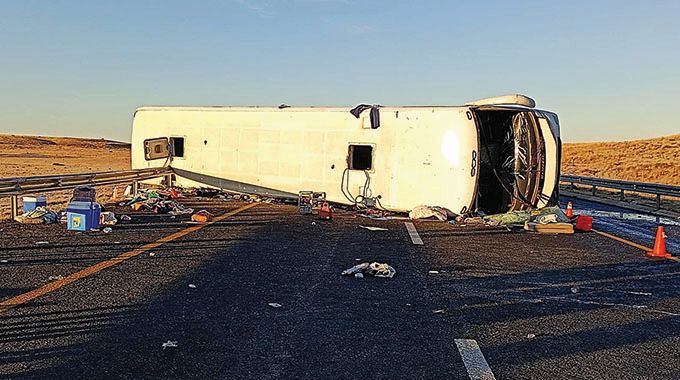
Samson Bhuza is the chief planning manager at the NRZ. He reported directly to Rtd Air Com, Karakadzai, who died in a car accident recently and was declared a national hero. For feedback, please contact writer on [email protected] <mailto:[email protected]>, 0712629484


 Online Reporter