


 Andrew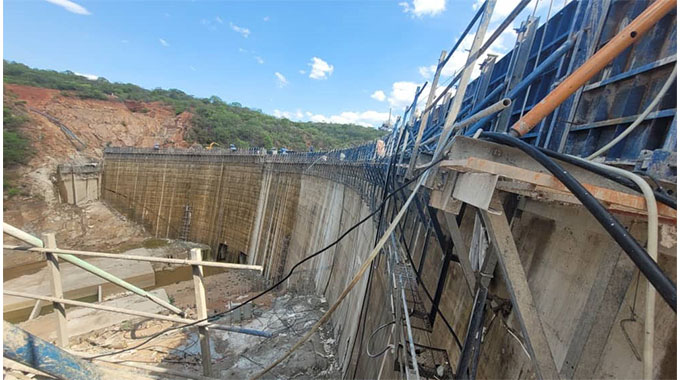
Nelson Gahadza
THE Government posted noticeable milestones in 2022 on the infrastructure development front, as it forged ahead with efforts to modernise and rehabilitate key enablers of economic growth and development for the achievement of targets set under Vision 2030.
Infrastructure development is a key factor towards President Mnangagwa’s Vision 2030 goal of achieving an upper middle-income society by 2030, while leaving no one and no place behind.
Presenting the State of the Nation Address (SONA) and officially opening the Second Session of the Ninth Parliament last month, President Mnangagwa said the Government had spent over $2,5 billion on infrastructure projects, indicating that road networks had resumed in earnest, with noticeable progress being recorded.
He said a total of $2,5 billion, which constitutes 34,5 percent of total development capital, was set aside for various transport, water, public amenities, energy, irrigation, social services and other infrastructural projects.
Other projects at different stages of implementation include the Hwange 7 and 8 thermal power project, the US$150 million Robert Gabriel Mugabe International Airport expansion, borehole rehabilitation and drilling, and the new Parliament Building, which has since been commissioned.
Dam construction projects such as Marovanyati and Lake Gwayi-Shangani, and walling of Causeway Dam, among others, are also on schedule.
In order to further support the projects, Finance and Economic Development Minister Professor Mthuli Ncube, in the 2023 National Budget, set aside $1,1 trillion for the capital development to prioritise infrastructure investments, which are key in unlocking sustainable economic growth and development.
He noted that the allocation will prioritise ongoing and stalled projects over new ones in order to ensure the sustainability of interventions under the difficult global and domestic financial conditions.
Economist Dr Prosper Chitambara said, while there was improved spending on infrastructure in 2022, it was critical to carry this forward into 2023.
“This means, as a country, we are going to reach the 9,6 percent of the gross domestic product (GDP), which is the threshold that has been set by the African Union (AU) on infrastructure spending,” he said.
He said there was need for more private sector involvement in infrastructure development to bridge the financing gap.
“Government, on its own, cannot do it. But it should continue to provide an environment that is conducive for private sector participation and even leverage on the diaspora through diaspora bonds,” he said.
The Government, on its part, said funding will be mobilised through a different funding mix such as tax revenues, loan financing, development partners support and statutory funds.
According to Minister Ncube, the distribution of the infrastructure funding for the various sectors is that energy will get the biggest chunk, at $429 billion, followed by Transport and Devolution at $195 billion each, while Agriculture will get $63 billion.
He said the Government is concerned with malpractices in costing of projects and programmes which in some instances have been marred with future pricing and exorbitant pricing aimed at profiteering which has negatively affected the macroeconomic fundamentals.
Another economist Mr Vince Musewe said while the Government has made significant progress on roads, it should spread the concentration to other critical infrastructure. “Although roads are essential for trade, we need to build factories and public utilities which have a direct social impact,” he said.
He said funding infrastructure was difficult and long-term capital normally comes from pension funds and insurance companies, however, with the reduced levels of contributions to these, there will be a funding deficit.
“Infrastructure bonds can be used to mobilise funding and we also need to see more public-private sector partnerships (PPP), especially within the energy sector,” said Mr Musewe.
The implementation of the targeted works on the Harare- Masvingo-Beitbridge road has progressed well with a total of 355 km having been opened to traffic whilst the remaining section is now targeted for completion during the year 2023.
The thrust by the Government is clear that all fiscal outlays on projects and programmes must, of necessity, add value to communities and thus, contribute to the overall economic growth and development of the country.
Mr Clemence Machadu, an economist, said the Government’s continued commitment to infrastructural development will help strengthen the foundations for economic growth.
“These infrastructural projects contribute to reducing the cost of doing business in Zimbabwe and also enhance competitiveness, efficiency and timeliness in the production of goods and services; and aid in promoting and attracting investment into the country,” he said.
He said road infrastructure will contribute to sustainable economic growth and development as it connects the country’s supply chains while allowing for our merchandise to be moved efficiently within and across our borders.
In terms of financing, Mr Machadu said the funding gap on Zimbabwe’s infrastructural deficit should be filled through innovative funding vehicles that take into account the country’s economic circumstances.
“The good thing about Zimbabwe is that we are strategically located as a regional hub for southern Africa and that should be utilised to attract excess savings in high-income countries in order for them to invest in our infrastructural projects.
“There is still huge scope for public-private partnerships that should also be complemented by an improved policy and investment environment,” he said.
He applauded the Government for coming up with an infrastructure investment programme for 2023, which unequivocally spells out the infrastructural projects being targeted.
“That is going to make it easy for investors to identify the projects to invest in. However, as these investors weigh their options with other countries, it is imperative to make sure that the country does not become an opportunity cost,” said Mr Machadu.
However, according to Minister Ncube, institutions undertaking projects and managing infrastructure assets will be required to strengthen their operations and maintenance programmes.
He noted that in order to achieve the set targets and ensure that citizens benefit from investments made, implementing agencies should concurrently develop monitoring and evaluation frameworks for their targeted projects including integrating the monitoring and evaluation issues before project execution.


 Bongani Ndlovu
 Online Reporter