admin
admin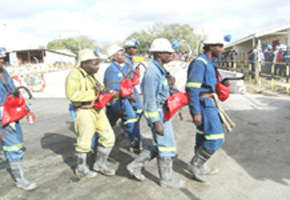
It remains the worst mining disaster in Zimbabwe and one of the worst mining disasters in the long history of mining in the world. There were 391 Africans killed together with 36 Europeans.
Proto teams from all over Africa and Europe responded within hours of hearing the news in a desperate bid to save lives if possible or at the worst bring up bodies. However, a decision was made to seal off the mine, thus entombing forever the bodies of all the miners. Kamandama mine disaster is commemorated every year.
Recently 178 miners were trapped underground for close to 24 hours at Mimosa Platinum Mine in Zvishavane after a conveyor belt caught fire.
Witnesses at the scene of the accident said miners were trapped underground as a result of the conveyor belt which caught fire. There was thick, dark smoke, which impaired the miners’ vision as well as extreme heat from the burning rubber.
Like in 1972, proto teams or rescue teams were rushed to the scene and this time around they managed to safely evacuate all the miners. The miners who were trapped underground at Mimosa were lucky in that they had access to ablution facilities, could communicate and there was water.
The rescue teams as they battled to put out the fire, found ways of providing the trapped miners with more drinking water, food and more advanced masks to protect them from the smoke.
The proto teams could only evacuate about eight miners at a time. One rescue worker would go in jogging for a couple of kilometres then come out walking with a set of miners that he would lead with his torch while encouraging them to follow him in a single file, use their breathing masks and assure them that they would be out of the mine safely.
Meanwhile, it is alleged that some of the miners could not even use their breathing masks thereby compromising their health.
What happened at Kamandama Mine and at Mimosa Platinum Mine has raised questions such as- How safe is it underground? Are miners well trained and equipped for disasters and are mines and their proto teams knowledgeable about how to react in the event of a disaster?
After the Mimosa Platinum Mine mishap, which could have been a replica of the Kamandama disaster, stakeholders should go back to the drawing board and find ways of improving mine safety.
It is important to come up with measures to ensure safe and healthy working environments. Disaster preparedness is critical therefore there is need for continuous training of rescue teams and workers in general.
Bubi Small Scale Miners Association vice-chairman, Mr William Moyo said safety in the mines should be a priority.
He said the safety of miners should always come first.
“A lot still needs to be done especially at small scale mines.
Safety should always come first so there is need to invest in health and safety at the workplace.
Many small scale mines are yet to meet the minimum health and safety standards,” he said.
Mr Moyo said certain improvements need to be made in the mines around the country.
“We need a more hands-on approach to ensure safety in the mines. As it is, some of the mines are generally safe but some of them are not.
“Both employers and employees need to be educated about the importance of safety in mines. There needs to be safety and security because they are very important.
“There should also be follow ups on how our mines are operating to avoid disasters,” he said.
The National Social Security Authority (NSSA) said in 2011 the country witnessed 71 deaths as a result of workplace related accidents, reflecting a decrease from the 84 recorded in 2010.
Seventy one people died at work or in work related accidents during the first 11 months of the year in a period in which 3 744 injuries were recorded.
Workers continue to die in work-related accidents as most employers do not prioritise occupational health and safety issues.
A senior NSSA official Dr Humphrey Mapuranga recently said the work related accidents were mostly recorded in the mining sector, manufacturing as well as in the agricultural sector.
Zimbabwe has experienced some of its worst work related accidents in the past dating back to 1972 when 427 mine workers perished at Hwange Colliery’s Kamandama Mine.
Another major occupational accident happened at the CABS Millennium Towers along Samora Machel Avenue in Harare when15 construction workers died in 2001. The Chamber of Mines works with Government, labour and miners to ensure that mining operations are safe.
“In this regard the Chamber of Mines of Zimbabwe works with the Ministry of Mines and Mining Development’s Mining Engineering Department that is responsible for the safety and health inspectorate function. It works with National Social Security Authority which is the lead agency for occupational health and safety in the country. In addition it works with the Environmental management Agency the national authority on environmental management. The Chamber of Mines of
Zimbabwe established a standing committee of Safety Health and Environment (SHE), the SHE Committee, whose mandate is to make recommendation to the Executive Committee on SHE issues in the mining industry. Membership to this committee is open to all members of the Chamber of Mines of Zimbabwe.



 Online Reporter