admin
admin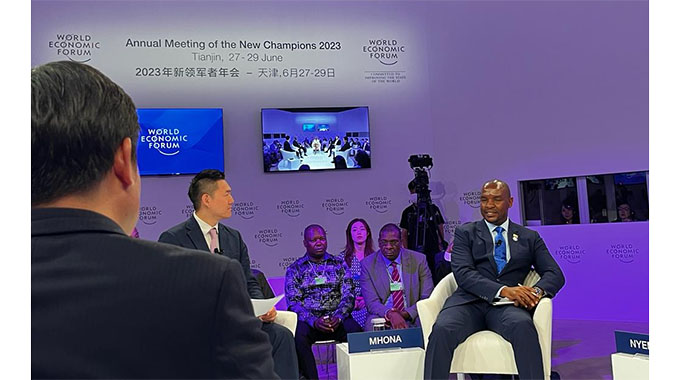
Freeman Razemba Senior Reporter
Transport and Infrastructural Development Minister Felix Mhona this week led a Zimbabwean delegation to the World Economic Forum in China where he yesterday addressed the evolution and trajectory of trade between China and Africa and how that will advance Africa’s regional integration.
During the forum which was held between June 27 and 29, Minister Mhona also addressed China’s commitment to bolster Africa’s growth, through immense infrastructure investment.
The meeting was running under the theme, “China and Africa: Mutually Transformative”.
Minister Mhona said the African Continental Free Trade Area (ACFTA) was the largest free trade area in the world by the number of signatory countries and that it creates a single market of 1,3 billion people with a combined GDP of US$3,4 trillion.
“Agriculture, Agri processing, Automobile, Pharmaceuticals, and Transport and Logistics are some of the fastest growing China-African trade areas. Annual flows of Foreign-Direct Investment (FDI) from China rose from just US$75 Million in 2003 to US$4,2 Billion in 2020, with China now standing as Africa’s biggest trading partner, where the value of trade between China and Africa has risen from US$10 billion in 2 000 to a record $254 billion in 2021; with China as the main source of imports for most African countries.
“Africa’s population is growing faster than that of any other continent, and our citizens are moving to cities faster than people elsewhere. These trends will drive demand and create opportunities for trade between Africa and China. In return, it is also factual that the cooperation has been transformative for China’s industrial manufacturing on a win-win basis,” he said.
He said investments in infrastructures such as roads and railways were crucial to the AfCFTA.
“According to the African Development Bank, about US$130 to US$170 billion a year is needed in hard infrastructure with a financing gap of US$68 to US$108 billion per year. Surely, the potential for increased collaboration between China and Africa is at its maximum more than ever before,” Minister Mhona said.
He said unified economic development of the African region has become a Pan-African initiative which commenced in 1963 through the formation of the Organisation of African Unity (OAU, which was later to be reinforced in July 2002 when the OAU rebranded into the African Union (AU).
“Since then, Africa has been on the trajectory of economic growth by opening new frontiers of cooperation, including with China. As a result, Agenda 2063 was developed as a strategic framework for Africa’s long-term socio-economic and integrative transformation.
“It calls for greater collaboration and support for African-led initiatives to ensure the achievement of the aspirations of African people. The targets contained in the Agenda 2063 and the strategies therein dovetail with the collaboration that exists between China and Africa,” he said.
Minister Mhona added that the Forum for China-Africa Cooperation (FOCAC) was established in 2000 as a platform for collective consultation and dialogue and has become an effective cooperation mechanism to promote development.
He said the Forum was premised to strengthen consultation and expand cooperation within a pragmatic framework, to promote political dialogue and economic cooperation with a view to seeking mutual reinforcement and cooperation.
“This is achieved through strategies and initiatives such as the Belt and Road Initiative (BRI), a global infrastructure development strategy adopted by the Chinese Government in 2013, to invest in more than 150 countries and International organisations.
“The brainchild of the Chinese President, Cde Xi Xi Ping is an ambitious economic development and commercial project that focuses on improving connectivity and cooperation among multiple countries, especially those spread across the continents of Asia, Africa and Europe,” he said.
Minister Mhona said the BRI objective promotes economic prosperity of the countries along the Belt and Road, and regional economic cooperation to strengthen exchange, and mutual learning amongst different civilisations and to promote world peace and development.
“The policy’s initiative is a Chinese economic and strategic agenda by which the two ends of Eurasia, as well as Oceania and Africa, are being more closely tied along two routes; that is, one over land and another over maritime. The BRI ensures China-African cooperation in the economic, trade, financial, agricultural, medical care and public health, scientific and technological, cultural, energy and mining, water and sanitation, educational, human resources development, transportation, environmental, tourism and other areas to promote the common development of China and Africa.
“In many areas, the partnership has delivered some concrete outcomes that are beneficial to Africa. In Africa, investments have been realised in Rail transport (Kenya), road infrastructure (Uganda and Tanzania), mining, roads and airport infrastructure (Zambia) and many more,” he said.
He said in Zimbabwe, the BRI has inspired investments in infrastructural development, airports rehabilitation and expansion projects, the energy sector (Thermal and Hydroelectricity), commerce (Tile manufacturing), water and sanitation (Chivhu Dam, Morton Jeffrey), peace and security (National Defence University), Tourism (Golden Peacock), heavy steel and platinum ore mining and value addition (Manhize), coal mining, technology (Net one – Huawei collaborations), technical transfer, training and development (public and private sectors training), and transport corridors.


 Online Reporter