

 Online Reporter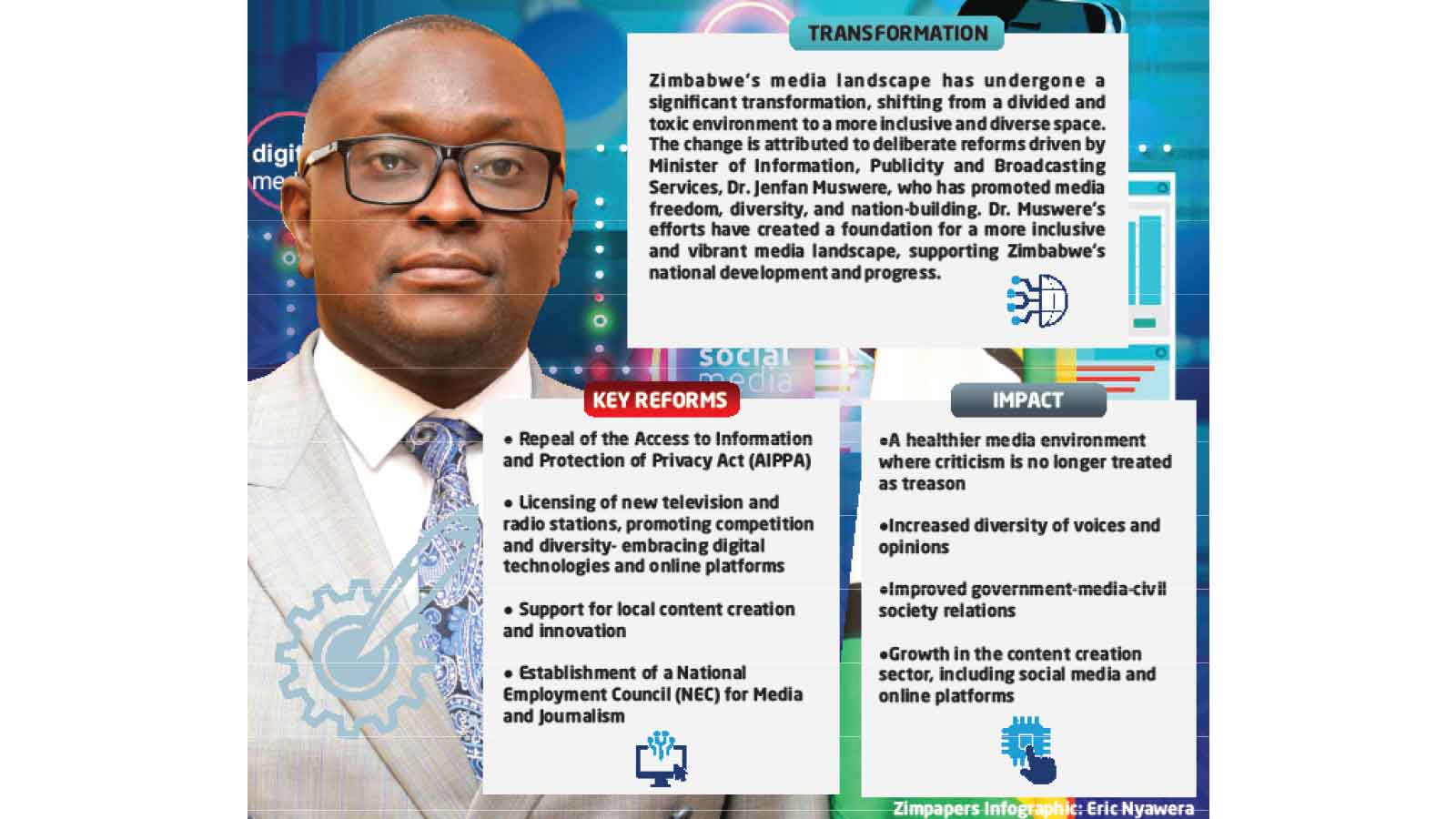
Alexander Rusero and Ranga Mataire
FOR years, Zimbabwe’s media landscape was defined by suspicion, hostility and trench-warfare narratives that helped no one.
A divided press mirrored and amplified a divided society. It was either a pro-Government or anti-Government, propaganda or counter-propaganda. The result was a loud but unproductive national conversation at exactly the time the country was struggling under heavy geopolitical pressure and economic siege.
Today, the temperature has changed. The fight has given way to debate. Diversity in opinion is no longer treated as a threat. Zimbabwe’s media environment is still plural and sometimes noisy, as it should be, but the toxicity that defined the 1999–2017 era has sharply declined.
The transformation did not happen by chance. It happened because of a deliberate reform wave driven under the watch of the Minister of Information, Publicity and Broadcasting Services, Dr Jenfan Muswere.
A Minister for Every Media House
Speaking soon after taking his oath of office at State House on September 13, 2023, Dr Muswere made a commitment that his ministry would work to ensure that the rights to freedom of media and freedom of access to information as enshrined in the constitution was upheld.
“I want to ensure you that I will be a minister of all media houses given the diversity. We are mainly focused on nation building, we are mainly focused on nation building, we are mainly focused on ensuring that we have an informed society which is beneficial to President Mnangagwa’s Vision 2030,” Dr Muswere said, a clear expression of his intention to chart a new path for the country’s diversified media
Since then, Dr Muswere has lived up to his word. He has been called many things, overly optimistic, strategic, political and the Joseph Goebbels of our time, but one label keeps resurfacing in media circles, “the genius information architect with a Midas touch.”
It sounds glowingly dramatic and yet the evidence is difficult to ignore. Zimbabwe lived with a state monopoly over broadcasting for a generation. That monopoly defined what the public could watch and hear. Under Dr Muswere’s tenure, those “Walls of Jericho” finally fell. The licensing of new television and radio stations has opened competitive space that once looked impossible.
Private players, University Campus, community radio initiatives, all now share the spectrum. The ripple effect is real – new jobs, new content, new viewpoints and a decline in the old binary of “State versus Private.”
Instead of one message amplified through a single channel, Zimbabweans now pick from multiple frequencies and make up their own minds. For years, media houses operated like political camps. Headlines, editorial lines, even columnists were treated as ideological soldiers.
Today, the sharp division between pro-Government and anti-Government media has faded. Competition exists, but not trench warfare. That shift is critical; a country cannot build if its information ecosystem is permanently at war with itself.
Constructive Engagement
Dr Muswere did not achieve that by lecturing newsrooms into unity. The repeal of the infamous Access to Information and Protection of Privacy Act (AIPPA) by the previous Minister Senator Monica Mutsvangwa was the clearest sign that the Second Republic meant business. AIPPA was a weapon. Its removal changed the tone instantly. Replacing it came modern legislation aligned to international standards.
The reforms were a result of across the board engagements from stakeholders in the media sector. While in the past some media organisations were viewed as adversarial, Dr Muswere has embraced them as critical cog in making the media industry not only a critical sector in employment creation but also a major contributor in nation building.
The Minister has been a permanent feature at all events to do with the media and has never discriminated anyone on the basis of their station. Thus on May 3, 2024 during the commemoration of Press Freedom Day, Dr Muswere told journalists that the Government was committed to eradicate polarisation in the local media industry.
In his own words, Dr Muswere assured media practitioners that the Second Republic will continue to work towards eradication of polarisation through constructive engagement with the media.
“The Second Republic under the astute leadership of President Mnangagwa has made tremendous progress in the creation of an enabling environment in the media sector.”
Dr Muswere said the Second Republic has made significant progress in ensuring a safe, free, and competitive operating environment for all media to thrive
A competitive free environment is a creation of tangible reforms that did not just soften the environment but transformed it. The reforms created a legal framework that respected press freedom while insisting on accountability and ethics. The result is a healthier media space where criticism is no longer treated as treason, and patriotism is no longer measured by silence.
Zimbabwe’s content creation sector has exploded. Social media creators, online platforms, digital storytellers, and innovative filmmakers are finally part of the national information ecosystem not outsiders. The sector is now supported from the highest office in the land. The presidency itself openly champions local content as part of national branding.
The old hostility towards independent digital creators has been replaced by engagement and support. In a world where influence is measured in clicks, not printing presses, that shift is more progressive than many realise.
Zimbabwe’s media policy now treats new technologies as necessity, not threat. Convergence, once academic jargon, has become practice. Traditional broadcasters and newspapers operate side-by-side with powerful online platforms, often owned by young Zimbabweans who were once too marginalised to be heard.
Honourable Muswere has made it clear that future battles are won on fibre, not paper. Another big shift is happening quietly, national conversations around a standalone National Employment Council (NEC) for Media and Journalism. For the first time, the industry is working toward formally recognised labour standards. That means journalists can negotiate as professionals, not informal workers hoping for fair treatment. Professionalisation eliminates the excuse for mediocrity and builds dignity into journalism. That is how sustainable media industries are born.
But taking stock of Dr Muswere’s achievements, the most underrated achievement is the long Government-media-civil society war. From 1999 to 2017, engagement was toxic, combative, and violently adversarial. Today, the atmosphere is functional. Government and civil society can argue without trying to bury each other. That alone is a breakthrough.
Media freedom does not mean loveless anarchy, and patriotism does not mean suffocating unity. Dr Muswere seems to understand that Zimbabwe’s story is stronger when told from different angles – as long as all those angles converge on national progress.
Sceptics will say the peace is fragile. They’re right, national narratives are always contested spaces. But the shift is already embedded, in the laws, in the licences, in the digital economy, in the tone.
Zimbabwe’s information order is now built on accommodation, not exclusion. Dr Muswere reads that for what it is, the new global standard. Around the world, Governments that shut media out lose the information war. Those that unite institutional voices with citizen voices shape their own image. Zimbabwe, against the odds, seems to have learned from history.
Has Dr Muswere magically ended toxicity? No transformation is truly “magic.” But what Zimbabwe has seen over the past few years looks impressive, clear-eyed reform, legal restructuring, technological inclusion, and a willingness to break old monopolies.
In a country once swallowed by its own media battles, peace in the information space is more than a milestone, it is a strategic resource.
If the Second Republic’s success requires a united national story told through diverse voices, Dr Muswere has built the foundation. Now the industry must build forward, debate honestly, and tell Zimbabwe’s narrative with the confidence of a nation that has survived storms and is finally talking to itself instead of shouting at itself.



