Online Reporter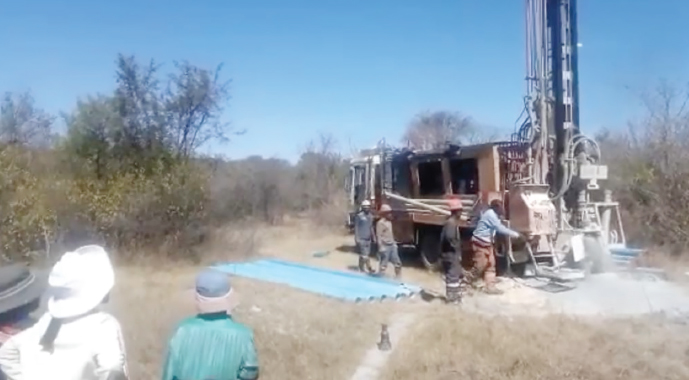
Nothando Zondo, [email protected]
Villagers in Mkhutshwa, under Nswazi in Umzingwane District, are celebrating the end of a water crisis that has stretched for nearly two decades, after a solar-powered borehole was drilled at the community’s dip tank last week, restoring reliable access to water for both livestock and domestic use.
The borehole was drilled on Wednesday at Mkhutshwa Dip Tank, a facility that serves residents of Ward 6 and Ward 7, and it yielded a strong flow of water that drew spontaneous ululation and songs of praise from community members who gathered to witness the moment.
For many families, the development marks the conclusion of years spent walking about 1,5km to a nearby dam to fetch water for dipping cattle and for household needs, a journey that placed the heaviest burden on women, youths and the elderly.
The crisis began when the bush pump at the dip tank collapsed due to poor casing, leaving livestock owners without a dependable water source close to the facility.
In the years that followed, dipping schedules became irregular, cattle health declined, and households were forced to prioritise which needs could be met with the limited water they could carry from the dam.
The latest intervention comes at a time when Government, working with development partners and local leadership, has intensified efforts to turn around livelihoods in rural communities by harnessing locally available resources, particularly water and solar energy.
The approach prioritises climate-resilient infrastructure that can be managed at community level and that delivers both immediate relief and long-term productivity, especially in agro-based areas where livestock and small-scale irrigation remain central to household incomes.
Mr Gift Dube, the livestock focal person for Ward 6 and 7, said the borehole was realised after sustained community mobilisation, documentation and follow-ups with relevant Government departments and the Rural District Council to have the project prioritised.
He noted that the process reflected a broader shift in how rural challenges are being addressed, with communities expected to take ownership while Government and partners provide technical and financial support.
“This is the kind of development we have been pushing for,” said Mr Dube.
“When we use what we have here on the ground — our water sources and solar energy — we can solve problems that have held us back for years without waiting indefinitely for grid power or large-scale schemes.”
The solar-powered design of the new borehole is central to that strategy. Once the remaining works are completed, including capacity and water quality tests, the installation of solar panels, a submersible pump and a storage tank will ensure that water can be pumped consistently without reliance on diesel or electricity from the national grid.
Officials say this will reduce running costs and make maintenance more manageable for the community and the Rural District Council.
Mr Siphon Sibanda, a villager who has used the dip tank for more than three decades, described the successful drilling as an answered prayer.
“We thought this was a far-fetched dream,” he said.
“For years we carried buckets in the sun to water our cattle and for home use. Today God has answered our prayers. We can’t believe water is here at the dip tank.”
Mrs Similo Ndlovu, another resident, said the impact would extend beyond livestock.
“No more 1,5km walks. Our cattle, our children, and our gardens will drink. This water means we can now spend time on other things that can improve our lives,” she said.
Community leaders in the area also welcomed the project and said the availability of water at the dip tank would free up valuable time that villagers can now channel towards nutrition gardens, income-generating projects and other community activities.
They also emphasised that regular dipping will improve herd health and contribute to the control of tick-borne diseases, which remain a major threat to cattle in the region.
In Zimbabwe, dip tanks play a vital role in providing immersion treatment to control external parasites and in protecting the national herd, given that tick-borne diseases account for up to 70 percent of cattle deaths nationally.
Government and its partners have been scaling up similar interventions across rural districts as part of efforts to build resilience and stimulate local economies.
The model aligns closely with the Village Business Units (VBU) concept, which establishes community-owned, solar-powered commercial agriculture hubs anchored by one-hectare irrigated plots, solar boreholes and clean water systems.
While Mkhutshwa’s project is focused on the dip tank and domestic supply, it is envisaged that the infrastructure creates a foundation for future expansion into small-scale irrigation and agribusiness, which are key pillars of rural industrialisation.
The remaining work at Mkhutshwa includes comprehensive water testing to confirm suitability for both livestock and domestic use, followed by the installation of the solar pumping system and storage infrastructure. Once complete, the facility will be handed over to the community and the
Rural District Council for joint management and maintenance, in line with Government policy of promoting community ownership and sustainability.
For the people of Mkhutshwa, who have endured nearly 20 years of water shortages, the gushing borehole represents more than a new source of water. It signals a shift towards self-reliance built on local resources, and it offers a practical example of how Government’s increased drive, supported by partners, is beginning to change daily life in rural communities.