Online Reporter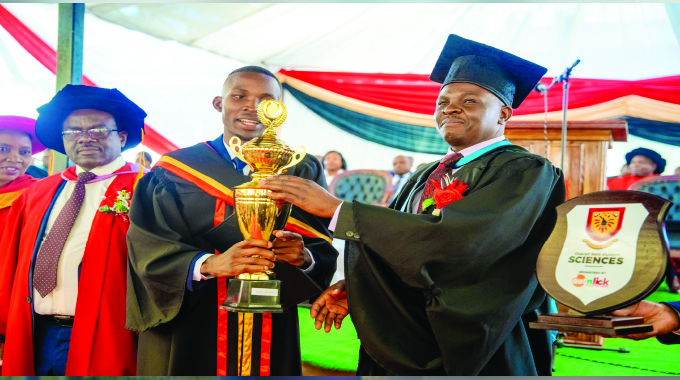
Patrick Chitumba, Midlands Bureau
LOCATED in Mkoba suburb in Gweru, Mkoba Teachers College (MTC) has made significant strides in innovation, fostering a culture of creativity and problem-solving, among its students.
This has led to the development of ground-breaking prototypes, which are being commercialised in line with the Education 5.0 philosophy.
Some notable innovations include a soil moisture tester, designed to support sustainable agriculture by accurately measuring soil moisture levels.
Additionally, the college has developed an alcohol breathalyser, promoting safety and responsibility by detecting alcohol levels. A gas leakage detector has also been created to enhance household and industrial safety by identifying gas leaks.
An offline library software has been developed, enabling students to access educational resources even without internet connectivity.
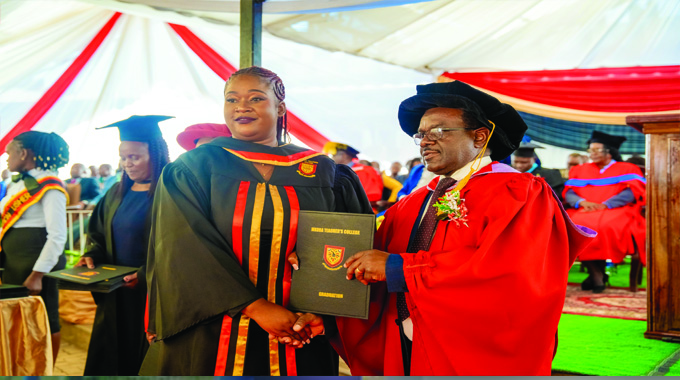
On Friday, the college held its 45th graduation ceremony where Deputy Minister of Higher and Tertiary Education, Innovation, Science and Technology Development, Simelisizwe Sibanda, officiated.
A total of 406 students graduated with diplomas after completing their studies in primary education. Of these, 293 graduated in the general course. The Early Childhood Development (ECD) was made up of 107 females and four males.
In secondary science education, a total of 113 students graduated, with 77 females and 36 males.
Addressing the gathering, Deputy Minister Sibanda said the ministry has embarked on a retooling of the laboratories in tertiary institutions, to allow for the development of innovative ideas and ultimately goods and services.
“MTC is one of the beneficiaries of these funds for its secondary science, technology, engineering and mathematics programme. The demand for Stem teachers is high, hence the commitment to the building of a science centre at this college,” he said.
“The funds for the commencement of the building will be released shortly. I am pleased to note that the results from the Stem programme are already showing at MTC.”
Deputy Minister Sibanda said that as MTC students are coming up with prototypes that can be used in teaching and learning, some of which were showcased at the just-ended Zimbabwe International Trade Fair, the Government will continue to fund Stem.
“To date, MTC College has produced 328 Stem graduates. This is a milestone achievement and we need to congratulate ourselves. This is commendable as we continue to produce Stem teachers. I challenge the principal to make sure that the prototypes designed or produced are transformed into products as we move towards industrialisation and commercialisation of these prototypes. The Government is there to support you in that journey,” he noted.
On the construction of Gangarabwe Secondary School in Chiwundura by MTC, Sibanda said progress was at 30 percent and vowed that more support would be availed to ensure its completion.
“It’s, therefore, paramount that you start working on the process of registering this school so that you can start enrolling pupils as soon as possible,” he said.
“I challenge the principal to explore that and engage the Ministry of Primary and Secondary Education to make sure that in 2026 we start enrolling pupils at that secondary school.
“I am also pleased to note that the college has started working on the construction of a primary school in Mvuma. These developments offer excellent services to the community by offering access to education.”
Sibanda said the graduates, who pass through MTC will get into the education business with the support of the ministry in the fulfilment of its mandate of human capital development.
“It’s a clear example of rural industrialisation and commercialisation of education. Let me assure you that the ministry will continue to seek financial support, to ensure that these projects become a reality,” he explained.
The Integrated Skills Outreach Expansion Programme is one of the ministry’s key vehicles for empowering disadvantaged youths and women.
Deputy Minister Sibanda said the ministry supports MTC’s initiative of setting a cultural hub at the institution, saying this promotes local heritage, interaction, as well as being a constant reminder of the people’s origins.
“The hub will assist in combating the challenges caused by globalisation, such as cultural decay, identity crises, and loss of African values, while providing a platform for cultural education and community engagement,” he said.
MTC Principal, Dr Rosina Mavunga, said by incorporating local histories and cultural narratives in a contemporary setting, MTC is in the process of establishing a cultural hub that merges traditional elements with technological advancements.
“This hub is designed to establish a sustainable platform for cultural education, safeguarding local heritage while fostering economic growth through cultural tourism, workshops, and the sale of indigenous products,” she said.
“In doing so, it reinforces our dedication to preserving, protecting and promoting our nation’s rich cultural legacy.”
Dr Mavunga said the initiative aligns with the visionary leadership of Amai Dr Auxillia Mnangagwa and embodies the principles of Education 5.0, which emphasises the integration of cultural heritage with technological innovation to redefine the future of learning.