Chronicle Editor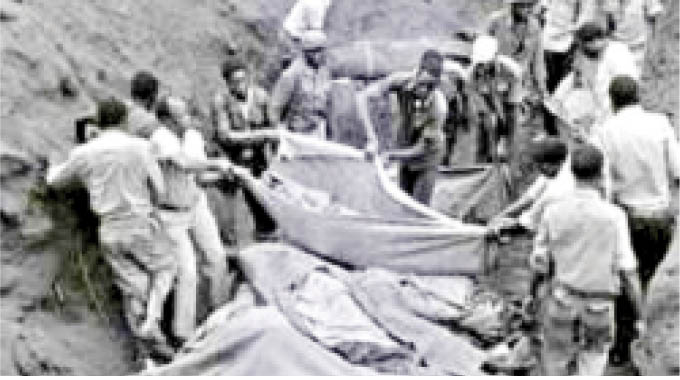
Nduduzo Tshuma, Political Editor
THE bombardment of Mkushi Camp in Zambia by the Rhodesian army in 1978 put Zipra female combatants, stationed at the camp, in the line of heavy fire by the blood thirsty Ian Smith regime unrestricted by the gender of the enemy.
The attacks were a retaliation after Zipra forces downed an Air Rhodesia Viscount plane as it left Kariba for Salisbury in February 1978.
Cde Panny Irene Khuphe whose pseudonym was Rita Mnkandla was underground in Mkushi Camp on the fateful and night and recalls the chilling tale of the bombings.
She said they were saved by one of the female commanders Ratidzo Ndlovu aka Jane Ndlovu who shouted that she had been captured by the Rhodesian forces and the female combatants should not respond when they heard the sound of a whistle.
“Those who can hear me, those who are close, do not come out. I have been captured. Don’t respond to the sound of the whistle, if you hear someone blow it, don’t come out,” Ndlovu shouted in defiance to the white soldiers who wanted her to blow the whistle, a signal used to call combatants for a parade.
For her defiance Ndlovu whom colleagues called a “man” or “magogo” saved some female combatants but paid the ultimate price for her heroism as she was executed by the Rhodesian forces.
Cde Khupe had just joined the war the previous year, having left Rhodesia via Botswana and ferried by a 7.7 plane to Zambia for training.
She says signs that the camp was being monitored started showing in 1977 after having gone for training for more than six months.
Cde Khuphe said they would go on a cross country run, toyi toying in the bush and it was then that one of the female combatants stumbled on a box of cigarettes indicating that the enemy was in the area.
“As we were there, a girl, (former police Deputy Commissioner-General) Nonkosi Ncube, saw a 20 Madison cigarette pack and we knew that things were getting bad.
“We realised that the Selous Scouts were there. The whites had come to investigate how the camp was structured and how the tents were located,” said Cde Khuphe, who was in the first battalion, company A.
She said on the day the Rhodesian war planes attacked the camp, a few helicopters had initially passed as they were learning about the commissariat under trees.
She said in 1978, they had finished most components of the training when the bombings started.
“They came from Wekasi where there were old people before they came to us. We were underground, at the time we were learning communication, to be a pronto, 104s, karate, 118 and switchboard operation,” said Cde Khuphe.
“We were bombed with stunning ferocity. Jane had been captured. She was the first to call for a parade but shouted that ‘you who can hear me, don’t come out, I have been captured by the whites.’”
It is said that the whites killed Jane as she refused to blow the whistle to call the parade.
The Rhodesian forces then took the whistle and blew it.
Cde Khuphe said the Rhodesian soldiers mercilessly butchered the combatants who responded to the whistle as they had already surrounded the camp.
“The whites had put lights in the camp and we were still underground. You could hear them walking around, opening cans and you would hear them say ‘John, Steven, don’t waste ammunition, just use the bayonets.’ You could tell that they were eating and afterwards there was no movement,” she said.
Cde Khuphe said they only managed to get aground the next morning after failed attempts throughout the night.
“We only managed to escape in the morning. We could see helicopters in the parade and corpses of our comrades being carried in plastic bags. We escaped and got into a river close to the kitchen where we used to cook.
“We were in the water for a week. They (Rhodesian army) had put stretcher beds across the river and monitored it, spraying a hail of bullets at anything that moved,” said Cde Khuphe.
She said they (her and five other combatants) braved the sting of tsetse flies and walked in the darkness on the bare ground as the enemy forces had burnt the grass in the area and dug trap holes filled with a combination of water and Napalm.
Napalm is a highly flammable sticky jelly used in incendiary bombs and flame-throwers, consisting of petrol thickened with special soaps.
It is an enormously destructive weapon that can adhere to the skin, ignite and cause terrible burns. Even light contact with the substance can result in second-degree burns, eventually causing scars called keloids.
“We fell in water where they had poured Napalm, it’s where I was burnt on the feet and on the hands,” said Cde Khuphe.
Her hands, she said, were burnt as she was taking off her boots so that she could rub soil against her legs to get the Napalm off her skin.
They eventually met Zambian soldiers who were responding to the attacks and were taken to Rusemfa then close to the Zaire border and later Solwezi where Dr Joshua Nkomo addressed then.

Cde Grace Nuku, who trained with Jane and was fellow commander, said the late heroine was the first Zipra female cadre.
“I had found her as the first woman cadre in Zipra even if they had not started training women. She told us that she came from the Midlands area around Silobela,” said Cde Nuku.
Cde Nuku said Jane had left Rhodesia in 1974 with five girls, crossing to Botswana before they were taken to Zambia.
“Upon arrival in Zambia, they were taken to Mboroma. Unfortunately, at the time they got there, a conflict erupted. There were many groups in Mboroma including ANC, Zanla. Zipra and the Zambians.
“What I heard from those at the time is that they were integrated to the Zimbabwe Liberation Council. After the conflict in Mboroma, Zipra and Zanla separated with Zipra remaining in Zambia and Zanla going to Mozambique,” said Cde Nuku.
She said one of the girls who was a spirit medium and referred to herself as “she devil” or Mbuya Nehanda died at the camp.
Jane, Cde Nuku said, opted to remain with Zipra because she was coming from a house where her mother was a strong Zapu supporter in the Midlands.
As the only female, Jane found a place to live in Zambia until 1975 when Cde Nuku’s group arrived.
“By February 1976, we were sent to Mwembeshi. We trained there but before we could finish, efforts were made again to integrate the children of Zimbabwe to come together and form Zimbabwe People’s Army (Zipa). We stopped training in Zambia and were sent to Tanzania and put in a camp in Mgagao.
“It was discovered that Zipras were the only ones that had brought women. Zanla had not brought women. Some people from Zanla who were with her in Mboroma spotted Jane and it was decided that she won’t be safe. She was removed and taken to Dar-e-Salaam,” said Cde Nuku.
“As we remained in the camp waiting for continuation of training, there was conflict again and we fought among ourselves. We proceeded to Morogoro as Zipra alone and started training. That is when Jane returned and we trained with her.”
Cde Nuku said Jane was a strong and committed woman.
“I was younger than her, around 16 and she was older, I think around 25. We were of small body build and would outrun her but even in exercises, she would never give up,” said Cde Nuku.
“She believed in achieving her goals. After six months of training, I was brought to Zambia and taken to Mwembeshi where we found more girls, about 53. We were sent to train those girls and left them (Jane and others) behind.
“They followed and were taken to Mbeya in Zambia and were collected by Cde Matswaha who took them to Victory Camp. That is where all female cadres arrived as a camp had not yet been established for training women.”
Cde Nuku said at the Victory Camp, there were two trained groups, one from Morogoro and another from Mwembeshi.
“Jane was appointed commander of trained women deputised by Audrey Ndlovu. I left Mwembeshi for VC where I stayed briefly and was sent to Cuba,” she said.
“The party then arranged a proper camp, because as the first two groups from Morogoro and Mwembeshi, we were being trained together with men. As the number of women increased, it was decided that there be a camp for females. That is when Mkushi was established.
“When I had gone, they were taken to Mkushi. Jane was in the group of commanders that went to Mkushi until a time they were attacked. I hear that on the day of the attack, the whites came and called out her name and said she should surrender. The rest of the story, you can be given by others who were there.”
Cde Nuku said Jane had left behind a child when she joined the war but its whereabouts remain unknown.
Cde Toriso Phiri, a fellow commander who trained with Jane and Cde Nuku, said the whites were fully aware of Janes’ training and capabilities so they marked her for execution.
“We were trained Commandos who should fight even without weapons. They knew from their intel that she was dangerous as she was highly trained and targeted her,” she said.
In a visit to Mkushi Camp in Zambia in 2015 by this reporter, another survivor of the bombings, Cde Lister Dube whose pseudonym was Rumbidzai Choga, a commander of recruits at the time, said they had joined the war as young girls.
She said it was decided that they go to school but she escaped with other girls from Victory Camp to Mkushi.
“We got here in the dead of the night and an announcement was made that we would be sent back to Victory Camp but we ran away until the commanders gave up and let us train with seniors,” said Dube.
“After training we went to Camp 2 of training personnel across the river. This one was Camp 1. While there, another group of recruits came and I was one of the trained personnel who came to provide security for the recruits.
“I had my platoon that monitored the road. There was a time we dug trenches so that we could hide at a time of bombings. What pains me is that it didn’t take long after that exercise that we were bombed.”
Cde Dube said at the time the attack was carried out, the Rhodesian Army went trench by trench killing the girls who were hiding.
“I and a group of girls didn’t hide in the trenches and neither did we run to assembly points. The assembly points, had already been ambushed. We managed to run away to escape with my platoon until we reached Rusensa,” said Cde Dube.
“I led the group, getting on and off the road, until we reached Rusensa. The injured were sent to hospital. We’re happy that the Ambassador (Zimbabwe’s Ambassador to Zambia Gertrude Takawira) said the shrines will be spruced up soon so that our colleagues can rest in a proper place.”


 Online Reporter