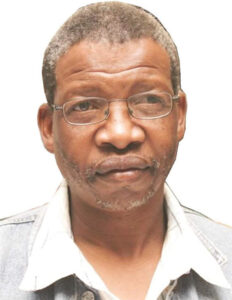
FORMER Highlanders FC defensive supremo Douglas “British” Mloyi remains one of the club’s most popular and respected footballers.
In this article, first published on 31 January 2016, Mloyi spoke about how he was stopped from joining splinter club Olympics at the beginning of 1977. It was a difficult time for Highlanders, who lost most of their first-team stars.
Mloyi’s loyalty and long service saw him achieve legendary status and remain among the select group of one-club players who achieved a great deal in the game.
Mloyi’s trophy cabinet is one to envy although there is one major piece of silverware that never made its way to his home in Mpopoma.
Highlanders helped him buy the house in recognition of his loyalty at a time when the club’s top stars had left to form Olympics at the end of 1976.
Mloyi was among the few players who remained with Bosso and went with the club to compete in the South Zone Soccer League against several unheralded clubs.
Lovemore Dube (LD) talks to Douglas Mloyi (DM) about the 1976 split and other football issues.
LD: Who is Douglas Mloyi?
DM: I was born Douglas Mloyi on 17 July 1955 here in Bulawayo, the youngest of eight children. My father loved football and was very supportive. Only my elder brother Tennyson and I played football.
LD: Where did you grow up and which schools did you attend?
DM: I attended Nkulumane Primary School and Magwegwe Secondary School here in Bulawayo. I started playing junior football at Highlanders in the under-14s.
LD: So you came through the club’s structures to the first team. Who was your first coach?
DM: We were coached by Washie “Come To Washie” Mpofu. Some of the notable players in the team were Willie Luphahla, Builder Nyaruwata and Ephraim “Kid” Moloi.
LD: When did you break into the first team? I suppose given the stars of the time, it was not easy, especially as the team had won the Chibuku Trophy and the regional league in 1973.
DM: I broke into the first team in 1974. I had been promoted to the reserve side directly from the under-18s. After the Chibuku Trophy-winning season, Boet Van Ays and James Nxumalo retired, so Silas Ndlovu, our manager at the time promoted me to the first team.
LD: Which defenders did you have to compete with for a starting place?
DM: Eish, there was Peter Zimuto, Chutika Tembo, Billy Sibanda, Nehemiah Dube and Lawrence Phiri. The competition was tough, but I had gained a lot of experience through the reserve league.
LD: The Reserve League—was it anything to talk about?
DM: Oh, in those days every team had a reserve team and we would play as curtain-raisers before the big game. Wherever we went, the reserves played before the first team. It exposed budding talent, while players recovering from injury in the first team also got a good run.
LD: Which team did you play against on your debut and in what position and what did coach Silas Ndlovu say to you before you went on to the field?
DM: We played Gweru United at Barbourfields Stadium some time in 1974. We beat them 7–0 and I scored on my debut. Before I came on, Silas said he was happy with the progress I had made. “Sonny, you’ve worked so hard, you deserve this. I can see you’re a tough tackler. Go out there and play your usual game.” The senior players were very encouraging, too. I was at right-back, Peter Zimuto at left-back and Chutika Tembo and Lawrence Phiri in the centre. They encouraged me to take it easy.
LD: Who were some of the Gweru United players at the time?
DM: If my memory serves me right, Ashton Mhlanga and Kisdo Matsika were among them. I was happy to have won the Southern Region League title at the end of the season and we progressed to the later stages of some tournaments. That Highlanders team was great.
LD: Any heartbreaks that season?
DM: We were beaten in the national league play-offs. I’m not sure whether it was Metal Box or Salisbury Callies.
LD: How was the league, and who were the top strikers then?
DM: The competition was stiff and we had fierce strikers to contend with, including David George, Victor Mapanda, Isaac Lungu, Chita Antonio, Nathaniel Maduku, Chris Yoyo and Twyman Ncube. We continued to dominate the region the following year, only to fall at the last hurdle—the national title. We also toured South Africa in 1975, where we played against the likes of Jomo Sono, Ryder Mofokeng, Patson Banda, Kaizer Motaung, Computer Ramola and Shakes Mashaba, the current Bafana coach. We played Kaizer Chiefs and Orlando Pirates.
LD: What made the team so dominant?
DM: We played with passion. Once you donned the Highlanders shirt, you knew what it meant and that drove us to do so well. Sadly, competition in our region was not very strong. Some of us worked, while others were full-time footballers who relied on their earnings from the game. I feel today’s crop of players lacks the passion we had.
LD: 1976 saw the introduction of a National League.
DM: We were very excited about that development, which meant we would compete with the best nationally. Teams from the north appeared to have a low opinion of us because they had dominated the scene for a while. We wanted to prove we were up to the task.
LD: How did you get on in that league?
DM: It was quite competitive, with fiery stars from our region and up north.
LD: You were on the verge of winning the league title in 1976, leading Dynamos by a point going into the last match at Barbourfields Stadium and things took a nasty turn in the last fixture of the season…
DM: We were devastated that the league was stolen from us. We had worked hard. It rained all week and the boss of the Rhodesia National Football League, John Madzima, was advised that
Barbourfields was waterlogged. There was no drainage then. On Sunday, we did not go to Barbourfields, but, surprisingly, Madzima arrived with Dynamos and we were given a walkover. We were pipped to the title by a solitary point. It denied us our first title and the consequences hit Highlanders hard afterwards.
LD: Then came the Olympics saga. I hear Highlanders were not paying well, which led to discord among some of the players and prompted others to leave. You were among those who stayed. What happened?
DM: Back then, football was a pastime. Most of us from Bulawayo had jobs but those from outside the city did not. We players were unhappy with our remuneration. For instance, in one cup game we knocked Dynamos out, but their players still received more than we did, despite our victory. We held meetings as players and I attended two.
We were paid to leave Highlanders. I received money after the first meeting, but I have never known who was behind it. I could not leave Highlanders because my father, who supported Bosso, would not have accepted it while I was still his son.
So my brother and I stayed at Highlanders, while some of our players left to form Olympics because of poor remuneration. I am not privy to any other reasons why certain players left, other than their dissatisfaction with the money. As a young player and the youngest at the time, I was really hurt to lose out on the league.
LD: Another notable feature of 1976 was the 4–0 drubbing by Zimbabwe Saints, inspired by Gibson Homela, the late William Sibanda and Max Tshuma. What went wrong in the Chibuku Trophy final at Rufaro Stadium?
DM: No team was playing at home, so the decision to make Bulawayo teams play in Harare annoyed us. As for the loss, the news that Saints were flying Homela in for the match also upset our plans. Psychologically, having someone come from Europe created a sense of inferiority in us and we never got into the game. Saints were the better side in every respect and took their chances.
LD: So who stayed for the South Zone Soccer League?
DM: My brother Tennyson, Lawrence Phiri, Majuta Mpofu, Willie Luphahla, Builder Nyaruwata, Josiah Nxumalo and Tymon Mabaleka. We had to bring in more players to bolster our team in the weak league, which we won in 1977. Losing those players affected us, we could have gone on to dominate the scene.
LD: If my memory serves me right, you won some honours in that league, playing against minnows…
DM: Yes, we won the league in 1977. I was part of the South Zone Select, alongside brothers Neil and Allan Boonzaier, Tymon Mabaleka, Majuta Mpofu, Lawrence Phiri, Harry Chitsa, Thomas Chipembere, Danny Mahaso, Vicent Levin, Lemmy Mnenekwa, Philemon Muriyengwe, Onias Musana and Mactavish Dube. I also appeared on the South Zone Soccer League calendar, adding to the Pelandaba, National Foods and Jairos Jiri Fete titles.
LD: Things seem to have gone well for you after Independence. You were capped and won several tournaments. Were you happy with what you achieved after returning to the national scene?
DM: Oh yes. I won the 1980 Chibuku Trophy, beating Rio Tinto 4–0 and the Heroes Trophy, beating Dynamos 3–2. I also earned my first cap in 1981 against Zambia. I partnered Sunday Chidzambwa before going on to win several other trophies. From 1984 to 1987, I won many trophies with Highlanders, playing in one of the best sides the club ever assembled, full of talent:
Mercedes Sibanda, Tito Paketh, Madinda Ndlovu, Willard Khumalo, Netsai Moyo, Peter Nkomo, Alexander Maseko and Dumisani Nyoni. It was not rosy all the way, we struggled when the young players were first introduced. We were a compact unit, playing for one another, the fans and our coaches. I eventually retired at 32 in 1987, content with what I had achieved in the game.
LD: What did you do after hanging up your boots following such a colourful career?
DM: I coached How Mine, Bulawayo Bottlers and other clubs. At one time, I was Highlanders manager.
LD: We see few former players in club administration or even at Zifa level. What is the challenge?
DM: It appears the doors may remain shut to former players, as elections now require candidates to have money to occupy office. In the past, the system was simple and thorough, with leaders coming from among the team’s members. Even at Zifa, there was recognition by merit for those who deserved it.
LD: Thanks for your time, British.
DM: You’re welcome.