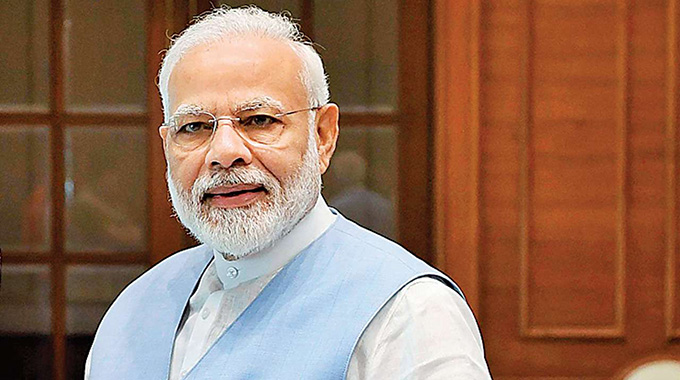
India expects consumption tax cuts announced by Prime Minister Narendra Modi will give a boost to the economy without hurting the government’s fiscal deficit, helping to offset the fallout from higher US tariffs.
Officials in New Delhi said on the weekend the proposed changes to the goods and services tax — which will see the number of tax categories reduced to two from four — would benefit a broad range of sectors, including consumers and small businesses. The adjustments would have a limited effect on government revenue, officials told reporters, requesting anonymity in order to discuss the plans.
Indian stocks rose in early trading Monday, led by automakers. The NSE Nifty 50 Index gained as much as 1.6 percent to 25,022, marking its biggest intraday gain in more than three months. The broader measures of small and mid-sized firms also rallied.
Indian bonds opened lower while the rupee strengthened against the dollar.
IDFC First Bank Ltd estimates the lower consumption taxes will help boost nominal growth by 0.6 percentage points, while the impact on inflation is expected to be a reduction of 0.6-0.8 percentage points, spread over 12 months. Emkay Global Financial Services Ltd forecasts a drop in government revenue of about 0.4 percent of gross domestic product, with states expected to bear a disproportionately bigger burden of the slump.
“Simplifying the GST structure is a welcome reform toward boosting domestic consumption, especially as India’s tax incidence has been increasing,” Madhavi Arora, an economist at Emkay, said in a note.
Even though changes to the GST had been discussed for years, the timing of the announcement in Modi’s Independence Day speech was a surprise to many. The move comes against the backdrop of President Donald Trump’s threat to double tariffs on Indian exports to the US to 50 percent by Aug. 27 to penalise the country for buying oil from Russia. Modi said Friday the economy needs to be more self-reliant, especially in critical sectors like energy, minerals and defence.
His tax announcement came a day after S&P Global Ratings raised India’s sovereign rating to BBB, the country’s first upgrade in 18 years. S&P said Trump’s tariffs would have a “manageable” impact on India’s consumption-driven economy. Spending by consumers and businesses contributes more than 60 percent to India’s GDP.
After Trump announced he was hitting India with 50 percent tariffs analysts, including from Citigroup Inc., estimated a 0.6-0.8 percentage point downside risk to India’s annual growth. The GST cut could help cushion the impact.
“The uptick in consumption may help to negate the impact of a no-deal scenario between the US and India,” said Garima Kapoor, an economist at Elara Capital. S&P’s upgrade may also enhance India’s appeal as an investment destination at a time when growth is slowing, she said.
India has a complicated GST tax structure, with four main categories of rates, at 5 percent, 12 percent, 18 percent and 28 percent. The proposed changes will see the number of categories reduced to two, with most goods that were taxed at 12 percent and 28 percent now taxed at the lower rate of 5 percent and 18 percent, respectively.
About two-thirds of government revenue from GST comes from the 18 percent tax category, which would limit any hit to fiscal coffers as a result of the adjustments, officials told reporters. Any loss in revenue is likely to also be offset by a likely jump in spending on basic goods like food that will be taxed at a lower rate, officials said.
“We see a good chance that GST on cement, two-wheelers and air conditioners may go down to 18% from 28 percent currently,” said Mahesh Nandurkar, analyst at Jefferies.
The proposals will be discussed by a panel of state finance ministers, and then submitted to the GST Council, which is headed by Finance Minister Nirmala Sitharaman, in September or October, officials said. The GST Council has the final say on any changes in tax rates. The changes will be implemented in the current financial year, the officials said— Bloomberg.