

 admin
admin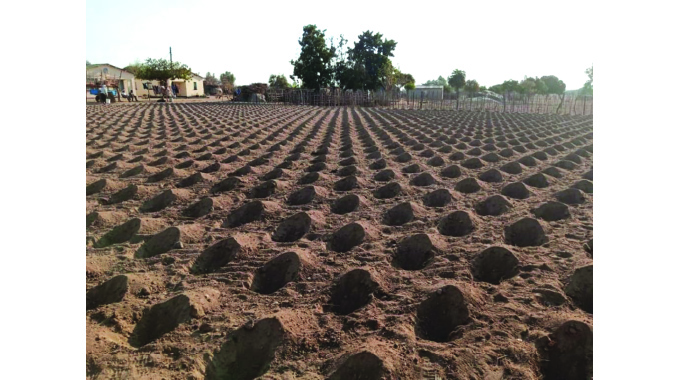
Precious Manomano Herald Reporter
More than 1,3 million women farmers have now been trained for Pfumvudza/Intwasa over the past three years, the Government Climate Proofed Presidential Inputs programme, and now form more than half of those who qualify for their free inputs once they have prepared their plots.
The major response ensures that almost all women small-scale farmers are included this year, so boosting their own incomes from commercial sales, feeding their families from what they retain on the farm, and with those two goals achieved meaning that targets for Vision 2030 and NDSI are being met.
Many women smallholder farmers do not have draught power and cannot afford irrigation equipment so need Pfumvudza, as this is their only practical option.
There is the work of digging the planting stations, the holes, but these can be reformed with far less labour if dug in previous seasons, and gather mulch for moisture conservation. Many farmers already in Pfumvudza and who had less than the five plots receiving free inputs have been extending their plots this year.
Estimates are that one plot can, if properly farmed, produce most of the year’s grain needed by a family. With the diversity of crops now becoming compulsory as the number of plots grows, other food will be grown, but even a large family is only likely to need the equivalent of two plots for food, so the rest is pure commercial production.
Pfumvudza promotes climate proofing agriculture by adopting conservation farming techniques and involves the use of small plots and then applying the correct agronomic practices for high yields and higher returns.
According to the update by the Ministry of Lands, Agriculture, Fisheries, Water and Rural Development on the preparations of the summer cropping season now starting, more than 2,3 million farmers have so far been trained under Pfumvudza over the seasons.
More farmers are going through the training and preparing land, and the Government still expects 3,5 million to be in the scheme.
Of the 2,3 million farmers, 1,3 million are women, outnumbering the 1 million men. Reports also showed that Mashonaland Central province was leading in Pfumvudza programme with more than 290 000 women participating compared to 229 000 men followed by Mashonaland East province where 219 000 women participating compared to 186 000 men.
In an interview, Tobacco Farmers Union Trust president, Mr Victor Mariranyika, urged farmers to diversify and take up Pfumvudza training in large numbers so as to ensure food security and boost household incomes by selling the surplus.
“I recommend farmers to take up this training. Pfumvudza is the only way to go in terms of ensuring food security and sustainability. The increase in women’s participation is a great sign which symbolises that the nation will be self-sufficient in terms of food crops.
“If you empower women there is a possibility that you have empowered the nation, but I urge both men and women to continue taking up this training,” he said.
In an interview Zimbabwe Farmers’ Union (ZFU) economist Ms Nyasha Taderera applauded women for taking up the programme saying it is empowering majority of women and will go a long way in sustaining their families.
“Women’s participation in this programme is crucial. I appreciate the involvement of women in such programmes. This will lead to economic growth. If we equip women, they can save their families.
“I recommend more women to take up these programmes. Its massive uptake has improved yields and enhanced household food security for the majority of smallholder farmers,” she said.
Women in various parts of the country applauded the Government for introducing Pfumvudza to sustain their families.
Mrs Wadzanai Maringe of Makombe said limited resources was the major issue which was affecting them in farming adding that Pfumvudza came as a solution to the problem.
“Most women still have challenges as they have limited resources. Most women cannot afford to apply for loans from financial institutions as the interest rates are high.
“Climate change has also affected agriculture and hit most women hard as they cannot afford irrigation. We applauded Government for coming up with Pfumvudza/Intwasa to climate-proof agriculture but there are also some instances we need irrigation so we can produce crops throughout the year and maximise profits,” she said.
The world has also supported the Pfumvudza concept saying the concept will help women farmers affected by climate vulnerability and extreme events.
Mr Takawira Marimo of Chirau village in Zvimba commended more women farmers to take up Pfumvudza training adding that the programme will ensure food security and give women profits from their business.
“Farmers who are taking up this programme are in the right direction. This is the way to go. We are happy to notice that women are now active in farming. Life is now changing more women are venturing into farming. We are guaranteed of food security and more yields because women are more serious when they venture into businesses,” he said.
Ms Auxillia Matanda of Maheu in Banket said women’s participation in Pfumvudza is crucial adding that domestic violence issues will be minimised since individuals can sustain their families easily.
“The programme is good; inputs are free so there is no need to ask money from the husbands. We can also maximise yields from small piece of land. We sell the surplus and solve all our issues at home,” she said.
Government has already released $20 billion towards the Pfumvudza/Intwasa programme as its main contribution to ensuring families are self-sufficient and have incomes. The programme is cheaper than providing free grain for those who would otherwise go hungry.
The 2022/23 summer programme’s strategic objective is to sustainably increase crop production and productivity to meet and surpass the national requirements for both human consumption and industrial use through the implementation of the key tenets of the Agriculture Recovery Plan.



 Online Reporter