daniel chigunwe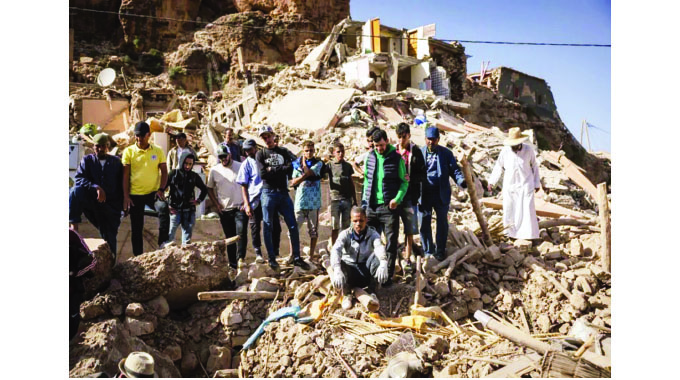
TALAT N’YAAQOUB, Morocco. – Villagers wept for their lost relatives in the rubble of their homes yesterday as the death toll from Morocco’s deadliest earthquake in more than six decades rose to almost 2 700 and rescuers raced against time to find survivors.
Search teams from Spain, Britain and Qatar were joining Moroccan rescue efforts after a 6.8 magnitude quake struck late on Friday night in the High Atlas Mountains, with the epicentre 72 km southwest of Marrakech.
The state news agency reported the death toll had risen to 2 681 with 2 501 people injured. Rescuers warned that the traditional mud brick houses ubiquitous in the region reduced the chances of finding survivors because they had crumbled.
It was the North African country’s deadliest earthquake since 1960, when a tremor was estimated to have killed at least 12000 people, and the most powerful since at least 1900, according to the US Geological Survey.
Among the dead was 7-year-old Suleiman Aytnasr, whose mother had carried him to his bedroom after he fell asleep in the living room of their home in a hamlet outside Talat N’Yaaqoub, in one of the worst-hit areas. He had been about to start a new school year.
“As she came back, the earthquake happened and the ceiling was destroyed and fell on him,” said Suleiman’s father, Brahim Aytnasr, whose eyes were red from crying. He had spent Monday trying to salvage items from the debris of his house.
Another son, 20-year-old Mouath, had escaped by climbing through a hole in the collapsed kitchen ceiling.
He broke down in tears and held his face in his hand as he described his deceased brother as a perceptive boy who loved the springs, the trees and the land around him.
Footage from the remote village of Imi N’Tala, filmed by Spanish rescuer Antonio Nogales of the aid group Bomberos Unidos Sin Fronteras (United Firefighters Without Borders), showed men and dogs clambering over steep slopes covered in rubble.
“The level of destruction is … absolute,” said Nogales, struggling to find the right word to describe what he was seeing.
“Not a single house has stayed upright. We’re going to start our search with dogs and see whether we can find anyone alive.”
After an initial response that was described as too slow by some survivors, search and rescue efforts appeared to be speeding up on Monday, with tent camps appearing in some locations where people had spent three nights outdoors.
A video filmed by Moroccan outlet 2M showed a military helicopter flying over an area close to the epicentre, dropping sacks of essential supplies to isolated families.
With much of the quake zone in hard-to-reach areas, the authorities have not issued any estimates for the number of people missing. – Reuters


 Online Reporter