

 Chronicle Editor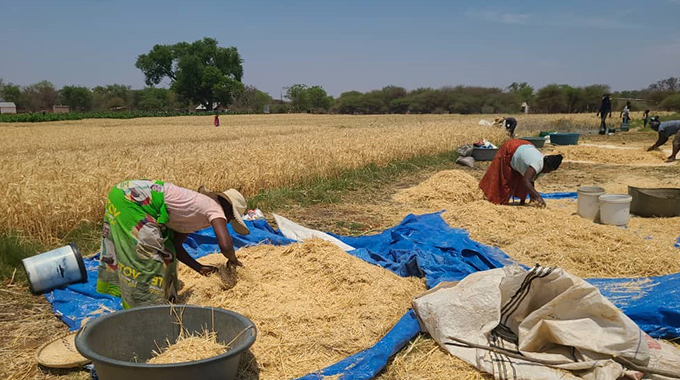
Sukulwenkosi Dube-Matutu, [email protected]
FARMERS operating at Mosenthals Irrigation Scheme in Insiza District expect to harvest nearly 60 tonnes from 12 hectares of their winter wheat crop, which is double what they realised from last year’s production.
Harvesting is underway and farmers estimate that five tonnes will be reaped per hectare, a significant increase from last year’s 35 tonnes.
The increase has been attributed to an improved crop variety, which the farmers adopted this season.
Despite the El Nino-induced drought that decimated hopes for many farmers, Zimbabwe’s winter wheat success story holds the promise of a bumper harvest and symbolises the country’s enduring resilience and determination to reclaim its position as a leading agricultural powerhouse in Africa.

Through close collaboration with the Government and private sector players, individual farmers and co-operatives at various irrigation schemes countrywide have increased their wheat hectarage this season to ensure the country achieves the targeted 600 000 tonnes output.
A total of 121 000ha was planted under winter wheat this year and this is expected to produce over 600 000 tonnes of the cereal compared to the 360 000 tonnes domestic consumption needs.
About 468 000 tonnes was harvested last year, the highest ever recorded since wheat production started in the country in 1966.

Mosenthals Irrigation Scheme in Ward 16 has 63 farmers having been established in 2012 and became fully operational in 2020. The scheme also has three hectares under maize out of a total 20ha land.
Project chairperson, Mr Jealous Ndlovu, said the Agricultural and Rural Development Authority (Arda) assisted them with inputs for their wheat crop and that once harvesting is complete, farmers will plant maize.
“We are in the process of harvesting our wheat crop and we are really excited because our crop did well this year. We partnered with Arda, which assisted us with inputs in the form of tractors and seed,” he said.
“Once we have harvested, we will use some of the grain to pay Arda. From the calculations we have made, we have seen that even after paying Arda, we will remain with significant quantities of wheat, which we can sell as farmers as well as wheat to eat with our families.
“With this winter crop that we have, we are certain that hunger will be a thing of the past. Despite the food crisis that has arisen as a result of the El Nino-induced drought we have been cushioned from its effects through this irrigation scheme,” said Mr Ndlovu.

A farmer at the irrigation scheme, Ms Sithokozile Sibanda, said the irrigation scheme has helped them to sustain their families. She said they also produce various horticulture crops, sugar beans and butternut.
Ms Sibanda said Government through Agritex has assisted them through trainings and technical advice to enhance their production. She said as farmers, they are eager to ensure successful production.
Ward 16 Agritex extension officer, Mr Doubt Sibanda, said this year, the farmers used SC Select Variety for their wheat.
“This year, the wheat crop performed well as we are expecting an average yield of five tonnes per hectare, which will give us a total of 60 tonnes from 12,8 that farmers had planted,” he said.
“Last year, we got a yield of 35 tonnes. This time around the farmers used a better variety. This irrigation scheme is playing a significant role in ensuring that households are food secure.”
Ward 16 councillor who is also Insiza Rural District Council chairperson, Mr Luke Dube, said the development of irrigation scheme is crucial for their area, which is located in Region Five.
He said each year households that are part of irrigation schemes in his areas are guaranteed of food supply regardless of rainfall patterns.
“Farmers from this irrigation scheme are still eating the maize crop harvested early this year. This wheat will further cushion farmers as they can sell and consume their crop,” he said.

“If we could have more villagers being involved in irrigation farming then we can fight the hunger situation. Our area is in Region Five and in five years we can get one good rainfall season. This means there is no way that people can survive outside irrigation farming.”
Government has been targeting an increase in wheat production to meet the national requirements in line with the Agriculture and Food Systems Transformation Strategy, the Agriculture Recovery Plan and the National Development Strategy One in pursuit of the vision of becoming an empowered and prosperous upper middle-income society by 2030.
In this regard, various measures have been implemented to ensure that the country meets its target, including the provision of adequate electricity and water. — @DubeMatutu.



 Online Reporter