Tinaye Agere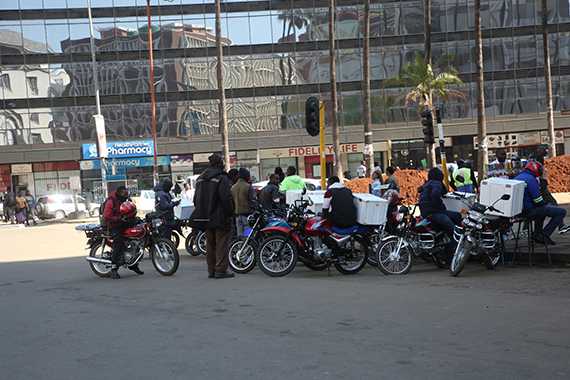
Veronica Gwaze
IT is a slightly sunny winter morning, and at the corner of Julius Nyerere Way and Nelson Mandela Avenue in Harare, a group of over 20 boisterous men are bundled up in puffy jackets and woollen hats.
Each of them is clutching a helmet, and nearby is a diverse collection of gleaming motorbikes that are neatly parked on the pavement.
This appears to be a casual get-together, perhaps lacking a formal agenda. One man seems to be leading the discussion, while the rest listen intently. In response, they shout, clap, whistle and laugh.
As the morning sun climbs higher, the number of motorbikes starts to dwindle as some men and women fire up their engines. Farewells are exchanged with a wave, a shout or a final burst of laughter.
One by one, they peel away from the curb, their motorbikes roaring into life and disappearing into the city traffic.
This unassuming corner, it turns out, serves a specific purpose.
It is not a casual meeting spot for motorbike enthusiasts, but a makeshift parking lot for a growing army of Harare’s “new” delivery men and women. The capital’s Central Business District (CBD) has undergone a transformation in recent years.

What used to be office buildings have been converted into bustling shopping malls, each one teeming with “runners” — small retailers selling everything from clothes, shoes to kitchenware and groceries.
Vehicle spare parts dealers and restaurants have been sprouting up too.
This boom in small businesses has created a unique opportunity for motorbike owners.
The runners, unable to afford delivery vehicles themselves, rely on these motorbike riders to ferry their merchandise to different corners of the city.
It is a win-win situation as the runners get their goods delivered quickly and efficiently, and the motorbike riders earn a decent income.
The corner, once a quiet spot for a morning chat, has become a microcosm of the city’s ever-evolving economic landscape.
Efficiency/Cost
A visit to most malls across the city reveals a similar sight.
Groups of men and women with motorbikes are always located nearby, waiting for their next delivery. Some own these bikes themselves, while others are employed as riders.
The motorbike riders weave through the city’s traffic, delivering goods across the CBD and beyond. Prices start around US$2 and climb based on the distance travelled.

This is contrary to traditional courier service providers that charge not less than US$6 for delivery.
Sheila Mapinga, a Harare runner, talks about this shift.
Mapinga owns three motorbikes and her riders use them to deliver goods to various suburbs. She reckons motorbikes are a perfect fit for Harare’s bustling streets.
Their lower maintenance costs and agility in traffic congestion allow for faster deliveries, a key advantage for the city’s growing army of runners.
“With the ever-growing competition among runners, I decided to introduce delivery services to lure customers. We deliver for all clients who are not able to walk into the shop and collect their goods. I make at least US$50 each day from deliveries,” she said.
Mapinga is one of the runners who decided to minimise their delivery costs by buying their own motorbikes.
Takunda Maburutse recently obtained a motorbike rider’s licence after failing to secure formal employment. He now uses his father’s old motorbike to provide delivery services and pockets at least US$30 on a good day.
“My father is now old. His motorbike was just lying idle as he can no longer ride it, so I decided to use it,” he said.
The scenes in Harare are an example of a trend that is happening across the country, notably in areas like Domboshava, Hwedza and Marondera.
Across borders, motorbikes are a dominant force in transportation in African countries like Zambia, Kenya, Uganda, Nigeria and Ghana, and with highest use in Asian countries like China, Cambodia, Vietnam, Thailand and Indonesia, due to their affordability and efficiency.
This trend is not new in Zimbabwe.
In the 1980s and early 1990s, companies such as Dairibord and Lobels made daily deliveries of milk and bread, respectively, to people’s doorsteps in residential areas using bikes, but on a smaller scale.
Consumers would leave an empty bottle and money by their gates and the milkman would replenish supplies. Supermarkets, too, would make home deliveries to customers who would have bought groceries in bulk.
Challenges
While motorbikes generally offer a win-win situation for traders and customers in terms of speed and affordability, there are downsides that need to be considered.
The informal nature of some courier arrangements can expose both runners and clients to risks, especially when there is lack of formal agreements or background checks.
One major concern is theft.
Celestine Mamvura from the Eastgate Mall lost a US$250 consignment after the biker, only identified as Chaerera, disappeared with the parcel. The transporter was supposed to ferry the goods to Tynwald, but never reached the destination.
“He was one of my delivery guys; he provided services for my other three friends and we trusted him. Sometimes we would ask him to collect our money from clients,” said Mamvura.
“One of my friends and I lost a total of US$1 000. We are trying to pick ourselves up because the biker is now unreachable.”
The traders also have to reimburse their clients.
Some of the unregistered delivery service bikers also open parcels and steal clients’ goods.
Sidney Makopa recently ordered a hair clipper set from a runner.
Later, after delivery, he realised that the complimentary batteries had been stolen.
“I called the runner; we exchanged unpleasant words because she thought I was dubious. Days later, the runner called to apologise, saying they had discovered that their courier man was stealing clients’ goods.”
Beyond theft, other potential challenges include overcharging of clients for deliveries, particularly if they are unfamiliar with standard rates.
Also, the informal nature of these services can make it difficult to hold riders accountable or ensure they are properly insured.
Prudence Ngwenya, a dealer, said the lack of formal agreements complicates matters. She said trust is built on verbal agreements, often cemented by successful initial deliveries and referrals.
This informality, while fostering a sense of community, also creates vulnerabilities as bikers can disappear with the goods.
Likewise, some runners might use social media to deceive clients with misleading product images. In some instances, customers pay for mileage even if they reject the product.
Bike owners who hire bikers stand to make losses, as the bikes are parked for the better part of the day, with the bikers criss-crossing the city on foot for deliveries on short distances and then pocket the money.
Chaos
There have been growing concerns over some of the bikers’ operations and conduct on the road.
The Vehicle Inspectorate Department’s requirement of a Class Three (A-Code) licence, with the minimum age of 16 for one to ride a motorbike, is being disregarded by some.
There are cases of bikers who are underage or lack proper authorisation, raising public safety concerns.
Furthermore, some of the bikers blatantly disregard traffic laws by parking in undesignated spaces, while others even ride on pavements meant for pedestrians.
Transport and Infrastructural Development Minister Felix Mhona urged riders to adhere to road traffic laws and exercise caution to prevent accidents.
“Let it be put on record that we will not hesitate to descend heavily on people caught riding recklessly and disobeying the laws.
“Bikes contribute to a certain percentage of road accidents and fatalities, hence the need for us to take a holistic approach in looking at these issues.
“They (bikers) should avoid deliberate disrespect of road traffic laws, riding under the influence of alcohol and other intoxicating substances,” said Minister Mhona.
Drivers Association of Zimbabwe president Nicholas Mabwe said they had crafted a code of conduct that is meant to regulate the riders’ operations.
“It now means, if one fails to obey road rules and regulations, they will have violated the code of conduct and the law, hence action will be taken.
“The association will make one pay a yet-to-be-set fine or face suspension. In worse scenarios, they can be excommunicated from the association, which means they will not be able to operate.
“Generally, we are setting up structures to bring sanity and keep records on all courier service bikers to safeguard them and the public,” said Mabwe.
A comprehensive analysis conducted by the police found that most accidents in the country are attributed to speeding, misjudgements, overtaking errors and failure to observe road rules and regulations.
Harare provincial police spokesperson Inspector Luckmore Chakanza said: “Most of these accidents can be avoided. Driving on our roads should be treated as a privilege. We will not hesitate to deal with culprits caught driving recklessly and disobeying road traffic laws.”



 Online Reporter