

 Online Reporter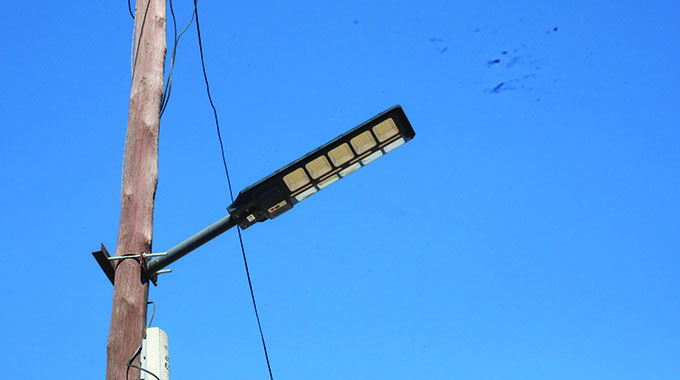
Raymond Jaravaza, [email protected]
IN response to increasing criminal activity fuelled by poorly lit streets, caused by power blackouts and, in some cases, vandalised streetlights, residents of Bulawayo’s Mpopoma suburb have launched an ambitious initiative to install solar-powered streetlights.
The solar-powered streetlights are mounted on existing Zimbabwe Electricity Supply Authority (Zesa) infrastructure and operate independently of the national power grid, providing consistent lighting even during electricity load-shedding in the suburb.
So far, residents from two streets have embraced the project, contributing US$5 per household for the purchase and installation of the solar streetlights. They hope this will deter criminals from their streets.
“We came together as residents of Block 70 and Block 71 and decided to pool money to buy solar streetlights, keeping both our streets well-lit at night, especially during load-shedding. Each household contributed US$5,” said Ms Silethemba Mpala, a resident of Mpopoma’s Block 71.
“The increasing number of muggings in our area was becoming worrisome. Residents could be mugged after alighting from a kombi before reaching their homes, some less than 20 metres from the main road.”
She noted that the two streets with installed solar lights are now well lit at night, making it difficult for criminals to hide in the darkness.
“The US$5 contribution per family isn’t excessive, but it takes unity to embark on such a project. During night-time load-shedding, our streets are so well lit that even the most opportunistic criminal wouldn’t risk robbing anyone,” she added.
Mr Prince Zulu, who finishes work at night, said he now feels safe walking home from the nearest bus stop under the bright lighting.
“Thieves target victims in dark areas to avoid identification. Attacking someone in a well-lit street is difficult, as criminals rely on quick escapes unnoticed,” Mr Zulu explained.
Ward 9 Councillor Donaldson Mabutho commended the residents’ safety initiative, particularly amid reports of machete-wielding gangs roaming Bulawayo’s streets.
“We cannot take these security measures for granted. As their local representative in Bulawayo City Council, I fully support this and hope it spreads to other areas of my ward in Mabuthweni and Mpopoma,” said Clr Mabutho.
“I’m prepared to seek technical assistance from the council’s electromechanical department to install more solar streetlights. Residents are spending their hard-earned money on the lights; the council could contribute technical expertise for installation.”
Clr Mabutho added that Mpopoma’s initiative reflects a growing trend in Bulawayo, with residents seeking sustainable, community-driven solutions to improve security amid infrastructure challenges.
Last year, Kumalo suburb residents similarly installed solar streetlights in response to rising muggings.
A Zimpapers survey revealed that most of Kumalo, including Burnham Road, now features solar-powered lights, illuminating streets that were previously dark during load-shedding.
This shift aligns with the council’s resolution to adopt sustainable energy sources for public lighting. Implementation, however, has been hindered by costs and the city’s electricity debt to Zesa, which has slowed lighting improvements in the western suburbs.



 derick.khumalo