admin
admin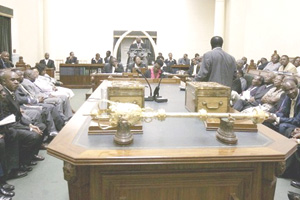
A parliament that fails to effectively carry out any of these three main functions is therefore a serious impediment to the development of democracy.
The legislative branch which is the branch under which MPs fall makes laws, the executive branch carries out or implements the laws and the judicial branch makes sure the laws are consistent with the constitution by interpreting them. Each branch has a way of checking the other two so that no one branch has too much power.
An MP is a representative of the voters to a parliament. What this entails is that they should consult the electorate on issues regarding development, welfare and any other challenges facing their respective constituencies and then take these up with Government.
MPs directly engage the relevant Government ministers or raise the issues in parliament during debates.
However, it has been reported that there have been some MPs who had been absconding Parliament and many have argued how these MPs represent their people if they do not attend parliament sessions.
Tsholotsho North MP Professor Jonathan Moyo and Mines and Mining Development Minister Dr Obert Mpofu topped the list of parliamentarians from Zanu-PF and MDC formations that were said to be absconding parliament sessions.
It was reported that several ministers and MPs attended twice to six times variably, but were absent for the better part of the life of this parliament, effectively leaving their constituencies unrepresented.
Other ministers who were absent from parliament sittings for the 32 days the House sat include Mount Pleasant MP Mr Jameson Timba of MDC-T, Binga MP Mr Joel Gabbuza of MDC-T, Beitbridge East MP Cde Kembo Mohadi of Zanu-PF and Mount Darwin South MP Cde Saviour Kasukuwere of Zanu-PF.
Also among the list were Mutoko South MP Dr Olivia Muchena of Zanu-PF, Headlands MP Cde Didymus Mutasa of Zanu-PF and Budiriro MP Mr Heneri Dzinotyiweyi of MDC-T.
Others have said MPs who abscond are more productive because they spend more time in their constituencies yet on the other hand, one of the jobs of an MP is that of law-making.
Does this therefore mean it is more important for an MP to attend parliament sessions and contribute towards the law making process or are they better off using that time to develop their constituencies?
The answer is “no”.
There has to be a way of striking a balance between the two because among the roles of an MP is that of representation. Who will represent the people if the MP is not there to do it personally?
Some of these MPs have been in the media saying they did not see the need to attend parliament yet they chose to be in a position that would require them to attend these sessions.
It is, however, interesting to note that some of the MPs that had been accused of absconding parliament have made significant strides in developing their constituencies.
Some of them have spearheaded the construction of schools and the drilling of boreholes in the areas they represent. They have taken heed of the needs of the people they represent and addressed the problems that affect them everyday. Having said that, can they be said to be neglecting their role as MPs?
While some may argue that the debilitating poverty and destitution that is afflicting some parliamentarians is what has made some of them abscond from time to time, it is an open secret that the inclusive government is cash-strapped and it has to attend to many competing interests.
Although it has been reported that some MPs cannot afford to buy a single meal in the hotels in which they are booked during parliamentary sessions, prompting them to remain at their homes instead of travelling to the capital to attend parliament sessions, providing service to the people should be a priority.
Absconding from parliament may suggest that these MPs contested for the seats with a hidden agenda. Some of them wanted the benefits that come with being an MP while others wanted the exposure they would get by being in such an office.
If an MP is not there to debate and when bills are passed, would the voice of the people they represent be taken into consideration?
Constituents have a voice that can only be heard through their MP. Therefore, if an MP absconds, there is no one to represent the thousands of people in that respective constituency.
There are parameters put in place to govern parliament and the conduct of MPs and these should be followed.
If an individual chooses to be an MP, they choose to represent the views and opinions of the people he or she represents.
A democratic state is one that takes into consideration every individual’s view and one way this may be done is by representation in parliament.
Constituents air their views to their MPs who then present these views in parliament on their behalf. People want to contribute to policies that would have a bearing towards the development of their constituencies.
For example, during the time the bill on indigenisation and economic empowerment was being debated, an MP’s interest would be how that policy would benefit an old woman in Nkayi. If there was no one to present the views of this old woman then the policy could have been passed without taking into consideration the views of the person that would be directly affected by the policy.
Meanwhile, we hear of reports of legislators that seem to be fighting for their personal comfort at the expense of the people they represent.
They want cars, more in sitting allowances and most recently residential stands in plush suburbs of Harare.
Many areas are lagging behind in terms of development, children, especially in resettlement areas, are walking long distances to the nearest schools, some areas are not accessible by public transport because of the poor state of the roads and some of these areas have no health facilities.
It is these shortcomings that the MPs should be fighting to have addressed by central Government or legislators themselves looking for donors to address these needs and the first place to start is in parliament.
MPs should play their watchdog role of ensuring that the Executive’s conduct is in line with national priorities.
They are the people’s representatives who should be pushing for the improvement of the welfare of the poor and the downtrodden.
Absconding parliament shortchanges the electorate.
Being a parliamentarian is a public duty; to serve Zimbabwe and not to have Zimbabwe serve them. Therefore, when politicians choose to be MPs, they should adhere to the conditions that come with them being MPs.



 Online Reporter