Online Reporter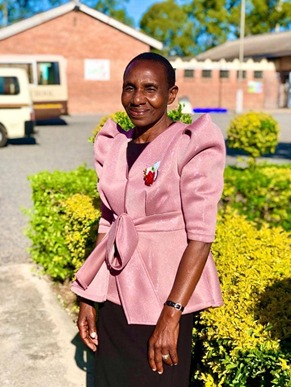
Thandiwe Chidzungu
On the outskirts of Bulawayo, in Pumula North, stands Pumula High School, a Government school registered in 1983 that today serves more than 1 700 learners with the support of over 80 teaching staff and 14 non-teaching staff.
Behind the numbers and the growing reputation of the school is a story of determination, sacrifice and leadership, and at the centre of it is Mrs Linda Ncube, whose journey from a rural childhood in Zhilo, Esigodini, to becoming head of Pumula High School is a powerful testimony to the transformative power of education.
Teaching, she believes, remains a noble calling because it has birthed all the other careers that society holds in high esteem.
A mother’s unfinished dream
Mrs Ncube is the third-born in a family of five. Her parents, MaNdlovu and Moyo received only a basic education but understood deeply that schooling could open doors they themselves had never walked through.
Their livelihood came from peasant farming, livestock and a thriving vegetable garden in the wetlands, and good rains usually meant healthy harvests that were sold locally and in Bulawayo to pay school fees and meet basic needs.
“We used to help our parents a lot,” Mrs Ncube recalls, adding that the values learnt at home shaped both their academic work and their personal lives.
Perhaps the greatest influence on her attitude to education was her mother. MaNdlovu was born into a family that valued learning, but when her father died, she was still in Standard One and had to leave school to look after cattle and fields while supporting younger siblings.
Every day she watched former classmates go to school while she took cattle to the grazing lands, and although it was a painful sacrifice, she turned that disappointment into a promise.
When she married, she was determined that her own children would get the education she had been denied, and in the evenings she turned the family kitchen into a classroom.
Using black anthill soil, she built a chalkboard measuring about 60 centimetres by one metre, and on it she taught the alphabet, syllables, word formation in isiNdebele, simple English, addition and subtraction up to Grade Three level.
“I am really grateful to my parents, particularly my mother, whose story was inspirational in our journey to education,” Mrs Ncube said.
Education against the odds
Mrs Ncube began at Zhilo Primary School in the 1970s, and although the school was close to home, there were times when she and her siblings went in ordinary clothes without proper shoes.
After Grade Five at Zhilo, the children moved to Swazi to complete primary school, staying with an uncle and maternal grandmother, and after Grade Seven, she enrolled at Matopo High School with her younger sister.
Financial pressures were mounting, and then the liberation war forced rural schools to close, including Matopo, which meant the sisters had to return home for about a year and a half.
They kept reading, however, and refused to let the interruption kill their hopes. In 1980, their older brothers found work with the National Railways of Zimbabwe and Bulawayo City Council and secured accommodation in Bulawayo, which allowed the sisters to return to school.
Mrs Ncube went to Bulawayo Adventist Secondary School, then to St. James Secondary in Nyamandlovu for Forms Three and Four, before completing A-Level at Thekwane High School with an Arts combination.
Her academic journey culminated at the University of Zimbabwe, where she obtained a Bachelor of Arts General degree.
Learning leadership one Head at a time
After university, she entered teaching, returning to St. James and later transferring to Masotsha High School in Bulawayo, where she served as Head of Department for Humanities, Senior Woman, and Acting Deputy Head.
More importantly, she worked under several Heads and observed different leadership styles that would later shape her own approach.
On 4 November 2004, she was promoted to Deputy Head at Pumula High, and barely six months later the Provincial Education Director asked her to act as Head after the substantive Head left.
It was an enormous responsibility that came during a severe economic crisis, when teachers were struggling financially, some resigned, others absconded, and many asked for transfers simply to cut transport costs.
Mrs Ncube remembers having to plead with teachers to go into classrooms, with some telling her openly that they were hungry and had left children without food at home.
Dollarisation in 2009 brought stability; teachers returned to work with renewed commitment, and the school began to regain its footing.
When the substantive Head post was advertised in January 2011, she applied and was shortlisted, and in May 2011 she was confirmed as Head of Pumula High School.
Transforming Pumula High
Under her leadership, the school has undergone a remarkable transformation. Once known by unflattering nicknames such as ePulazini, eMahlangeni, ePaka, eKasi and eMadonkini, Pumula High is now admired in its community, and discipline among both learners and teachers has improved significantly.
Academic results have also risen sharply. The O-Level pass rate has climbed from 6 percent to 41 percent despite the school being non-selective, while the A-Level pass rate has increased from 75 percent to 96 percent.
Infrastructure has expanded too, with the acquisition of three buses — a Nissan Caravan, a Nissan Civilian and a 72-seater Asia Star bus — the construction of an A-Level laboratory block for Biology, Physics and Chemistry, and the completion of the perimeter wall.
A school that looks beyond results
For Mrs Ncube, success cannot be measured by examination results alone, and she has championed holistic education that builds confidence, discipline, teamwork, creativity and practical skills.
Pumula’s Environmental Club helped the school win the national Clean Schools EMA competition in 2022, while the Scouts have won the prestigious national Assegai award.
The National Aids Council of Zimbabwe Quiz Club has represented Bulawayo Province at national competitions for 16 consecutive years, the choral music group has been among the country’s top five schools for three years running, and darts has become a major strength with the school recording the highest number of national competitors since 2023.
This story is not only about one woman. It is also about a mother who refused to let her interrupted education become her children’s destiny, siblings who sacrificed to put each other back in school, teachers who endured hard times, and a community that invested in a school so that thousands of young people could discover what they can become.