Online Reporter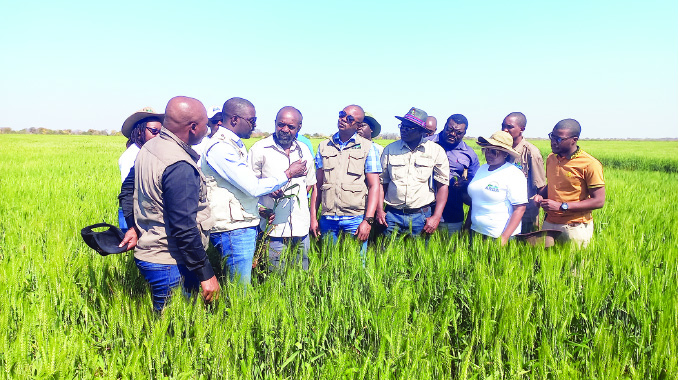
Sukulwenkosi Dube-Matutu [email protected]
THE Government has intensified efforts to boost food production and rural incomes through the installation of a second centre pivot at Mtshabezi Irrigation Scheme in Gwanda, effectively doubling the scheme’s irrigated area from 50 to 100 hectares.
The development marks a key milestone in the drive to transform irrigation schemes into productive, income-generating hubs under the Second Republic’s rural industrialisation agenda, in line with Vision 2030.
Established in 2021 after nearly nine decades of stalled plans, the scheme has emerged as a flagship project aimed at unlocking agricultural potential in the drought-prone Matabeleland South Province.
With 200 hectares of arable land and 115 farmers drawn from six villages, the scheme had previously been limited by the existence of a single centre pivot, restricting production capacity.
The chairperson of the scheme, Mr Sindiso Moyo, said the installation of the second centre pivot is a long-awaited breakthrough that will significantly scale up output.
“We are excited that a second centre pivot is now at our irrigation scheme and works are underway to get it operational. We have been operating on 50 hectares, which has limited our production. With the second centre pivot, we will now irrigate 100 hectares, allowing us to increase both food and cash crop production,” he said.
The expansion comes at a critical time, with farmers targeting winter wheat production as works to connect the new system near completion.
Beyond boosting output, the development is expected to enhance farmer incomes and support investment in mechanisation.
“If production improves, we will be able to raise funds to acquire our own equipment, such as tractors, which will also address delays we have been facing during planting,” said Mr Moyo.
Another farmer, Ms Thandekile Nkomo, said improved irrigation capacity will positively impact livelihoods.
“We were sharing proceeds from just 50 hectares, which meant low returns. Increasing the hectarage will improve our earnings and livelihoods,” said farmer Ms Nkomo.
Community leaders said the project is already transforming local economic prospects.
Mtshazo Village head Mr Roy Mayisa said the expansion reflects the Government’s commitment to uplifting rural communities.
“The Government facilitated the establishment of the irrigation scheme and has now gone a step further to install a second centre pivot at the scheme. The increased capacity is a huge boost for the entire community,” he said.
Matabeleland South Provincial Agricultural and Rural Development Advisory Services (Ardas) director, Mrs Shupikai Sibanda, said the intervention marks a major boost to food and nutrition security in a province heavily affected by climate variability.
“As a dry province, we cannot rely on rain-fed agriculture. Irrigation is essential. This expansion will increase yields, create employment and strengthen household food security,” she said.
Mrs Sibanda added that complementary works, including repairs to the Mtshabezi weir and construction of a pump house, are underway following flood damage earlier this year.
“As a province, we can’t do any sound cropping activity in this region without supplementary irrigation or full irrigation as it’s dry.
Also, considering the consequences of climate change, we definitely need climate smart technologies to address these issues.
Having a second centre pivot is a major boost for farmers operating at the scheme, community as well as the province. Production will increase and in the process increasing yields.”
Mrs Sibanda said the thrust of the Second Republic remains ensuring food security at household level.
The Mtshabezi Irrigation Scheme is part of a broader national irrigation acceleration programme targeting the development of 350 000 hectares countrywide, aimed at climate-proofing agriculture and ensuring sustainable food production.
In recent years, Government has prioritised the revival and expansion of irrigation schemes across Matabeleland South, turning previously idle or underutilised projects into productive assets.
The latest upgrade signals a shift from subsistence to commercial farming, with irrigation schemes increasingly positioned as engines for rural industrialisation, income generation and community resilience.
—@DubeMatutu