admin
admin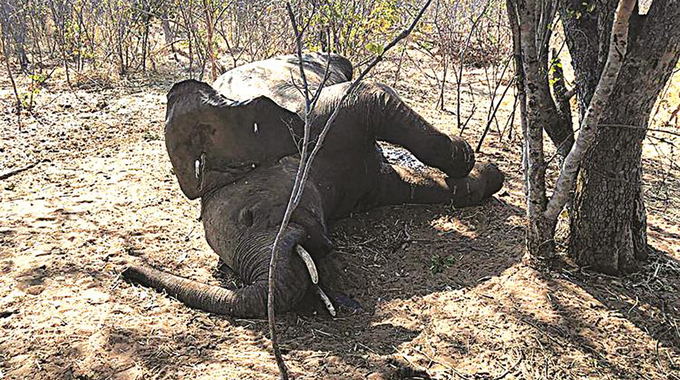
First it was Botswana that reported the mysterious death of hundreds of elephants at the country’s famed Okavango Delta in May this year. Zimbabwe, too, has now reported the mysterious death of at least 22 elephants (as at September 2, 2020) whose carcasses were discovered recently in the Pandamasue forest tucked between Hwange and Victoria Falls town. Sifelani Tsiko (ST), our Agric, Environment & Innovations Editor speaks to Zimbabwe Parks and Wildlife Management Authority (Zimparks) spokesperson Tinashe Farawo (TF) to get an insight into the crisis which has come under international spotlight.
ST: Between May and July, Botswana recorded the deaths of more than 275 elephants in the Okavango Delta. Findings for the hundreds of mysterious elephant deaths in Botswana pointed to a naturally occurring toxin as a probable cause. To what extent could you attribute the cause of death of elephants at Hwange National Park to the ones that happened in Botswana? Are they similar?
TF: There is no evidence which links the case to the deaths of elephants in Botswana. Investigations are in progress and there are indications that there was bacterial infection to the affected elephants. Elephants must be dying because they are densely populated in that area, according to our preliminary findings.
ST: Tests done on samples taken from some of the 275 carcasses found in north-west Botswana were sent to laboratories in Zimbabwe and South Africa for examination. What do the samples taken from Botswana elephant carcasses prove? What is your general comment on the results?
TF: I can’t speak on behalf of Botswana. The Botswana government has issued a statement on this. Of course, we work with them through various fora. We have taken the samples as a country and we are exploring taking the samples to other independent labs. Currently, the samples are being tested in the labs that we have in Zimbabwe — the Department of Veterinary Services, as well as private labs.
ST: What are the common ages and sex of the elephants which are dying in Zimbabwe? Could you also shed light on the signs of neurological damages that you have observed from the elephants prior to their death.
TF: The majority of the elephants are sub-adults, which means they are around five or six years, and juveniles which are less than 18 months. The oldest elephant death was 30 years and the other one around 15 or so years. The majority are young ones as I indicated. There were no obvious signs of struggle around the carcasses or spoor patterns which are indicative of neurological signs. No wounds were seen.
Internally, active worms in the digestive tract inflamed abdominal organs. So, the animals had inflamed abdominal organs, especially the spleen. Those are the key findings for now. What this means is that the animals were not poisoned, we have ruled out cyanide poisoning. Not any other animals were affected, including vultures and scavengers. We have also ruled out poaching because the tusks were intact.
ST: In which particular areas do the elephants die? What does this show?
TF: The animals died in the Pandamasue, Woodlands Forest and the Zambezi National Park. The carcasses were found close to the watering holes. This shows that these animals might have died due to stress after walking long distances in search of the precious liquid. The biggest threat to the survival of our elephants is loss of habitat. The animals are now a danger unto themselves because they are destroying their habitat and vegetation. And because of the numbers, they then move and encroach into human settlements in search of water and food, resulting in human-wildlife conflicts which have already claimed 50 lives and injured 40, some with permanent disabilities since January 2020. Some of the people injured can’t even look after themselves afterwards, not to mention the destruction of crops which has resulted in most local communities being impoverished.
ST: Dr Rob Rees, a private wildlife veterinarian, in a report, said there were four avenues of investigation into the cause of elephant deaths. He suggests deaths could be due to a) Anthrax b) Malicious poisoning c) Naturally occurring poisons d) Viral or bacterial infections. What is your general comment on these identified items and to what extent could they help explain the deaths happening here in Zimbabwe?
TF: We have already ruled out anthrax. Tests for anthrax were negative. Malicious poisoning is also out of the question, but indications are that the deaths were due to bacterial infections which are yet to be confirmed by the tests. The problems are largely emanating from the high-density populations of the animals. If you look at the age groups that are succumbing, they are young and cannot reach top branches for food and end up eating anything, including some poisonous plants. We are still investigating to prove this. Chances are high that it is bacterial infections.
ST: What scope is there for the comparison of the Botswana and Zimbabwe samples from the elephant carcasses found in both countries? Could this help inform investigations at national, regional and international level?
TF: We have always been cooperating with our neighbours, not only in times of crisis like these, but we have about six Transfrontier Conservation Areas (TFCAs) within SADC and in this particular incident we have the Kavango Zambezi Transfrontier Conservation Area. We always work with our neighbours not only for law enforcement and anti–poaching patrols, but we also do joint research together because animals know no boundaries — they can move anywhere around the region.
When we have problems, we invite our neighbours to share experiences and knowledge about wildlife issues. Our neighbours also do the same. Our relations are tight, especially under the armpits of TFCAs and government to government arrangements. That’s why the region converged in Victoria Falls for the inaugural Wildlife Economic Summit last year. The summit was hosted by President Mnangagwa and several Heads of State from the region attended. Botswana’s President Mokgweetsi Masisi also hosted an Elephant Summit and Zimbabwe also attended. That’s the kind of cooperation within the region, its supported at the highest level.
ST: Are wildlife authorities in Zimbabwe getting international support to investigate the latest spate of elephant deaths? If so, what is the nature of support coming in from private animal rights groups, NGOs and other international bodies?
TF: We continue to mobilise international support to make sure that we sustainably manage this very important resource. We work with a lot of conservation partners such as WWF, International Fund for Animal Welfare, African Parks, African Wildlife Foundation and many others. Some assist us with game water, some provide rations to our game rangers on the ground, some come in with training while others assist us with research activities.
Other bodies give us vehicles for patrol and for administrative work. We are eternally grateful for the support which is helping us to successfully conserve our wildlife. It’s not a one-man band, it’s a collective responsibility not only to benefit the current generations, but also the future ones. The numbers that we see in our national parks are not by accident, but a result of this collaborative work with our conservation partners and also good management practices under the leadership of our Zimparks director general Mr Fulton Mangwanya.
ST: What do you think needs to be done by Zimbabwe and Botswana wildlife authorities to protect elephants from these deaths and other threats such as poaching and malicious poisoning?
TF: We are on high alert and we will continue to do patrols through the use of drones and helicopters. And since we have started using drones, we have seen more arrests of poachers and less cases of poaching. The number of elephants being poached has decreased over the last three or so years. This is a result of the work we are doing as a country and as a region, that’s why SADC boasts two thirds of the remaining elephants in the whole world.
As Zimbabwe, we don’t have a specie that has gone extinct, we still have all our species although in some cases the numbers have gone down due to various reasons such as overpopulation, climate change induced droughts, habitat loss and other factors.
ST: What are your hopes for the future of elephants in Zimbabwe and others in the region?
TF: We must be proud of what we have done in terms of wildlife management as a country and as a region in general. Since the establishment of the first protected area in 1928, no park has been de-gazetted. This means we are doing something right in terms of protecting our ecosystems. We deserve a pat on the back.
Some of the criticism we get are unjustified, they are unfounded. We are doing something right, judging by the numbers of our animals in the parks. We deserve a pat on the back and not a slap. We must ensure that our people benefit from their wildlife resources. Our communities must see our animals as an economic opportunity, this is a sure way of protecting our wildlife.



 Online Reporter