admin
admin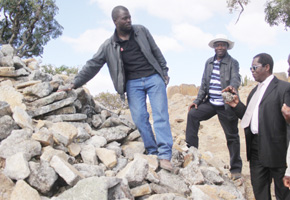
The heritage site, which is situated between Shangani and Gweru, about 27 kilometres south of the Bulawayo-Gweru highway, was last year identified as one of the 67 threatened heritage sites that needed funding for restoration, under the 2012 world monuments watch.
The monuments are attributed to the Kalanga Torwa State and are thought to date from the seventeenth century. The site is highly decorated and features all of the designs of the Zimbabwean architectural tradition.
It also features the remains of the principal hut which was damaged by early treasure hunters seeking gold.
When Chronicle visited the site on Wednesday, a team of curators was busy restoring the monuments and the NMMZ executive director, Dr Godfrey Mahachi, toured the monuments to see the progress of the restoration.
He was accompanied by the NMMZ director of the central region Mr Norbert Nhutsve, the chairman of the local board of trustees, Rtd Brigadier Petros Ngulu, a member of the board, Mr Stanford Bonyongwa and the director of research and development Mr Kundishora Chipunza.
Dr Mahachi told Chronicle that the restoration of Nalatale Monuments was part of the NMMZ conservation programme to preserve its monuments.
“We are restoring the monuments because after some years the stone walls weaken and collapse due to different weather elements and this is part of our conservation programme to make sure that the monuments are intact,” said Dr Mahachi.
“It is important for us to restore the site because it is related to the Zimbabwean culture. It is extensively decorated and one of the most beautiful cultural sites in the country.”
He said NMMZ had mobilised its own funding to do the work although they required more money to completely restore the monuments.
“We have thousands of people, especially schoolchildren from Shangani and Gweru who visit Nalatale Heritage Site every year and it is our duty to make sure that they get value for their money. We are also restoring other sites around Masvingo.”
“We mobilised our own funding to do the work and the team of curators has been renewing the site for the past two weeks although we need more funding to completely restore the site,” said Dr Mahachi.
Mr Nhutsve said NMMZ needed more than $50 000 to restore the monuments.
“We have a challenge in raising the funds that are needed to completely restore the monuments and the portion that was restored for the past two weeks cost about $4 000.
“We need more than $50 000 to completely restore Nalatale Monuments and the curators will have to wait until we get more funding for them to finish off their work,” he said.
He said NMMZ was yet to receive the funding which was unveiled by the World Monuments Fund (WMF) in November last year to restore the special heritage site.
WMF availed a $5 million grant sometime last year to support the programme over the next five years.
“We are yet to receive the funds from WMF but we decided to make use of the limited resources that we have to start the project before the walls completely collapse,” said Mr Nhutsve.
The project manager Mr Clapperton Gutu said the restoration process was based on research, as the project was meant to restore the site not to reconstruct it.



 Online Reporter