admin
admin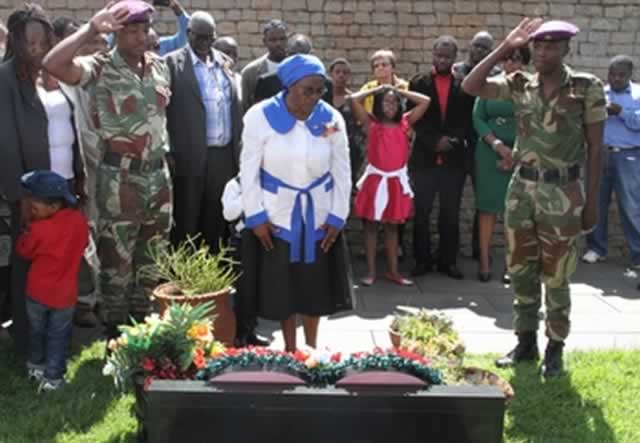
Takunda Maodza and Daniel Nemukuyu
The nation yesterday commemorated the 34th anniversary of the death of acclaimed military strategist and revolutionary icon General Josiah Magama Tongogara.
Defence Minister Dr Sydney Sekeramayi saluted the late Zanla commander for displaying unparalleled leadership capabilities during the Second Chimurenga.
Gen Tongogara died on December 26, 1979 in Mozambique as he went to tell liberation fighters that independence talks at Lancaster House had ended in agreement just six days earlier.
In a speech read on his behalf by Acting Commander of the Zimbabwe Defence Forces Air Marshal Perrance Shiri, Dr Sekeramayi said the commemorations gave Zimbabweans an opportunity to share positive memories of the astute and down-to-earth general whose devotion to the country’s liberation was incontestable.
“Personally, I also worked with this great man and his life touches me as we travelled the road to the total independence of Zimbabwe together,” Dr Sekeramayi said.
He said Gen Tongogara’s military and political exploits were second to none.
“For many Zimbabweans, particularly those that participated in the liberation struggle, the name Tongogara was synonymous with Zanla’s successful prosecution of the liberation struggle. At the inaugural commemorations held last year, His Excellency President Mugabe explicitly indicated that Cde Tongo envisioned a Zimbabwe that is free and unshackled by settler colonial racism. A Zimbabwe of equals in all spheres of human effort,” Dr Sekeramayi said.
He said King George VI Barracks in Harare – the Army headquarters – would soon be renamed Tongogara Barracks.
Last year, ZDF Commander General Constantine Chiwenga proposed renaming KGVI to Tongogara Barracks. Recently, war veterans leader Cde Jabulani Sibanda reiterated the need to honour the national hero thus.
“It is very unfortunate that today’s commemorations are being held before the final decision is made but I am quite positive that the proposals that were made by Gen Chiwenga will see the light of day,” Dr Sekeramayi said.
Present at the commemorations at KGVI Barracks were Gen Tongogara’s family, Foreign Affairs Minister Simbarashe Mumbengegwi, his deputy Ambassador Christopher Mu- tsvangwa, and service chiefs.
Dr Sekeramayi said the Josiah Magama Tongogara Legacy Foundation was working flat out to put up a cenotaph (an empty tomb or monument) at the accident site in Mozambique in recognition of “this great man, great fighter, great strategist and visionary leader”.
“As Government we may also want to recognise the great work by the Mozambican locals who have built a pole and dagga clinic at the accident site in memory of Cde Tongo by building a proper clinic and drilling a borehole which the foundation is contemplating,” Dr Sekeramayi added.
The foundation intends to establish at least one centre in each province to educate and prepare young Zimbabweans for leadership roles.
Major-Gen Douglas Nyikayaramba described Gen Tongogara as a legend.
“His death was as if the world had come to an end. Losing such a commander was very difficult to fathom,” he said, adding: “We need to celebrate the greatness of Gen Tongogara together with the family. We believe we should join them every year on this particular day to perpetuate the objectives for which Gen Tongogara sacrificed his life.”
In the morning, family, friends, senior Government officials and service chiefs congregated at the National Heroes Acre in Harare for Gen Tongogara’s memorial service and in separate interviews, they showered the late liberator with praise.
His daughter, Ms Sukai To- ngogara, said: “He used to advocate for peace and unity among Zimbabweans and I wish all Zimbabweans will remember him in that regard and carry his legacy on.”
The youngest daughter, Ms Nyaradzo Tongogara, said her father was a man of the people.
“Cde Tongogara is viewed as a person who worked for the nation and he belongs to Zimbabwe and not only to our family . . . and that is why there are many people gathered here who are not even related to us.”
Gen Tongogara’s eldest grandson, Mr Magama Tongogara, said he was proud to be named after the nationalist.
Air Marshal Shiri said: “He was a great strategist, a father figure to all of us. He is a true hero. He was one of the first Zimbabwean soldiers to receive guerilla war training in China.
“He played an important role in unifying Zipra and Zanla forces in the fight against the Rhodesian forces.
“Cde Tongogara taught us how to work and relate with the public. He should be remembered all the time for his contribution and determination in liberating Zimbabwe.”
Zimbabwe Prisons and Correctional Services Commissioner-General Major-General (Retired) Paradzai Zimondi called him a “unifier”.
“He did not fight the race but the system. He taught us to fight colonial rule and not the white race. I was commander for Manica province and I had an opportunity to travel with Cde Tongogara on several occasions.
“He would always speak of the war and the need to liberate the people of Zimbabwe.”
Maj-Gen (Retired) Gibson Mashingaidze said he had an encounter with Cde Tongogara shortly before his death.
“He had been invited to give an interview to BBC but he refused to do that before he got information from one of the commanders in the provinces.
“I was chosen, maybe because I happened to be the fastest or the closest, I do not know. I was caught up, force-marched quickly to Beira, and I was given a briefing the night before the interview.
“He wanted all the details of our operations in Manica province where I was the commissar and Cde (Paradzai) Zimondi was commander.
“I gave him everything and politically, I learnt a lot from him on that day. I learnt that we were not fighting colour but the Rhodesian system.”
Gen Tongogara was appointed military commander of Zanla and chairman of the High Command in 1972, and in 1973 he became Chief of Defence in Dare reChimurenga, the Zanu Supreme Council directing prosecution of the war.


 Online Reporter