admin
adminDr Gift Mugano Tough Talk
It is public knowledge that Zimbabwe is renowned for churning out good policies. Some of these policies have been copied by regional countries such as Botswana, Malawi, Namibia and Zambia. The current labour policy in Botswana was copied from Zimbabwe. The agricultural policies used in Zambia
and Malawi were borrowed from Zimbabwe.
It is also interesting to note that our policies are in sync with international policies. For example, the current blue print – the Zimbabwe Agenda for Sustainable Socio-Economic Transformation (ZIM-ASSET) is in line with the United Nations’ Millennium Development Goals (MDGs) and subsequent Sustainable Development Goals (SDGs). The same applies to the Indigenisation and Economic Empowerment law (community share ownership trust) is in line with World Bank Extractive Industries Initiative and the UN Charter on Sustainable Development.
This is a clear testimony that our policies are good. Interestingly, we are also well known for poor policy implementation. It is very difficult to pick out one policy which we can comfortably say we have gone through a complete policy cycle that is, setting the strategic direction, developing solutions, implementation and monitoring and evaluation.
For Zimbabwe, our policies suffer from lack of implementation. There are a number of reasons why we fail to implement policies. These include lack of sufficient consultations during the development of the policies, weak institutions, lack of resources and lack of national consensus. With brutal frankness, this week’s discussion focuses on the business case for the need for national consensus in order to unleash our economic potential.
For starters, it is important to acknowledge that as a country we have lost national pride, patriotism and dignity. The challenge ahead of us of turning the fortunes of this country is a smaller task as compared to the one which was fought by our fathers and mothers – the liberation struggle. The struggle was a matter of life and death.
Our comrades were very committed notwithstanding serious atrocities committed by the Smith regime and intense propaganda which was paddled by the same regime aimed at discouraging more comrades from joining the struggle. As a matter of a fact people died in thousands but the comrades never gave in until the mighty British army surrendered!
Sadly, the attitude of the current crop of people in Zimbabwe would not have won the struggle nor ever tried to fight.
What is awaiting us is a much simple task – policy implementation and economic patriotism. Implementing policies will neither lead to death nor injuries. Politics and polarisation and limited consultation have been main factors contributing to lack of consensus and hence policy failure.
With respect to policy consultations, yes, for a number of years Government carried out limited consultations. This situation resulted in policies suffering from lack of ownership. As a result, it was both costly and difficult to implement them. This was understandable.
In recent years, especially from October 2013 when the ZIM-ASSET was launched way to early 2014, Government has embraced inclusivity through public private dialogue (PPD) through various taskforces and clusters which were developed under the ZIM-ASSET.
These clusters are represented by both Government and private sector including their leadership – they are co–chaired by Government and private sector. To buttress this, the National Economic Consultative Forum (NECF), a local think tank, developed a PPD guide which was launched in July this year by the Chief Secretary to the President’s Office, Dr Misheck Sibanda.
The PPD guide was built on already existing consultations practices and other international best practices aimed at insuring inclusivity in policy formulation, implementation and review. This guide was adopted by Government. Hence, the argument that policies failed due to lack of consultations has been put to rest.
With respect to politics and polarisation, we have allowed politics to rule our minds at the expense of business. We have become a nation of politics. For the last fifteen years, we have entrenched ourselves in politics forgetting about bread and butter issues and selfishly keep our minds blared for each five-year period because of the event which happens in a day – elections! I am not underrating the importance of politics in the economic governance but we can’t become slaves of politics.
Because of politics, we have rejected Government policies not on merit but on political grounds.
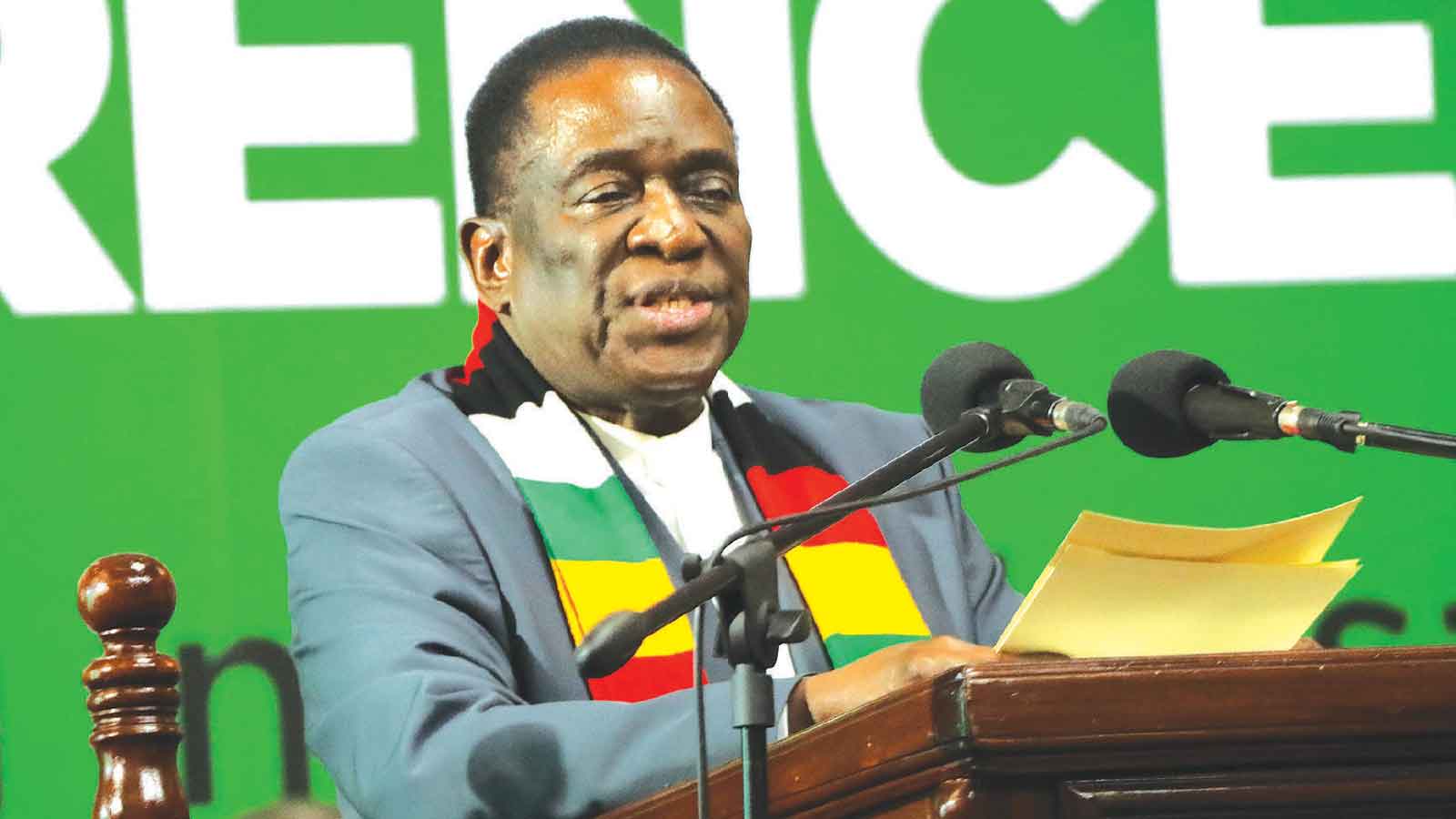
A good example is the recent state of the nation address (SONA) by His Excellency, President Mugabe. Some quotas have criticised the SONA as clueless and not in sync with economic reality yet one don’t need to be a rocket scientist to know that the SONA is panacea to economic challenges. The SONA covered ten points, that is:
Revitalising agricultural and the agro-processing value chain;
Advancing beneficiation and/or value addition of agricultural and mineral resource endowment;
Supporting infrastructure development in key sectors like energy, water, transport and Information Communication Technologies (ICTs);
Unlocking potential of Small to Medium Enterprises (SMEs);
Encouraging private sector investment;
Restoration and building of confidence and stability in the financial services sector;
Promoting joint ventures and public private partnerships (PPPs) to boost the role and performance of state owned companies;
Modernising labour laws;
Pursuing an anti corruption thrust; and
Implementation of special economic zones to provide impetus for foreign direct investment.
The thrust to revamp agriculture is centred on the importance of agricultural sector in the supply of raw materials to manufacturing sector, employment creation and its contribution to the gross domestic product (GDP).
Issues of value addition and beneficiation are of paramount importance in the face of volatile commodity prices which have negatively affected our export earnings. We can only arrest this by producing value added goods which will not only have stable prices but also get higher returns for the country.
In the same vein, the call by His Excellency to put measures aimed at attracting foreign direct investments (FDIs) alongside modernisation of labour laws, pursuing an anti corruption thrust and restoring confidence in the financial sector are important measures which are in sync with the economic demands.
Lastly, the call to put measures to unlock potential in SMEs is timely considering that the economy has shifted into SMEs. The same applies on the need to support infrastructures. There is no economy which can grow without infrastructures like energy, transport, water and ICTs.
There is no other alternative SONA which His Excellency could have read unless if we are reading from different books of economics.
I guess the question which people wanted the President to address is the how part of it. Unfortunately or fortunately, we are supposed to respond to the SONA in our various constituencies and answer the how part and move into action.
So what should we do? We must disarm ourselves from treacherous politics. Business, for example, must see Government policies/pronouncements as opportunities to make money.
For example, private companies (banks, agro-processing, seed houses, etc) in agriculture value chain should engage Government on how to address matters raised by the President of agriculture. These could be issues regarding policy incentives/issues on local content, business linkages and contract farming.
Here, they have bargaining power which will be good to everybody because they are coming under the banner of implementing SONA which is the President’s desire.
For individuals, we need a paradigm shift of our mindset from the one that is polarised to the one that is developmental. We are our own ambassadors of our beloved country wherever we are we must talk positively, sleep and dream positively.
No doubt, the economy is our collective responsibility. If we are getting sacked everyday it is our responsibility. We cannot blame the wind for drying our lips if we don’t leak them.
South Koreans, for example, in the face of poverty in the 1970s (poor than Ghana) with only one mineral resource, that is, limestone, they accepted the fact that the economy was in their hands. In this regards, they initiated a village movement which was called Saemaul Movement.
This was a diligent and self-help programme and collaboration were the slogans to encourage community members to participate in the development process. The United Nations accepted this model as one of the efficient rural development models in the world. The movement has been exported to more than 70 countries, sharing the rural development experience world-wide.
Economics behaves in a self fulfilling prophecy. If we believe that it is impossible then it will become impossible. True to the South Korean case, the Koreans’ motto was that “we can do it”. Today, South Korea is now a rich economy and is a proud manufacturer of international brands like Samsung, Hyundai, Kia Motors, LG, etc.
We won the struggle because we believed in ourselves no matter how painful it was. In our collective numbers we can do it again!
Iwe neni tine basa!
Mina Lawe Silomsebenzi!
- Dr Mugano is an Economic Advisor, Author and Expert in Trade and Competitiveness. He is a Research Associate of Nelson Mandela Metropolitan University. Feedback: +263 772 541 209 or [email protected]



 Online Reporter