Online Reporter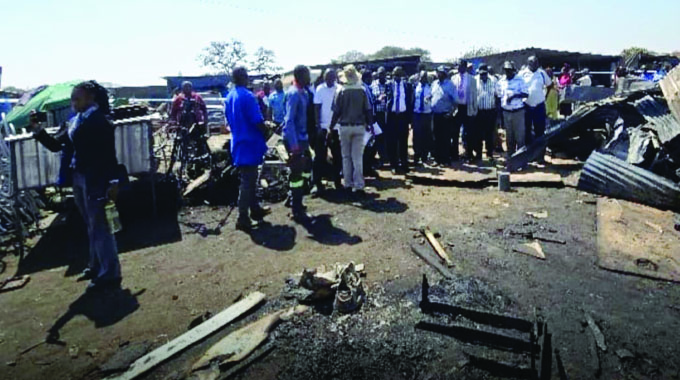
Gibson Mhaka, Senior Features Writer
IN the wake of a devastating fire that swept through Gweru’s DST Market recently, Ms Netsai Phiri, a trader, was left to confront a scene of utter desolation.
Her voice, heavy with grief, was one among many echoing the tragic fate of a community’s livelihood.
“I lost nearly all my stock. The fire broke out around mid-morning and it destroyed all that was in its path. An assortment of goods, including wardrobes, headboards, kitchen units, sofas, sewing machines, fridges, and generators, were burnt to ashes,” she said.
The flames had not only consumed stalls of furniture, clothing, and textiles but had also reduced electrical appliances to mangled heaps of metal.
For Ms Phiri and others, it wasn’t just goods that were lost; it was a lifetime of hard work, dreams, and a secure future turned to ash in a single, cruel moment.
The tragic DST Market fire, which affected over 50 traders, is a stark reminder of a larger national crisis.
The Glen View furniture-manufacturing complex in Harare, for instance, has on several occasions been affected by mysterious fires, with traders losing goods and raw materials almost every year.
In August, a devastating blaze at the complex, one of Zimbabwe’s largest informal industrial hubs, destroyed furniture workshops and stockpiles of timber and upholstery materials.
With 3,4 million small and medium-sized enterprises (SMEs) operating in the country, employing 4,8 million people and contributing a significant US$8,6 billion to the Gross Domestic Product (GDP), the sector’s growth and resilience are crucial to achieving the United Nations’ 2030 Agenda for Sustainable Development and the nation’s Vision 2030.
However, without insurance, the entire sector remains vulnerable to sudden shocks.
The Insurance and Pensions Commission (Ipec) has urgently called on SMEs to prioritise insurance coverage, highlighting its critical role in protecting assets and ensuring business continuity.
According to Ipec Public Relations Manager, Mr Lloyd Gumbo, a lack of insurance means that incidents like the recent fires, which have destroyed property worth hundreds of thousands of dollars, have devastating consequences.
“Taking into account some recent incidents that saw property worth a million United States dollars being razed down by fire, it is important for SMEs to be insured.
“Working with the Insurance Council of Zimbabwe and the Ministry of Women Affairs, Community, Small and Medium Enterprises Development, trainings are being rolled out to conscientise SMEs on the importance of risk management, particularly around insuring their wares so that in the event of any mishap, insurance will then come in to protect them and help them recover from losses.”
While many small business owners avoid insurance due to concerns about profit margins, it is a crucial tool for financial stability.
One of the biggest obstacles for SMEs is the myth that insurance is out of reach. This is where insurance brokers play a vital role.
Unlike insurance agents who represent a single company, a broker works for the client, bridging the gap between business owners and the complex insurance market.
They simplify the process by first conducting a thorough risk assessment to understand a business’s specific vulnerabilities.
Based on this, they provide tailored advice and compare different products from various insurers to find the most suitable and cost-effective policies.
For an SME, this partnership with a broker is essential for finding affordable coverage that ensures resilience against unforeseen challenges, protecting their businesses and livelihoods for long-term success.
Ms Beaulah Nkomo (44), a trader at Mutize Flea Market in Bulawayo, popularly known as “Little Musina”, which was gutted by fire two years ago, said the primary reason why many SMEs don’t get insured is the perception that it’s too expensive.
“Many SMEs don’t get insured because of the perception that it’s too expensive. Many small business owners, operating on tight budgets, view insurance premiums as a significant and unnecessary cost rather than a vital safeguard.
“This belief is often fuelled by a lack of awareness about the different types of affordable coverage available and the potential financial ruin that could result from unforeseen events like theft, fire, or legal action.
“Consequently, they choose to risk their assets and business continuity to save money in the short term,” she said, adding that after receiving awareness from an insurance broker, she has realised the importance of insurance.
Brokers directly address this by working for the client, not the insurer. Ultimately, a broker transforms insurance from a distant, confusing service into a tangible tool for resilience and long-term success.
Secretary-General of the Insurance Brokers Association of Zimbabwe (IBAZ) Dr Richard Mutyavaviri said an insurance broker is a very essential partner for Small and Medium-sized Enterprises as they are an intermediary who acts with complete freedom in the negotiation and arrangement of insurance cover on behalf of clients.
“His or her role includes finding appropriate cover for clients at the right price and with the right insurer.
“Given the fires that have been ravaging the Gweru’s DST Market and Glen-View complex in Harare, insurance broker’s need to educate these small scale entrepreneurs on the importance of insurance.
“Insurance operates on the principle of indemnity, which seeks to put back someone to the same financial position that they occupied before the loss.
“This will ensure continuity in the way these people have been doing business. Losses are paid for and there is no disruption in their livelihoods,” said Dr Mutyavaviri.
He said there is a misconception about insurance that often happens in circles where members of the public think that insurance is expensive and only meant for the rich.
“This is not true, small scale businesses can also be covered with tailor-made insurance products that can suit their pockets while enjoying full cover against losses in the event of fire, theft or accidental damage to their properties.
“Insurance brokers therefore have a duty to educate the public on the need to be insured if one is in business irrespective of the business size.
“Brokers are able to carry out an assessment of their business and advise on what could go wrong, how bad the situation can be after the loss and how best one can protect themselves against such eventualities.
“Their duty does not end with the purchase of insurance alone, but they also go on to give free advice on how one can minimise and avoid such losses in future,” he said.
Dr Mutyavaviri said educational campaigns that brokers can lead to build trust include coming up with road shows where members of the public, especially SMEs, are given knowledge about insurance.
“One area that should not be left out is to educate the general populace about insurance using our own indigenous languages.
“Currently, insurance is offered in foreign languages, especially English at the expense of our own local languages.
“As we speak, the insurance industry is working on modalities of how best the subject of insurance can also be introduced in schools at junior level.
“There is a general consensus that this subject must be taught from the grassroots level so that everyone is very much aware of the risks that face businesses at each and every level of their life-cycle.
“We are also happy that the Government is currently at the centre of spearheading financial inclusion as this will also witness SMEs being given the right knowledge and tools to participate in all financial activities affecting the country’s small scale entrepreneurs,” he said.
Another insurance expert, Mr Felix Dube, emphasised that a broker transforms insurance from a distant, confusing service into a tangible tool for resilience and long-term success.
“They demystify the process, which is a major obstacle for many business owners who are unaware of their specific risks or the types of coverage available,” he said.
“Brokers conduct thorough risk assessments to identify a business’s vulnerabilities, from fire and theft to liability and business interruption.
“They then translate that into a clear, understandable insurance plan, ensuring you get the right policy without paying for unnecessary coverage.”
According to Mr Dube, brokers also make insurance more affordable.
“They shop the market to find policies that offer the most suitable coverage at the best possible price.
“They can negotiate on your behalf and find products with lower premiums or flexible payment options that fit tight budgets. This financial guidance turns a seemingly unaffordable service into a practical and necessary business expense,” he explained.
It is clear that while the short-term cost of insurance may seem prohibitive to SMEs operating on tight budgets, the long-term benefit of safeguarding a lifetime of investment is invaluable.
The partnership with an insurance broker transforms this vital safeguard from an intimidating expense into a strategic asset, providing not only protection against catastrophic losses but also a clear pathway to sustained growth and stability in an increasingly unpredictable business environment.