Online Reporter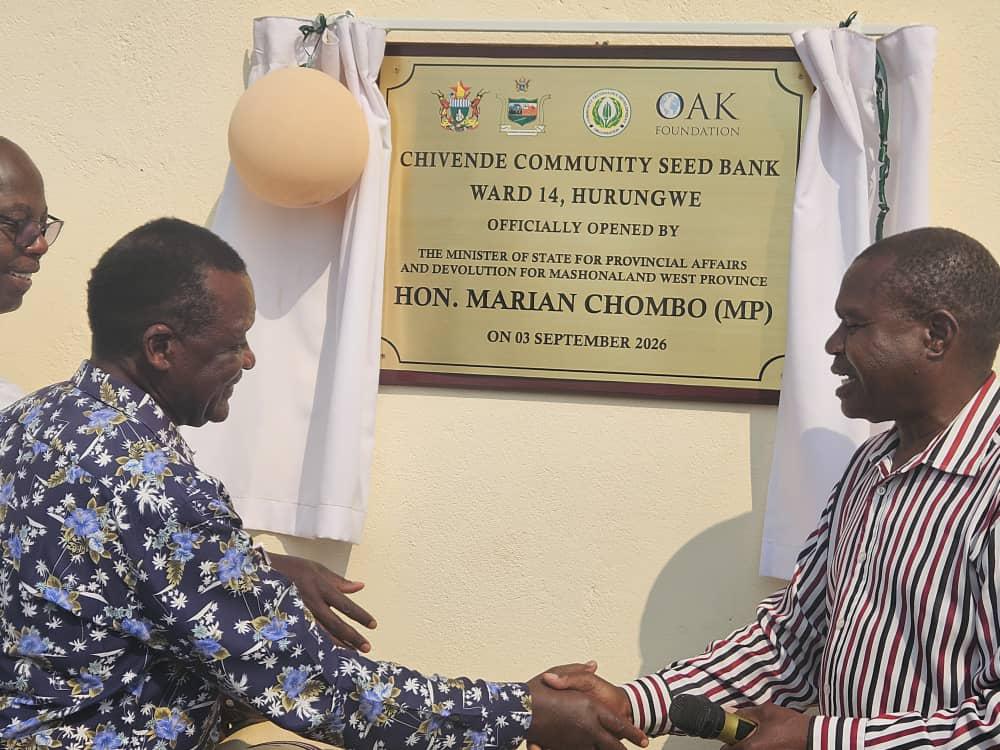
Sifelani Tsiko in HURUNGWE
A NEW community seed bank has been opened in the Chivende area of Ward 14 Hurungwe District in Mashonaland West Province to strengthen resilient seed systems and enhance food security.
Opening the Chivende Community Seed Bank, in a speech read on her behalf by Mr Andrew Tizora, Minister of State for Provincial Affairs and Devolution for Mashonaland West, Marian Chombo said the new facility stands as a direct expression of devolution at work.
She said it demonstrated how resources, planning, and development are taking root exactly where communities need them most.
“It is my strong belief and understanding that the establishment of this structure serves specific and important purposes and objectives,” the Minister said.
“Of particular importance is its focus on addressing seed and food security in the context of a changing climate.
“I am particularly impressed by the fact that the community has already taken the initiative to collect and preserve important indigenous and farmer-managed seed varieties for storage, management and future use.”
To strengthen resilient seed systems, Community Technology Development Organisation (CTDO) with support from the OAK Foundation, Government and other multilateral partners built the Chivende CSB under the
Community Seed Banks for Regenerative Agriculture Project.
The CSB is one of 34 facilities that have been built by CTDO in partnership with various local communities across the country to conserve crop diversity.
This new facility will target to conserve accessions such as sorghum, pearl millet, finger millet, bambara nuts, cowpeas, indigenous vegetables and locally adapted tree species, protecting agricultural biodiversity while strengthening farmers’ access to resilient seed.
The seed bank is connected to national and regional gene banks, helping safeguard locally adapted varieties and linking community conservation efforts to wider plant genetic resource networks.
Zimbabwe is bringing an important design innovation through new functions at the CSB.
Apart from seed storage, the CSB has Wi-Fi connectivity that links farmers and seed bank curators to the world, expanding access to agricultural information, research institutions and knowledge-sharing networks.
The youth will have free access to Internet as part of expanded functions of the CSB that include solar powered boreholes to provide water for gardens, farmer field schools, irrigation, crops and livestock.
CTDO led the development of the seed bank and community seed systems. Agricultural extension officers are supporting farmers with seed selection, multiplication and cultivation through Farmer Field Schools.
Mr Andrew Mushita, Executive Director of the Community Technology Development Organisation (CTDO), said the facility will strengthen both seed conservation and the exchange of knowledge among farmers.
“Today is not simply about officially opening a new building or facility. It is about investing in the future of our communities, agricultural systems, environment and most importantly, the resilience of future generations,” he said.
The establishment of Chivende Seed Bank, Mr Mushita said, reflected his organisation’s collective commitment to ensure that farmers have access to quality, locally adapted and climate-resilient seed. He said the CSB will strengthen the communities’ capacity to conserve, manage and sustainably use agricultural biodiversity.
The rich agrobiodiversity of Zimbabwe is under unprecedented threat, experiencing a dramatic loss of many valuable local varieties and wild relatives of main crops.
The introduction of modern varieties (hybrids) has led to a decrease and in some cases extinction of crop genetic diversity in traditional farming communities in the country.
CSBs are widely recognised for their potential to enhance seed and food security and support climate-change adaptation.
Government under NDS2 is targeting to construct 100 CSBs across the country.
“Its the first huge intervention which has taken place on Mashonaland West in terms of build climate resilient agricultural systems,” said Mr Mushita.
Community seed banks are places where seeds are stored primarily to share, through seed swaps or other events. Farmers often donate seed to the community bank after a good harvest.
When they don’t have enough seed for planting, they borrow from the seed bank.
According to the UN Food and Agriculture Organisation, the diversity of cultivated crops declined by 75 percent during the 20th century and a third of today’s diversity could disappear by 2050.