admin
admin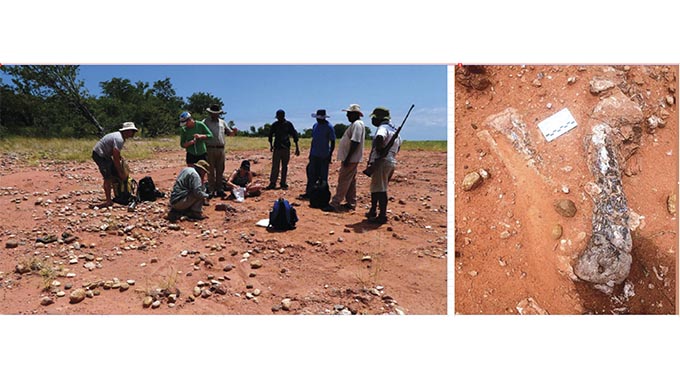
Sifelani Tsiko
Innovations Editor
A new species of dinosaur has been discovered in the ground on Spurwing Island at Lake Kariba, the world’s largest man-made lake and reservoir by volume.
Scientists have dubbed the newly-found fossil, Musankwa sanyatiensis.
This becomes the fourth dinosaur species named from Zimbabwe.
The research unravelling this major heritage discovery was published in Acta Palaeontological.
An international team of scientists made up of researchers from the University of the Witwatersrand (Wits) in South Africa, the Natural History Museum of Zimbabwe and Stony Brook University in New York, conducted the study.
Professor Paul Barrett from the Natural History Museum in London was the lead researcher.
The publication said the discovery of Musankwa sanyatiensis is particularly significant as it is the first dinosaur to be named from the Mid-Zambezi Basin in more than half a century.
The latest discovery follows the descriptions of “Syntarsus” rhodesiensis in 1969, Vulcanodon karibaensis in 1972, and, most recently, Mbiresaurus raathi in 2022, according the publication.
A report by the Wits University said the rocks yielding this new specimen date back to the late Triassic period, approximately 210 million years ago.
Researchers said Musankwa sanyatiensis is represented by the remains of a single hind leg, including its thigh, shin and ankle bones.
“Despite the limited fossil material, these bones possess unique features that distinguish them from those of other dinosaurs living at the same time,” Dr Kimberley “Kimi” Chapelle, assistant professor at Stony Brook University and an honorary associate at the Evolutionary Studies Institute at Wits was quoted saying.
The evolutionary archaeologists named Musankwa sanyatiensis after the houseboat “Musankwa”.
In the Tonga dialect, “Musankwa” means “boy close to marriage”.
The report said this vessel served as the research team’s home and mobile laboratory during two field expeditions to Lake Kariba in 2017 and 2018.
The vessel was provided generously to the research team by David and Julie Glynn, and the crew — Coster Katupu, Godfrey Swalika, Simbarashe Mangoroma, and Never Mapira — who provided essential logistic support.
Researchers say an evolutionary analysis reveals that Musankwa sanyatiensis was a member of the Sauropodomorpha, a group of bipedal, long-necked dinosaurs that were widespread during the Late Triassic.
“Interestingly, this dinosaur appears to be closely related to contemporaries in South Africa and Argentina. Weighing in at around 390kg, the plant-eating Musankwa sanyatiensis was one of the larger dinosaurs of its era,” a Wits University report suggested.
“Africa has a long history of dinosaur discovery, with the first dinosaur in the southern hemisphere found in South Africa just three years after the term “dinosaur” was coined by Sir Richard Owen in 1842.”
Researchers noted that most known dinosaur fossils have been found in just 10 countries, particularly in the northern hemisphere, leading to a sparse representation of African dinosaur diversity in the global fossil record.
“The main reason for the under-representation of African dinosaur fossils is ‘undersampling’,'” Barrett was quoted saying in Wits University report.
“Put simply, there have been fewer people looking for and unearthing dinosaurs in comparison with other regions of the world.”
Even though Africa has a small number of known discoveries, researchers said many of these fossils are “historically and scientifically significant.”
The researchers said these include some of the oldest dinosaurs, like Nyasasaurus parringtoni from Tanzania and Mbiresaurus raathi from Zimbabwe, as well as rich dinosaur faunas from South Africa, Tanzania, Niger, and Morocco.
“The Late Triassic-Early Jurassic sediments of Zimbabwe are crucial for understanding the End-Triassic extinction, a catastrophic event that dramatically reshaped Earth’s biodiversity around 200 million years ago,” the Wits University report noted.
“These different layers provide insights into how different fossil-bearing sediments around the world correspond in age and help in piecing together the global picture of prehistoric life.
“This new dinosaur species also highlights the untapped potential of the region for further palaeontological discoveries.”
Said Barrett: “Over the last six years, many new fossil sites have been recorded in Zimbabwe, yielding a diverse array of prehistoric animals, including the first sub-Saharan mainland African phytosaurs (ancient crocodile-like reptiles), metoposaurid amphibians (giant armoured amphibians), lungfish, and other reptile remains.”
The researchers said as more fossil sites are explored and excavated, there is hope for uncovering further significant finds that will shed light on the early evolution of dinosaurs and the ecosystems they inhabited.
“Based on where it sits on the dinosaur family tree, Musankwa sanyantiensis is the first dinosaur of its kind from Zimbabwe,” Dr Kimi Chapelle was quoted saying in the Wits report.
“It, therefore, highlights the potential of the region for further palaeontological discoveries.”



 Online Reporter