admin
admin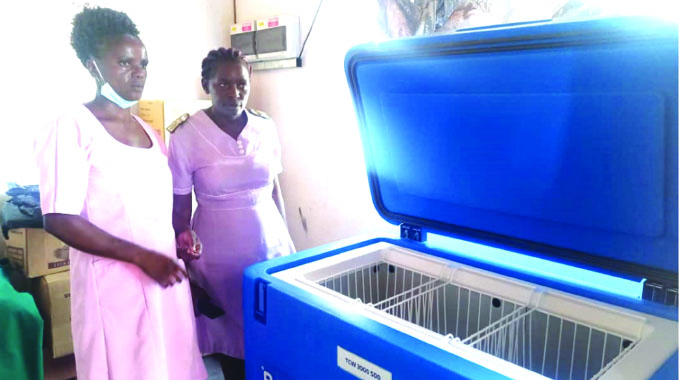
Sifelani Tsiko Agric, Environment & Innovations Editor
For years, lack of electricity has been a nightmare for Mariga Clinic, the main healthcare centre for the Doma community in Kanyemba, about 393km north of the capital, Harare.
This centre in the dry and arid region of the northern end of the Mid-Zambezi Valley had to grapple with how to keep Covid-19 and all childhood vaccines at the right temperature for a long period of time.
Apart from this, logistical challenges added to the woes.
Mariga Clinic is about 105km from Chitsungo District Hospital, another major healthcare centre in Mbire district often used in the supply chain for the vaccines.
Distance alone was a major disruptive factor of the cold chain distribution network for Covid-19 and other vaccines for children that require seamlessly low temperatures from manufacturers to airports to remote rural villages such as here in Mariga.
Lack of reliable power and solar fridges meant limited Covid -19 vaccine access and a high child mortality rate for many that could not be inoculated against diseases such as measles among others.
“It is very hot here in Kanyemba. It is so remote and before we got the solar fridges we had limited storage capacity for vaccines,” said Mindy Chipokoza, district nursing officer for Mbire District.
“Most vaccines require cooling at between 2 and 8 degrees Celsius and it was so hard for us to maintain the cold chain for the vaccines. We faced logistical challenges just to restock.
Chitsungo District Hospital is about 105km from here, the road is bad and this has serious implications for access to vaccines for the Doma community and other people here in Kanyemba.”
Through funding support from the Japanese Government working with UN Women and through a project implemented by the Lower Guruve Development Association (LGDA) titled: ‘Prevention of Covid-19 infection among vulnerable women and girls in drought-affected districts of Guruve and Mbire of Mashonaland Central,’ – Mariga Clinic and two other healthcare centres got solar –driven vaccine fridges.
This quiet revolution in refrigeration that keeps vaccines cold, even in places without reliable electric power is helping to improve vaccine storage, Covid -19 and other childhood immunisation programmes in Guruve and Mbire district.
“Mariga Clinic is in a dry and remote part. The road is bad and the supply chain for vaccines when they run out becomes complicated and expensive,” said Tavirai Marega, an LGDA programmes coordinator.
“Without a refrigerator they would only get a few stocks that could work within the cold chain limit.
“It was cumbersome to restock and it was difficult to access vaccines when the nearby Mwazamutanda river became flooded.”
LGDA, through support from the Japanese government working with UN Women, procured four solar fridges at a cost of US$38 000 from Luxembourg in Europe.
The fridges were distributed to Mariga Clinic and Mushumbi Clinic in Mbire and Mahuwe Clinic and Guruve District Hospital in Guruve.
“The solar fridges have expanded vaccine storage capacity for the healthcare institutions. They are solar powered and even if it is overcast, they can maintain temperatures of between 8 degrees Celsius and -2 degrees Celsius for four days,” Marega said.
Said Chipokoza: “We are so grateful to the Japanese government, UN Women and LGDA for this support. The solar fridges will help us to increase the storage capacity for vaccines for Covid-19 and for immunisation of children under 5.
“I am confident that we will improve the vaccination of the Doma community and many other people in Mbire district. We are going meet our vaccination targets for our district.”
Solar refrigerators will help boost both adult and child vaccinations in Mbire and Guruve districts.
These new solar freezers make it possible to allow doses to be distributed, stored and eventually administered to people in the remote Kanyemba area with no electricity.
This is good news for us here. We are not being left out in the push by our Government to have all people vaccinated against Covid-19 and for our children under five to be vaccinated against diseases such as polio and measles,” said Elizabeth Muveteri of Chanzato Village in Kanyemba.
Said Shelter Dirawu of Chanzato village: “I am so grateful about this project. We want it to continue so that it can help us improve our access to healthcare services and to improve our livelihoods.”
Boyd Zhuwanetu of Chanzato village said the donation of the solar fridge to Mariga Clinic will help increase the number of people in need of vaccination in Kanyemba.
“We thank LGDA, the Japanese government and UN Women for supporting us with the fridges. We need our vaccines to be kept under correct conditions so that our people are vaccinated with drugs that work for them,” he said.
“I have received my third booster shot and I have come to accept the importance of Covid-19 vaccination. No one should be left behind when it comes to vaccination. We are spreading the message and even the Doma people are now coming for vaccination.”
Many rural healthcare centres in remote parts of the country without electricity used to have outdated kerosene-powered refrigerators that would often break down, damaging or destroying vaccines.
Gas-powered refrigerators were never used as they were expensive with similar cost runs such as kerosene powered ones.
First-generation solar refrigerators were an improvement, but they had storage batteries that often stopped working after two to three years and were hard to replace.
Solar direct – drive refrigerators are bringing in new changes — improving the efficiency of vaccine storage in healthcare institutions in Zimbabwe and most other parts in Africa.
These are improving vaccines storage at the right temperature for a long period of time and having people access them regardless of where they live.
Some rural healthcare centres do not have working refrigerators and there is a renewed drive to equip them with direct — drive solar units to push up monthly immunisation sessions in rural areas.
Energy is at the heart of all efforts aimed at attaining the country’s Vision 2030 of becoming an upper middle income economy, as well as a major driving force behind the attainment of all Sustainable Development Goals (SDGs).
In Zimbabwe, energy still remains a key enabler for many SDGs — from expanding access to electricity, to improving clean cooking fuels, from reducing wasteful energy subsidies to curbing deadly air pollution that each year prematurely kills thousands of people around the country.
SDG 7: Affordable and clean energy aims to ensure access to affordable, reliable, sustainable and modern energy for all by the end of the next decade, speaks clearly about the importance of energy in the country’s national development agenda.
Zimbabwe has a two percent contribution of renewable energy in its own energy mix and energy experts say it is possible to grow it to about 5 percent by 2030.
And, the revolutionary new generation of solar fridges may prove crucial in all efforts to immunise Zimbabweans in rural areas against Covid-19 and other childhood immunisation programmes.
“All we need at the moment are these new direct solar refrigerators so that we can improve the vaccination of people in hard to reach areas such as Kanyemba and others,” said Marega.
“Solar powered fridges are the way forward for rural healthcare centres in remote areas without electricity.”



 Online Reporter