Online Reporter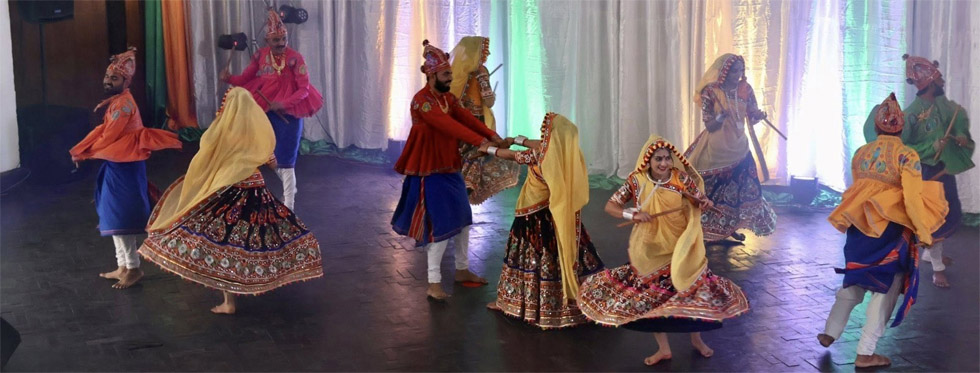
Liberty Dube
Entertainment Correspondent
IN a dazzling display of colour, rhythm and cultural unity, Sanskruti Dance Academy, an acclaimed Indian folk dance group, lit up Mutare Hall on Wednesday afternoon during the Lok Kala Sandhya (Folk Dance Evening).
The performance, which formed part of a cultural exchange initiative, saw audiences treated to a rich tapestry of India’s traditional music and dance.
Comprising five male and four female dancers, the group captivated the audience with their elegant, high-energy performances, seamlessly blending intricate footwork, expressive hand gestures, and vibrant costumes.
The dancers, ever-smiling and adorned in colourful traditional attire, turned the venue into a celebration of culture and unity.
At the heart of this initiative is Sanskruti Dance Academy, led by Anjanaben Devprasad Agravat.
The academy is committed to preserving and promoting India’s diverse folk traditions.
Under Agravat leadership, the group has performed across the globe, including in Dubai, Oman, Qatar, Syria, Egypt, Hungary, Algeria, Zimbabwe, Malta, Indonesia, Seychelles and Tanzania, showcasing India’s cultural heritage through dance and artistic expression.
Speaking on the sidelines of the event, India’s Ambassador to Zimbabwe, His Excellency Mr Bramha Kumar, lauded the performance and reaffirmed the strong cultural and diplomatic ties between Zimbabwe and India.
“Zimbabwe and India share a great relationship — not only politically, but also culturally and socially. Today, we witnessed yet another excellent performance from an Indian group. These exchanges continue to bring our peoples closer.”
He acknowledged the role of the Indian Council for Cultural Relations (ICCR) — an autonomous body under India’s Ministry of External Affairs — for facilitating and sponsoring the Sanskruti Dance Academy’s tour to Harare, Bulawayo, and Mutare.
Ambassador Kumar added: “The ICCR has played a pivotal role in deploying cultural troupes like Sanskruti as part of India’s efforts in cultural diplomacy. Since 1950, ICCR has been India’s leading institution for promoting cultural exchanges and people-to-people connections across the globe. Since the time of liberation struggle of Zimbabwe, India and Zimbabwe become politically connected too.
Strong friendly and steadfast bilateral relations have been instrumental to further cementing cultural contacts between peoples of our countries.
Immediately after Zimbabwe’s independence, India and Zimbabwe signed Memorandum of Understanding (MoU) on Cultural Cooperation, which provided an enabling framework to strengthen cultural aspect of India-Zimbabwe bilateral relations.
From time to time, exchange of cultural groups between our countries has added vibrant colours in our already strong people-to-people contacts.”
With 38 Cultural centres worldwide and 19 Regional Offices in India, the ICCR also offers nearly 4,000 scholarships annually to students from over 140 countries, organises Festivals of India Abroad, and fosters collaboration in the areas of dance, music, yoga, art, and literature.
Ambassador Kumar also highlighted previous collaborations, including the Namaste Zimbabwe festivals in 2022 and 2023, which brought a variety of Indian cultural performances to multiple cities across Zimbabwe.
Ambassador Kumar further spoke about the expanding educational and economic partnerships between the two countries:
“India stands as one of the top destinations for Zimbabwean students seeking world-class higher education. With around 5 000 Zimbabwean students currently studying in India, this vibrant academic exchange underscores our shared commitment to progress and knowledge. Indian investors have poured in over US$600 million across various sectors, generating more than 15 000 direct and indirect jobs for Zimbabwean youth. Our bilateral trade is also on the rise, reaching US$260 million in the last financial year,” he added.