Timothy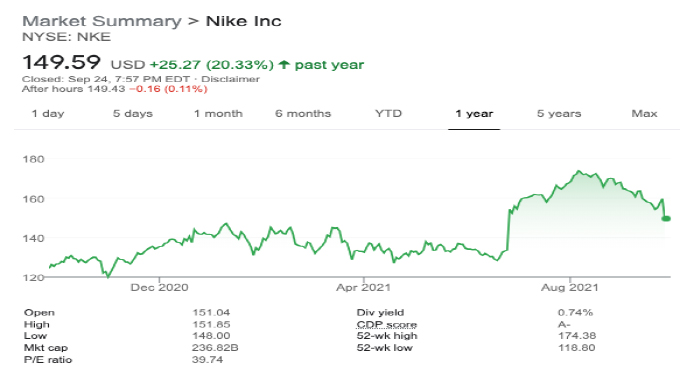
The global sports footwear & apparel behemoth missed revenue expectations — US$12,2 billion actual vs. US$12,46 billion expected — and lowered its fiscal 2022 outlook, but also slightly beat earnings per share (EPS) expectations — US$1,16 actual vs. US$1,12 expected — due to the companies ability to sell more goods to shoppers at full price.
Still, Nike ($NKE) watched its stock drop more than 6 percent on Friday, which now sits nearly 14 percent below its prior all-time-high, but is still up 20 percent over the last 12 months.
Demand for Nike’s footwear and apparel appears to be strong, both domestically and internationally, but the company continues to experience global supply chain congestion similar to many other businesses worldwide.
On the earnings call, Nike Chief Financial Officer (CFO) Matt Friend said that they anticipate their entire business will see short-term inventory shortages and now expects sales to be flat or down low single digits in the fiscal second quarter.
Why? It’s two-fold.
The company produces roughly 50 percent of its footwear and 30 percent of its apparel in factories throughout Vietnam, which have been closed for weeks as the government tries to stop the spread of Covid-19.
The factory shutdowns in Vietnam have delayed Nike’s production schedule by about ten weeks so far, but even worse, once the products are produced, they are also running into shipping delays.
For example, before the pandemic, it took Nike about 40 days to move its goods from Asia to North America, but with transit times doubling in length due to Covid-19, that same journey now takes Nike roughly 80 days — or 2x their pre-pandemic expectations.
Of course, we shouldn’t feel too bad for Nike. Sure, longer transit times, labour shortages, and production facility shutdowns will probably have a somewhat significant impact on short-term profitability. Still, long-term, they’ll be just fine.
Accelerated by the pandemic, Nike is currently on pace to have digital sales represent 40 percent of its business within the next 3-4 years, and their strategy to increase profitability by reducing their reliance on wholesale partners that typically sell at a markdown has been paying off.
Not to mention, they now have nearly US$14 billion of cash and short-term investments on their balance sheet, up 44,5 percent over the last 12 months, despite returning US$1,2 billion in aggregate to shareholders through dividend payments and share repurchases.
Nike cash & short term investments
2017: US$6,17 billion
2018: US$5,24 billion
2019: US$4,66 billion
2020: US$8,78 billion
2021: US$13,47 billion
These are the problems that investors face when investing in public companies.
Do you let short-term noise that is compounded through quarterly earnings reports impact your long-term view of the business, macroeconomics aside?
No, you shouldn’t, because the best investors have continuously shown us that it’s more important to pick a good asset in the right market and let your long-term vision play out.
Ultimately, we’ll see how Nike ends up recovering from its pandemic-related woes, but if any company in the industry is well-capitalised enough to deal with production shutdowns and longer transit time,
it’s undoubtedly Nike. — Huddle Up (Online).



 Online Reporter