Online Reporter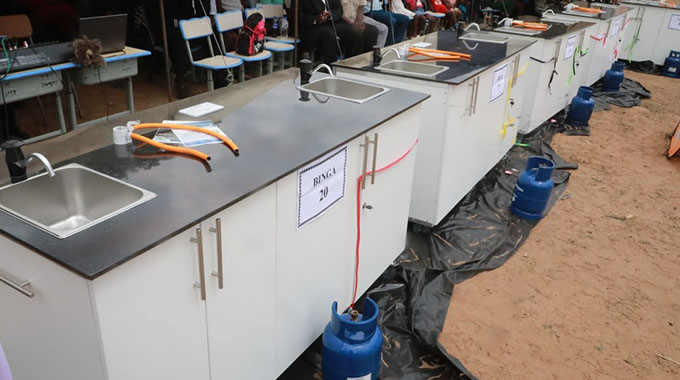
Thupeyo Muleya
Beitbridge Bureau
BEITBRIDGE Rural District Council (BBRDC), with the support of the Rural Infrastructure Development Agency (RIDA), is working on the construction of science laboratories at nine secondary schools in the district as part of the Presidential Science Laboratories Scheme.
These are part of the 40 that the Government is set to establish in Matabeleland South Province as part of legacy projects to be implemented in the province, which will host this year’s Independence Day celebrations.
The initiative seeks to strengthen Science, Technology, Engineering and Mathematics (STEM) education and provide practical experiment opportunities for students, particularly in remote and underserved rural communities that previously lacked equipped facilities.
In addition, it is understood that this project is part of a broader Government push under President Mnangagwa’s administration to improve school infrastructure and integrate technology and science education nationwide.
BBRDC head of engineering and works, Latani Singo, said they had started foundation excavations at the selected schools.
The benefiting secondary schools include: Siyoka and Nuli High Schools, Chituripasi, Malungudzi Matshiloni, Malala, Malikuwa, Swereki, Chamnanga Secondary Schools.
“We have started with the civil works with RIDA as the lead agent,” said Engineer Singo.
“So far, all the initial eight labs have been sited and the community have excavated the trenches and we are waiting for delivery of building materials to begin full scale construction”.
He said foundation trenching was underway at all the identified sites.
RIDA coordinator for Beitbridge Mr Tinashe Ngundu said they had sent a list of the requirements to their procurement section and the bill of quantities.
He said they were expecting to start receiving the building material soon and that most of the labour will be engaged from the local communities around the schools.
“We have sent our requirements to our procurement section and we will soon be recruiting the builders and related labour from the local communities,” said Mr Ngundu.
Speaking recently, Matabeleland South Provincial Affairs and Devolution Minister, Albert Nguluvhe, said these projects will significantly boost the province’s education sector.
He stressed that preparations for the celebrations require the involvement of all stakeholders, adding that other priority areas include improving network coverage and surfacing major roads.
“It’s a great honour and privilege for us as a province to host next year’s Independence Day celebrations,” he said.
“Hosting this event comes with significant development for our province, which will have a lasting impact on the lives of community members. One of the sectors that will record major development is education.
“About 40 science laboratories are set to be constructed in schools across the province and this will be a huge boost for the province’s education system.
“Learning science and computer skills is crucial for building critical thinking, problem-solving abilities and creativity among learners. The learners will be empowered to use these skills to contribute to national development.”
Generally, most schools in Matabeleland South province continue to face an acute shortage of Mathematics and Science teachers as well as resources including laboratories for teaching the subjects.
As a result, the majority of pupils in secondary schools around the province major in arts subjects due to lack of science subjects in schools.
In 2019, President Mnangagwa directed the Minister of Higher and Tertiary Education, Science and Technology Development and the Minister of Primary and Secondary Education to ensure that science subjects are taught at most schools in Beitbridge.
He is also on record as urging students to take science subjects and emerging new fields of study as the Government escalates the drive to modernise the economy in line with the fast-changing world.



 leeroy