admin
admin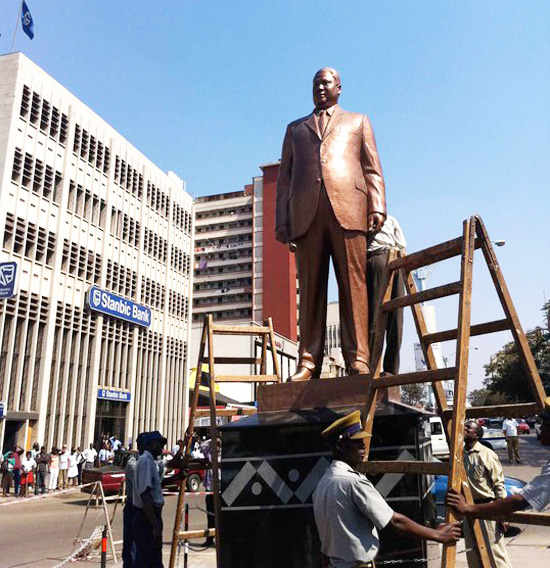
Since time immemorial, people have perpetuated the legacies of their respected leaders in various ways. Some hold official commemorations the day their hero was born or when he died, while name persons, prominent places or structures after their icons.
In the case of one of Zimbabwe’s founding nationalists and post-independence greats, Dr Joshua Mqabuko Nkomo, the government had led in efforts to show respect for him and also to further his legacy.
Soon after his death on July 1, 1999, the Government named some landmarks after the luminary. In Harare, one of the busiest highways was named after Dr Joshua Mqabuko Nkomo.
The road that links the city centre to the Harare International Airport was named after Dr Nkomo.
The airport is a sublime facility at which every visitor that comes to Harare and leaves by air lands or takes off.
Everyone drives on the road as he or she lands in Zimbabwe, right into the capital city and when they depart.
Considering the prominence of the Harare International Airport and the activity on the road that links it to the capital, the naming of the highway after the late heavyweight is quite appropriate. Work on the road is now being finalised.
In Bulawayo, the Government decided to name the local airport after him.
The airport is one of Zimbabwe’s busiest. Over the past few years, the Joshua Mqabuko International Airport underwent a massive facelift.
A lot of money was spent in upgrading it so that its outlook is consistent with the activity that takes place there and the icon after which it is named.
President Mugabe commissioned the new airport on Unity Day last year, December 22.
In Matabeleland South province, in the provincial capital Gwanda, the Government named another landmark after Dr Nkomo. Matabeleland South is also Dr Nkomo’s home province, since he was born in Kezi, in Matobo district.
The former Gwanda Zintec College, which is situated a short distance south of the town centre as one drives down the highway to Beitbridge was named after Dr Nkomo.
In 2004, the Joshua Mqabuko Nkomo National Foundation (JMNNF) was established and registered.
The foundation was inspired by the creation of the Nelson Mandela Foundation in South Africa a year earlier.
The foundation turned the national hero’s house in Matsheumhlope, one of Bulawayo’s best residential areas, into a museum, which it completely refurbished in 2007.
In September 2004, the foundation, in conjunction with Capernaum Trust established a scholarship fund to assist underprivileged students through their education.
When the JMNNF was established in September 2004, it had a broad goal to share the values that were taught by the late nationalist, namely honesty, transparency, humility, humanity, determination and accountability.
A few months before the establishment of the foundation, the government, through the National Museums and Monuments of Zimbabwe commissioned the making of two bronze statues of the late gallant fighter.
The statues were to be erected at selected sites in Harare and Bulawayo.
The Bulawayo one was erected last year and President Mugabe commissioned it on December 22.
He also officially renamed Main Street to Joshua Mqabuko Nkomo Street. It is on that street, where it meets Eighth Avenue, that Dr Nkomo’s statue stands majestically, looking northward.
Unveiling the statue, President Mugabe said:
“The statue we are gathered here to officially unveil and the street we have renamed, are the real story of Zimbabwe and Zimbabweans, our struggles and our aspirations as a people.
That story is embodied in the person of Dr Joshua Mqabuko Nkomo.
Both the statue and the renamed street commemorate and are a tribute to Dr Joshua Mqabuko Nkomo, for his leadership, his dedication and his ability to understand and translate the aspirations of Zimbabweans.
“During his life, he pursued many national roles, before and after independence. The statue and renamed street reconnect us with Umdala Wethu. They are a collective remainder that this country was not given on a silver platter. We fought a bitter armed struggle to get back our country. Never should we forget that. Taking back the land would be one sure way of making Mdala Wethu roll with joy in his grave!
“The man whose statue we are unveiling today has always had the land issue at his heart. He was “Mwana Wevhu”, son of the soil.
Umdala Wethu’s deathbed message remains vivid to me, to this day. He told me to continue the land reform programme and maintain the unity of the people.
“The statue, a national monument, is therefore, part of the national heritage of Zimbabwe which embodies the national values and aspirations of Zimbabweans.
The statue and the renamed street allow us to continuously reflect on where we stand as a nation, also to introspect on what we are doing, as people, vis-à-vis what Dr Joshua Nkomo stood for.
I take this opportunity, to thank all the people through whose combined effort, art, sculpture and architecture, contributed to the construction of the statue that we unveil today.”



 Online Reporter