

 Online Reporter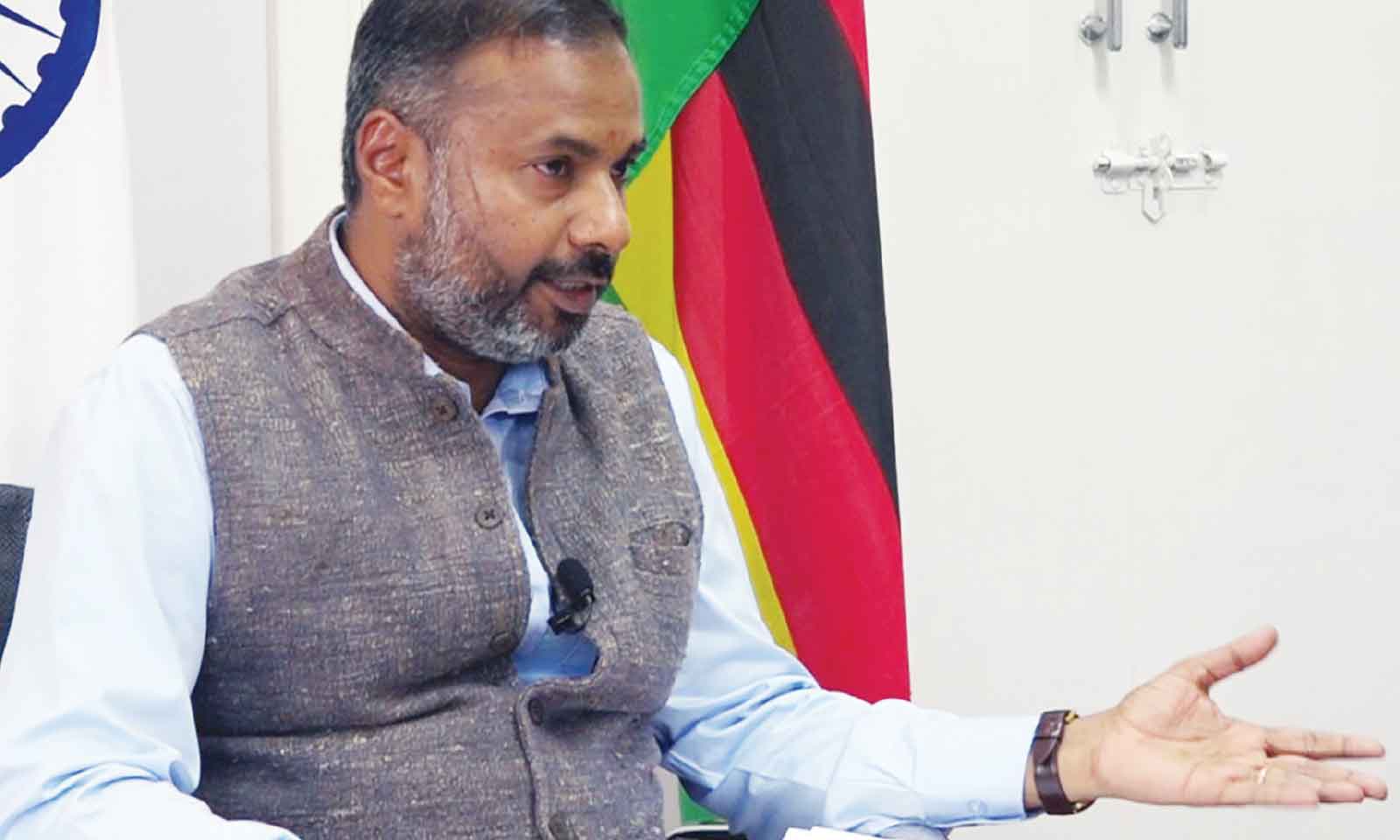
Gibson Nyikadzino
Zimpapers Politics Hub
ON January 26, India held celebrations to commemorate its 77th Republic Day. After a brutal colonial experience of exploitation, murder and plunder overseen by the British for approximately 200 years, India won its independence through non-violence. In an interview with Zimpapers Politics Hub’s Gibson Nyikadzino (GN), India’s Ambassador to Zimbabwe Bramha Kumar (BK) reflects on the importance of non-violence and how it helped shaped modern India; ways to ensure Zimbabwe-India relations are seamless, and more. Below are excerpts:
GN: Why did Indians choose non-violence over armed struggle as an instrument to achieve independence?
BK: India has an ancient tradition of non-violence ingrained in her ancient civilisation. Teachings of non-violence gained popularity since the 6th century BC with the advent of Buddhism and Jainism. With the arrival of Mahatma Gandhi from South Africa in 1915, India was ready to experience mass mobilisation for a non-violent and peaceful show of opposition to colonial masters. Mahatma Gandhi used this Indian tradition to awaken the strength of non-violence. He emphasised that the practice of non-violence needed internal the strength of practitioners. The end of World War I further exposed the hollowness of British promises. The British government in India gave an example of their killing machine when in April 1919; more than 400 innocent and unarmed civilians were killed in cold blood in the infamous Jallianwala Bagh Massacre. The whole nation was agitated and it was the first time that India saw a bigger and widespread mass mobilisation under the leadership of Mahatma Gandhi and the first civil disobedience movement was launched. The movement was successful in assuring people that non-violence was a better way of opposition as the British were still very strong, militarily, to suppress any armed rebellion with brutal state force. From this, we discern that while revolutionary methods received popular sympathy, it was the non-violent means of opposition that received popular support from all corners of Indians. Due to the message of non-violence, it became difficult for British government to use brutal force against unarmed civilians.
GN: What contribution did non-violence make in influencing India’s rise in innovation, scientific revolution, or medical progress?
BK: The principle of non-violence gave Indian freedom fighters a strong moral foundation and ethical discipline. It enabled a smooth transition from struggle to constitution-building, laying the basis for democratic nation-building after independence. Government policies, which include universal adult suffrage and provisions for positive discrimination, along with constitutional guarantees of equality before law and non-discrimination on grounds of religion, race, caste, sex, or place of birth, helped create a more equitable society. By expanding access to education and national resources across all sections of society, these measures nurtured inclusion, innovation, and the growth of a scientific temper essential for long-term development. Thus, evolution of morals, values and ethos were essential for democratic principles that were finally established by the Indian Constitution. Today, India is a country known as a harbinger of a successful and biggest democracy that has preserved rights of minorities, secularism, fourth biggest economy in the world, robust developments in areas of science and technology, ICT, agriculture, industry and manufacturing, biggest pharmaceuticals supplier, among the top 10 trading nations.
GN: On a global platform, India and Zimbabwe are discussing reforms for UN Security Council expansion. How useful is this conversation in enhancing relations between the two states?
BK: Recently, India and Zimbabwe have extended reciprocal support to each other for their campaign for non-permanent membership to the United Nations Security Council (UNSC). This support reflects our long and historical understanding and firm belief in global peace and the liberal world order. We also believe that peaceful co-existence is essential for humanity and also to the collective response to the new challenges to our global society. We have continuously shared a similarity of views on most international issues and closely cooperate at the UN and other multilateral fora. Zimbabwe supported India’s candidature for a non-permanent seat in the UNSC elections held in June 2020. India also appreciates Zimbabwe’s participation at the Voice of Global South, an India-led initiative. Our countries have been active supporters of South-South cooperation, and our bilateral relations have reflected strong bonding between the peoples of our countries.
GN: Indian investments in Zimbabwe are around $600 million and the two countries have signed several investment MoUs. What is stopping the unlocking of more value to increase investments in agreed sectors with Zimbabwe?
BK: The number of Indian companies operating in Zimbabwe is rising steadily and gradually. Indian investors are having a strong presence in various sectors with a private sector investment estimated at around $600 million in sectors like food processing, beverages, mining, textiles, agricultural equipment, and polymers among others, which are also on a path of upward trajectory. In August 2024 we discussed more bilateral cooperation. Given our strong and friendly bilateral relations, the present status of bilateral investment and trade does not reflect its true potential. It needs support of both governments to unlock the very obvious potentials that exist between our two countries. It is also important that the two governments work together to establish some of the important and enabling framework to assist investors and trading companies to enhance their presence in both countries for mutual benefit. I am hopeful that our discussions in forthcoming meetings we should be accelerating progress in identified areas and steer the way forward to sign MoUs that are already under discussion, for quite some time. I am hopeful for Zimbabwe’s proactive approach in implementing the already signed MoUs such as in the mining sector.
GN: Wit time, relations between Zimbabwe and India have been refined. How are these changes being translated to monetary value for the benefit of the two peoples?
BK: The Embassy of India has made an effort to further intensify our already existing people-to-people contacts. We both have been active supporters of South-South cooperation, and our bilateral relations have reflected strong bonding between the peoples of our countries. India’s offers of scholarships in training and higher education have received an overwhelming support in Zimbabwe. Last year the Government of Zimbabwe deployed 71 officials to undertake a training of trainers’ programme at Centurion University in Odisha. India has established itself as a skill hub of the world and we are happy to share our experience with Zimbabwe. During the last couple of years, we had active engagements between our business chambers. I am encouraged to see participation of Zimbabwean business delegations to various events in India. It has encouraged further engagements between our business bodies. Similarly, from India, the Federation of Indian Chambers of Commerce and Industry (FICCI) deployed a business delegation to participate at the ZITF 2025 edition. In December 2025, the Embassy of India, in partnership with the Federation of Indian Export Organisation (FIEO), ZimTrade and Zimbabwe Investment and Development Agency (ZIDA), organised a “Hybrid Interactive Seminar on Enhancing India-Zimbabwe Trade and Investment Cooperation”. I am sure that these interactions would result in further enhancing trade and investment between our countries.
GN: What can the two countries do better to ensure their relations are seamless and that cooperation is deepened and translated for mutual benefit?
BK: While we are looking forward to revive Joint Commission Meeting that last met in 2013, we had Joint Trade Committee Meeting in May 2024 wherein the two countries agreed to enhance bilateral cooperation. This is in identified areas such as healthcare and pharmaceuticals, capacity building in mines and minerals including investment from India in scientific collaboration in agriculture, training in diamond related sector including cooperation to assist Zimbabwe in developing a robust regulatory framework, digital public infrastructure and logistics arrangements for digital payment. These newer areas which could be implemented in near future have potentials to further enhance our already existing strong and friendly bilateral relations. These areas have been agreed upon with a view to boost growth in the Zimbabwean economy by helping it to advance towards a more formal economy. It will also boost economic relations between our two countries with more exchange of knowledge and experience. The visits of trade delegations between India and Zimbabwe and their interactions with some government agencies would further promote bilateral trade and commerce. It is important that the visiting business delegations could get more constructive engagements with their counterparts.



