Tawanda Musarurwa
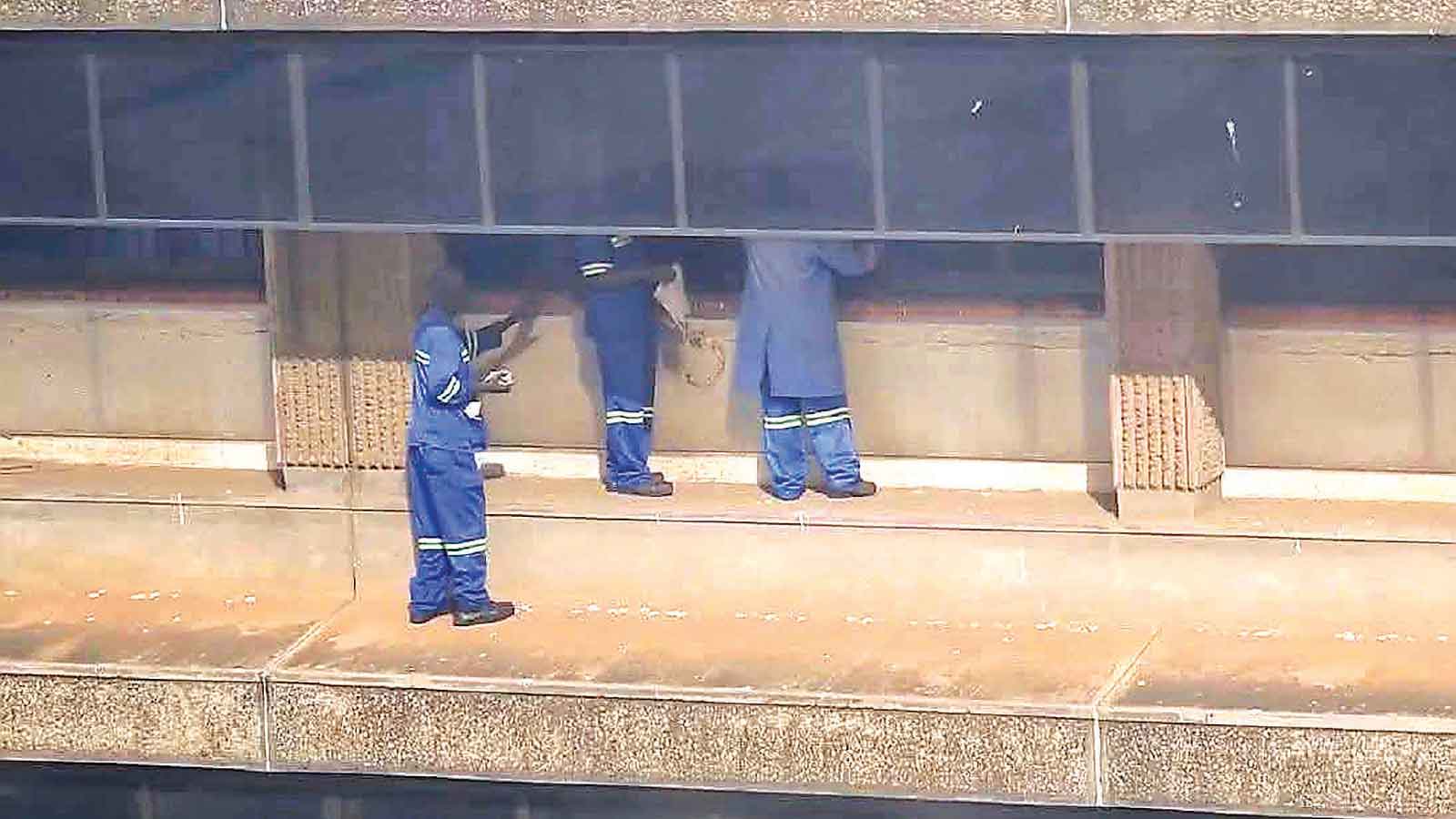
IMAGES of window cleaners working without visible safety harnesses on the eighth and ninth floors of a Harare office building have triggered a formal investigation by the National Social Security Authority (NSSA), after photographs of the workers at Takura House — at the corner of First Street and Kwame Nkrumah Avenue — circulated widely on social media this week.
NSSA inspectors attended the site the same day the reports emerged, but the workers had already left.
The authority says it issued an immediate instruction barring any further window-cleaning at the building without the direct consent of its occupational safety and health inspectors and conducted a formal inspection on May 20.
“Any work at height without adequate protection is unacceptable and unlawful.
“We gave instructions that no work of cleaning windows should continue without the consent of NSSA OSH inspectors,” NSSA general manager and CEO Dr Charles Shava said in an interview.
A formal inspection followed on May 20, 2026.
The assessment revealed nuance that was absent from the viral images.
Inspectors found a stepped external walkway and canopy system just outside the windows at floor level, providing nearly one metre of usable width.
The workers reportedly wore full-body safety harnesses anchored to window frames, and a review of the task’s risk assessment indicated the operation could be performed safely.
Dr Shava was careful not to close the book. “Our inspectors will be carrying out further investigations to confirm if there are any detailed risk assessments, training records, previous incidents and other relevant documents that may be relevant to this incident,” he said.
The incident is far from isolated.
In 2025, NSSA recorded 4 471 workplace injuries across Zimbabwe. Of those, 1 015 — roughly one in four — were caused by falls of persons or materials from height, making it one of the country’s single largest categories of workplace harm.
That toll, officials acknowledge, is almost certainly an undercount.
Added Dr Shava: “NSSA is particularly concerned that the construction, maintenance, and property management sectors remain highly informal, meaning the reported figures represent only a fraction of the true scale of the problem.”
The informalisation of the country’s labour market has compounded the challenge. In sectors such as cleaning, property maintenance and construction, work is frequently subcontracted through chains of intermediaries who blur the lines of legal responsibility.
Workers often lack formal contracts, training, and protective equipment.
“Responsibility for safety is sometimes unclear,” Dr Shava acknowledged.
“Employers may avoid regulatory obligations and shift responsibility to subcontractors.”
Under Zimbabwean law, the requirements for high-rise work are explicit and demanding.
The Factories and Works (Building, Structural and Excavation Work) Regulations of 1976 require that where full compliance with fall-prevention measures is impractical, employers must provide safety nets, safety sheets, safety belts, or other contrivances sufficient to protect workers from injury.
Violations of working-at-heights provisions can attract fines of up to level seven or imprisonment. Inspectors possess the authority to issue improvement notices, prohibition orders that immediately halt dangerous operations, and — in the gravest cases — to pursue criminal prosecution.
In 2025, NSSA served prohibition notices on 15 construction sites nationwide, accounting for 23 percent of all prohibition notices issued that year.
The NSSA Board has recently approved the recruitment of additional inspectors to extend coverage across the country’s workplaces.
During the 2026 World Day for Safety and Health at Work, concern was raised publicly about the trajectory of occupational incidents. Dr Shava did not deny the challenge.
“While some organisations maintain high safety standards, there are some gaps in compliance, particularly among smaller contractors, property management companies and informal sector operators,” he said.
“NSSA believes that more effort is required to ensure full compliance, strengthen safety culture, employer accountability and enhance worker training.”
Efforts to get a comment from Takura House officials were fruitless by the time of publication.
For property owners and contractors receiving NSSA’s message this week, Dr Shava’s guidance was direct: conduct risk assessments before any high-risk task; provide full fall-protection equipment; train workers; use compliant apparatus, including cradles, scaffolding, and rope-access systems; appoint competent supervisors; and build a safety-first culture that is not subordinated to cost.
As for Takura House, Dr Shava confirmed the matter remains unresolved.
“The Takura window-cleaning case is still under our radar as we ensure safety and health are observed for the benefit of all of us,” he said.