admin
admin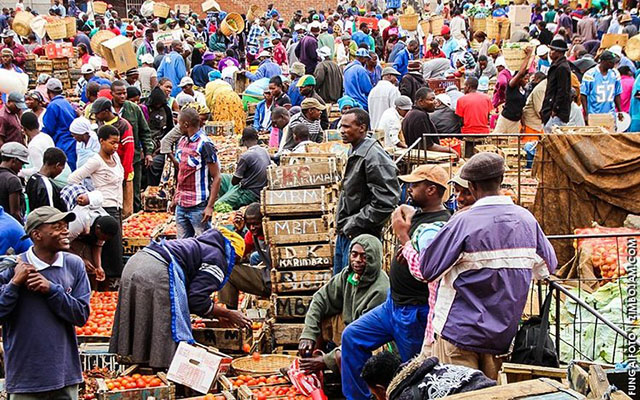
Obert Chifamba-Agri-Insight
EVERY morning, they are drowned in a sea of vivid colours from various fruits, merchandise, crop and vegetable produce.
Yes, mass markets are scenes of lively interactions between sellers and buyers, punctuated with palpable energy, as they shout and haggle, demonstrating the chaotic but rhythmic nature of commerce and community as the two merge to achieve one common goal.
These are indications that bargaining is happening. In fact, bargaining forms the heart of this environment and defines relationships between buyers and sellers.
One obvious ingredient that keeps the bargaining civil and meaningful is laughter and animated conversations that literally fill the air in lavish quantities, as people trade both merchandise and stories.
These are mass markets. They are dotted all over the country. To the unsuspecting eye, they are just platforms where trading in various agricultural products takes place and ends there. But alas, their function goes beyond just providing the trading platform for buyers and sellers. They perform many other crucial functions that are easily out of scrutiny to the less analytical individual.
In real life, mass markets form the bedrock for individual entrepreneurial ambitions and are credited with carving out the social fabric and day-to-day life in ways trusted by the majority of citizens.
These markets create that environment in which citizens can dissect critical matters — be it politics, social, religious and economic.
Citizens are brought together by food security matters, which the mass markets always solve.
In essence, people come and do their trading and go away every day but as they go about their business, they also get the opportunity to share concerns on how best the mass markets can be run and what policymakers should prioritise when making improvements in these crucial spaces.
In this way, mass markets allow citizens to initiate a process that will influence the direction the socio-economic fabric will take as it develops.
Mass markets therefore present citizens with the space to express their views on various important aspects of their lives ranging from politics, religion and the way the economy will be performing.
This is also the same setting in which they can even make informed suggestions on how best to address pressing economic issues that touch their lives daily.
If only policymakers could spare a moment of their precious time and visit these markets regularly, they can get free but constructive feedback on how they execute some of their obligations.
Mbare Musika in Harare, for instance, is always a hive of activity from morning to dusk, which makes it the perfect destination for policymakers intending to get a feel of the socio-economic temperature and decide their next moves basing on real matters that affect the farmers that bring produce for sale, the buyers, service providers like local authorities and transporters and many other citizens participating in the long value chain.
In most cases, it is the affected or a sojourner who can easily proffer a solution to a difficult situation that policymakers may have been struggling to find.
It is common knowledge that people always make suggestions on possible solutions for various problems although they are not capacitated to roll them out.
It will take the astute policymaker to listen to such discourses in a casual and relaxed atmosphere before adding or subtracting unnecessary detail to come up with viable solutions.
Policymakers can easily pick constructive pieces of advice from the interacting citizens because they are the ones who know what policymakers should do differently to advance the dream to develop resilient food systems as opposed to promoting monoculture.
One of the most important functions of mass markets is promoting food security through bringing together crop producers, buyers, consumers and all the important players in the food chain.
In one of his numerous works of writing, Knowledge Transfer Africa chief executive officer and long-time friend of mine, Dr Charles Dhewa says: “It is through collaborating with farmers, traders, transporters and other actors that policymakers can understand trading practices and entrepreneurship levels within mass markets.
When policymakers master what happens in mass markets, they will realise that financial literacy should not be too academic.
“It is unfortunate that in many African countries, financial issues have remained too academic such that people who study finance in formal academic institutions are the only ones who understand issues like money supply. However, the majority of people understand how money functions in practice,” he said.
He added that: “Through mass markets, African policymakers should be able to develop indigenous financial systems rather than always thinking that trading should happen through a medium of exchange in the form of a currency. As shown by what happens in mass markets and farming communities, the intrinsic value embedded in commodities is more important than a currency.
“That is why one can exchange a packet of sugar worth US$2 for a chicken worth US$5 and still be satisfied. A farmer can exchange a bull worth US$800 with a heifer worth US$300 and be satisfied because s/he values what the heifer will produce in the long run.”
One exciting observation is that business at mass markets is usually driven mostly by young agricultural entrepreneurs, who represent the emerging crop of farmers who treat agriculture as a business.
Their farming activities are essentially a demonstration of indigenous commerce driven by easy-going trading that accommodates a wide range of commodities born out of many different enterprises.
Of course commodities on sale are produced on a household level with the entire family in most cases participating during the process of production. The entire family contributes to the building of its socio-economic reality.
This allows mass markets to consolidate their role as seedbeds for family enterprises and economically empowers both the family and its individual members since they will be involved in the process of production, which broadens their income sources.
Each family member can produce something different that will be brought to the market alongside what the other would have produced too.
By so doing, the family is effectively empowered and does not look up to one individual as their saviour socio-economically.
On any given day at the market, it is naturally possible that different products may perform differently – either badly or well, which leaves a family with a fall-back position.
Mass markets allow farmers to trade in a little bit of everything and there are no restrictions.
They make it possible for different family members to trade in various classes of merchandise – moderate, low or high value. Incomes generated from the various commodities all help moderate the cost of living for the families.
The good thing about trading on mass markets is that families get incomes that come in every time and do not have to wait for the end of the month or season to get some cash.
They can always do staggered planting of crops especially under horticulture and ensure they have something coming into their coffers always whether small, big or moderate.
Farmers trading their produce at mass markets usually have a lot of say in how much money they make in a day, week, month or year.
They just need to know what crops to produce and at what time, which is different from what someone formally employed does given that the employer makes the bulk of the decisions especially where money is concerned.
Sometimes natural process act in the farmers’ favour, for instance, when demand for a product suddenly surges and the farmer has no option but name a better and higher price.
Consumers are also benefiting immensely from the presence of mass markets.
The fact that they go and buy directly from the produce in some cases means that they are safe from the mark-up price that effected by retailers who would have sourced commodities from the producers.
This means consumers will have access to basic commodities at reasonable and affordable prices that can also negotiate at times.



 Online Reporter