

 admin
admin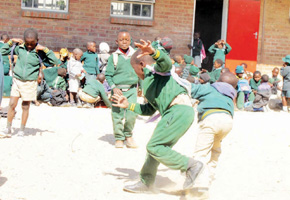
This condition is caused by a shortage of learning space forcing most schools in high-density suburbs of Bulawayo to adopt the hot-seating system in order to accommodate scores of pupils enrolled each year.
A Grade Four pupil at one of the primary schools in the high-density suburbs said her school was divided into two broad learning sessions with one attending lessons from 7:30am to 1pm and the other from 10am to 4pm.
“We use the same classroom used by a Grade Three class and when we are in the afternoon session we have to learn in the open air from 10am up to 12 because that is when the Grade Threes move out of the class to learn in the open air up until they knock off at 1pm,” she said.
She said during times when they learn in the open air they use their laps as desks and the ground as their chairs.
“When we learn in the open air we sit under trees or outside the classrooms and most of the times we write notes that are dictated to us or the teacher conducts revisions. It is difficult to write in such an environment because we sit on the ground and we place our books on our laps and use them as desks,” she said.
A Grade Six pupil said in extremely cold weather conditions classes learning in the open air are forced to move into the occupied classrooms and a room was shared by two classes which results in a lot of commotion.
“Our classroom is also used by a Grade Five class and when we are in the afternoon session and the weather is extremely cold we move into the same classroom occupied by the Grade Fives. The Grade Fives shift their desks and occupy a part of the class while we sit on the floor and use another part of the class.
“This causes a lot of commotion and it becomes difficult to concentrate in such an environment. It is impossible to have two separate classes in one classroom having two separate lessons. It is difficult to learn when our teacher is conducting a lesson and another teacher is conducting another lesson by the side,” she said.
She said when the two separate classes move into one room it also becomes difficult for the pupils using desks to write properly because of congestion.
“When the desks are moved to one place we have little room left to write and we are expected to remain in that highly congested classroom from 10am up to 1pm because that is when one class knocks off.
“Now that we are in the winter season we have learned under this unfavourable condition several times and we are yet to share classes on more occasions because of the weather,” she said.
Another pupil who is in the first grade in a local school said the teacher was the one who determined whether a class had to move into the classroom or not.
“When we are learning in the open air, the teacher is the one who decides whether we have to move into the classroom or not. Sometimes we can complain about the weather but the teacher may prefer that we learn from outside until the other class moves out,” he said.
Many schools that were built several years ago in high-density suburbs have been operating with inadequate classrooms.
Among these schools some have never had any classrooms built in addition to those used by pupils in order to develop the schools despite having been operating for several years.
This has affected the quality of education that pupils receive from such schools as the resources available in some of these schools are highly inadequate.
Most parents turn to schools in the high-density suburbs which are either Government or city council-run because of the relatively low fees they charge. The schools are also located near their homes, which has proved favourable as parents are able to avoid transport costs if they learnt at further-away schools.
Despite these conditions, resources in these schools are way below expectation as the schools enrol scores of pupils but development is slow.
Financial constraints being faced by the Government and the Bulawayo City Council have forced some school bodies to charge special levies that are paid by parents in order to raise money for building classroom blocks as they remain way below the capacity of pupils.
A survey revealed that one of the primary schools, Mkhithika Thebe in Cowdray Park, has as many as 1 700 pupils but is operating with only 15 classrooms.
A teacher at the school said this was a great challenge as three separate classes were being forced to share one room because of harsh weather conditions.
“On extremely cold days three separate classes use the same room and you can imagine the congestion that arises in such a situation. The classrooms become overcrowded and this poses health threats to pupils and teachers,” she said.
Another example is Tategulu Primary School which has six classes per grade bringing the total to 42 classes excluding Grade Zero but has 27 classrooms. At this school two separate classes are forced to share the same room. A teacher at the school, who cannot be named for professional reasons, said the sharing of one room by two separate classes at the same time was not an ideal condition both to teachers and pupils.
“Being two separate classes in a room is difficult because children become uncontrollable. As a teacher, I feel I am deprived of the necessary space for teaching because whenever I conduct my lessons and there is another class in the same room this causes disturbances to the teaching process,” he said.
He said it was better to move out of the classroom to the open air even on days when the weather was harsh.
“Sometimes I opt to conduct my lessons in the open air until my turn to use the class because sometimes when we share a class tension rises between teachers,” he said.
The teacher said he did not expect pupils to continue learning in such unfavourable environments for several years without any visible developments taking place.
“I think there has been a delay in the development of such schools because some have been operating for over 10 years but we have not seen any new classroom blocks being added to those that have been used by pupils over the years.
“An ideal learning place for primary pupils has to be an enclosed place which ensures full concentration from pupils. Once children learn in the open air or crowd in one room they become uncontrollable. This makes learning difficult,” he said.
He said an ideal learning environment also had to have the basic equipment which pupils can use in the learning process such as chairs and desks.



 Online Reporter