admin
admin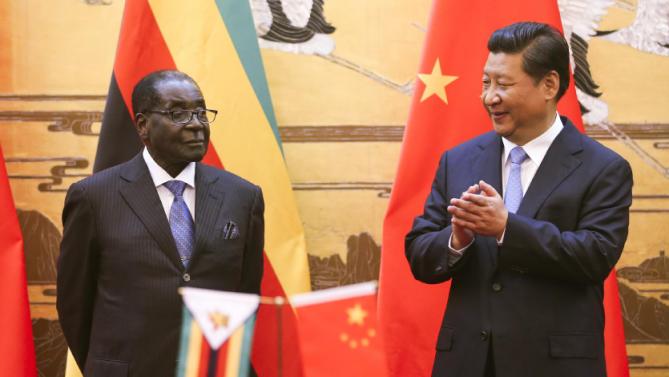
Saul Gwakuba Ndlovu
The recent state visit to Zimbabwe by the Chinese President, Cde Xi Jinping, was a historic consolidation of mutually beneficial relations that date back to a period when both nations were experiencing virtual ostracisation by the world at large.
China was viewed with hostility by the western European nations following its successful armed revolution that ended with its liberation in 1949.
In 1959 when Joshua Nkomo decided to put the Southern Rhodesia colonial question on the international map, he visited China, and was well received by the government whose head was the historic Mao Tse Tung, the architect and leader of the Chinese armed revolution.
That visit led to closer relations later when in 1962 Zapu sent its first group of cadres to train militarily in China.
Among that group were the late editor of The Herald, Charles Chikerema, Philemon Makonese and David Mpongo. Those were followed a year or so later by another group comprising Zimbabwe’s Vice-President, Cde Emmerson Mnangangwa whose colleagues were the late Luke Nene Mhlanga and Gordon Butshe, among others.
That time, it was not easy for a state to offer military training facilities to freedom fighters because they (freedom fighters) were regarded as terrorists by virtually every western-oriented media organisation, and they predominated throughout Africa and Asia.
In spite of all that hostility and vilification, China stood solidly behind the African liberation cause. Mao Tse Tung and his unforgettable lieutenant, Chou en Lai, adopted a pro-African position against the imperialist west.
To facilitate Zimbabwe’s liberation war, China built the 1,696km long Tanzania-Zambia railway line that freed Zambia from the use of the Southern Rhodesia-controlled railway services for its vital copper exports and oil imports.
Stretching from Kapiri Mposhi in Zambia’s Central Province, the line goes as far as Dar es Salaam on the Indian Ocean coast. The line enhanced Zambia’s national sovereignty by greatly reducing that nation’s dependence on Rhodesia, Mozambique and South Africa, countries that were by then under minority settler regimes.
In Tanzania, China built textile mills and trained Tanzanians how to operate machinery that it supplied for the factories.
China’s goodwill and all-weather friendship continued into independent Zimbabwe.
The giant National Sports Stadium was built by the Chinese, and so was the military academy in Harare.
In the energy infrastructural development field, China has undertaken to enlarge Zimbabwe’s Hwange Thermal Power Station and expand the Kariba South hydroelectric facility, two projects that will generate an additional 900 megawatts by 2018.
That will be a major boost to the country’s energy needs, and will enable commerce and industry to operate more or less efficiently.
China’s goodwill towards Zimbabwe is highly commendable and must be appreciated by every Zimbabwean who values our independence.
Its decision to invest in some of Zimbabwe’s economic sectors at a time when the world is by and large facing recession shows the same type of solidarity it exhibited practically by constructing the Tazara line at a time when imperialist nations were convinced that black-ruled Africa would be held to ransom by the then white minority dominated Africa south of the Zambezi River.
Zimbabwean entrepreneurs and industrialists should seize the goodwill between the two nations to invest in China or to enter into the Chinese market.
That could be of much advantage to Zimbabwe in view of the fact that China’s population is equivalent to a third of the entire world’s, and its people’s buying power is second to that of the United States, if considered on a per capita basis.
In the cultural field, Zimbabwean cultural promoters, particularly those who have turned culture into an industry, could do themselves a world of good by seizing this Sino-Zimbabwean goodwill to exploit the Chinese cultural market.
That is especially so for promoters of performing arts such as music, drama and poetry, those who have commercialised these arts.
It would be most plausible if Zimbabwean educational authorities were to deepen and widen the country’s relations with Beijing, a development that could cover a segment of the two countries social relations through exchange programmes.
Purveyors of Zimbabwean artifacts should similarly exploit the present Sino-Zimbabwean goodwill to penetrate the vast Chinese market. All these possibilities can help revive and expand Zimbabwe’s national economy, a development that can add to what China is contributing to Zimbabwe socio-economic progress.
Some of Zimbabwe’s educational institutions, especially the tertiary level ones, could help strengthen the country’s amicable relations with China by establishing bilateral ties with their appropriate Chinese counterparts.
Zimbabwean universities can play a very significant part in this regard by entering into scientific research agreements with China. Such Sino-Zimbabwean projects can be based in Zimbabwe so that they can better serve the nation by moving into the next stage after research, that is, the development stage.
Saul Gwakuba Ndlovu is a retired, Bulawayo-based journalist. He can be contacted on cell 0734 328 136 or through email. [email protected]


 Online Reporter