admin
admin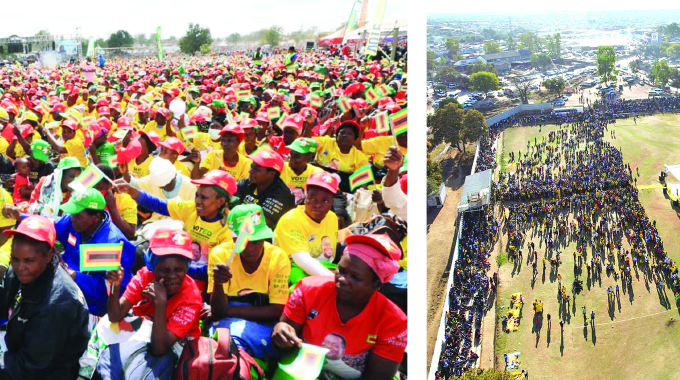
Ranga Mataire Group Political Editor
Eleven years ago in the United States, Mitt Romney, the leading candidate in the Michigan Republican primary elections, set out to give a headline-grabbing policy speech to explain his plan to revive the struggling economy.
After security concerns, the venue was shifted to the more spacious Ford Field football stadium. It proved a bad move as all the media focused on was the near-empty stadium instead of the content of Romney’s speech.
Despite having 1 200 people in attendance, the near emptiness of the 65 000-seater stadium projected bad optics to the electorate. It was that experience that re-awakened election campaign strategists to the significance of optics in an election.
The bad optics overshadowed Romney’s desired message and his campaign confirmed an important political principle: it is not just what politicians say or write that matters, but also how a politician looks and visually presents himself to the electorate.
For political communication audiences, what they see is just as important as what they hear or read.
Optics in politics are therefore critical in shaping public opinion and understanding.
In Zimbabwe’s current electoral contests, optics of images or videos are proving to be a dominant takeaway from the campaign rallies.
At the start of the campaigns, it appeared as though the opposition CCC was competing well with the ruling Zanu PF in projecting good optics at their rallies.
As the campaign progressed, it has become clear that the CCC’s one-man band campaign is no match for the highly organised and systematic Zanu PF campaign machinery.
Attempts to manipulate visuals by using close-up shots to give an illusion of an oversubscribed rally were quickly debunked with the aid of drone technology, which gave the actual reality of the people who had attended the rally.
We saw some in the online media space claiming that the drone footage of the CCC’s rally in Beitbridge had been manipulated to show a small crowd.
Yet, when challenged to show their own drone footage to show a full stadium and debunk the circulating footage, there was silence. They only resorted to using close-up images of the crowds.
Seeing that they were no match for Zanu PF, the CCC started disparaging crowds at the ruling party’s rallies.
They accused Zanu PF of bussing people and frog-marching them to rallies.
However, Zanu PF has fired back. The party points out that one can only bus supporters if they have them, and if they have the means to do so.
The bigger takeaway from the rally visuals is the one CCC supporters do not want to talk about. It is the reality that it is only Nelson Chamisa who is able to draw any crowds of significance.
In fact, outside of Chamisa’s rallies, CCC supporters have nothing else to share. It says a lot about the campaign; as Chamisa himself said on nomination day, only one candidate matters — Chamisa himself.
Contrast this with Zanu PF rallies.
The party is able to garner supporters at various levels. It is not only President Emmerson Mnangagwa who is campaigning and drawing huge crowds.
From his two Vice Presidents to every candidate, Zanu PF has figures able to campaign for the President and the party, on their own.
President Mnangagwa has given them the mandate to do so.
He trusts them. Those in the CCC do not have such a mandate.
They must bow to Chamisa. He has no trust in his lieutenants.
These are the optics that should worry their supporters more than their fixation with paltry rally numbers.
In this election, there is a battle between imagery and substance. For Zanu PF supporters spoken to at the recent rally in Centenary, Mashonaland Central, it is not about oratory, but delivery.
From farmers to working women, they feel that the incumbent President Mnangagwa has served them well. They have something tangible, such as the irrigation schemes in Mashonaland Central and across the country.
The rallies have done well in showing the President’s grassroots appeal.
Experimental research in political communication has found that a single photograph of a candidate can influence voters’ judgements regarding the candidate’s demeanour, competence, leadership ability, attractiveness, likeability and integrity.
Crowds at rallies are a powerful visual to the electorate. Images of candidates juxtaposed with cheering supporters make a “social proof” argument for the popularity of a candidate. As social becomes a critical battleground, visuals are increasingly important. What a politician says is very important, but as the case of Romney’s speech at Ford Field showed, the “optics” of an event sometimes become the story.
As the election season moves to a crescendo, voters will undoubtedly be faced with a vast collage of political images, each visual vying for attention and wooing them. Any politician who disregards the importance of optics in this modern era of the internet and social media is crafting his own political epitaph even before the actual voting has taken place.
For a party like CCC, the optics of a party unable to organise itself outside the whims of its leader have been loud in this election. Those visuals are screaming louder about the state of the CCC than any attempts to use close-up pictures of crowds to inflate their size.


 leeroy