Sundaymail Editor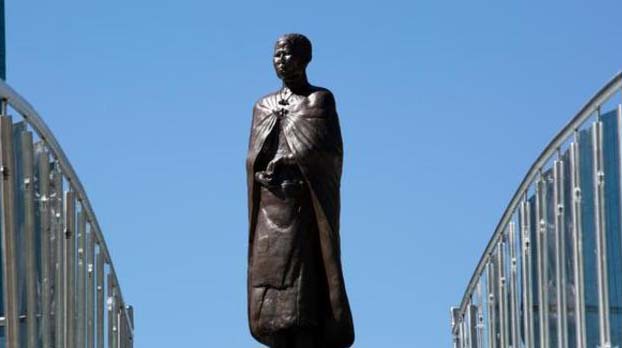
Leroy Dzenga
WHEN Charwe, the last widely authenticated vessel of spirit medium Nehanda was killed in 1898, she left a bold declaration: promising that her bones would rise again.
The cryptic message, which has not been interpreted in a singular manner to date, was a proverbial spit in the face of the colonial settler regime, which was hanging her.
She had been convicted on charges of orchestrating the murder of native commissioner Henry Hawkins Pollard.
Charwe’s words, which cannot be ascertained whether she was speaking in mortal form or was channelling reflections from the ethereal world, propelled both her being and the spirit which she wore into a perpetual section of history.
That death crystallised her position as one of the sources of inspiration in the fight against colonial oppressors.
Mbuya Nehanda’s enduring spirit, which historians trace back to as far as the 1500s, was given a new lease of life and was placed in the broader national discourse, of Zimbabwe, which eventually became reality.
This was a woman who had died refusing to recognise settler rule, and more importantly, was refusing to be assimilated into the coloniser`s religion, Christianity.
There is a photograph which was taken at the occasion of her murder which depicted a defeated woman, who looked as if she carried the weight of the world on her shoulders.
It was carefully framed to represent defeat so as to dissuade those who may have thought of following her footsteps.
It was supposed to be a deterrent visual text, akin to a scarecrow.
It is that image which has been kept and preserved to carry the memory of one of the country’s most iconic figures in resisting colonialism.
Zimbabwe would have betrayed herself if she had not pursued other ways of conveying the importance of Nehanda across generations.
By all means, Mbuya Nehanda is central to the country’s independence.
Freedom fighters, upon learning of her story, would revere her as a central figure of resonance in their quest for independence.
A freedom fighter interviewed by Dr Julia Mutambara, in 2018, for a paper titled: “Exploring the Role of Spirituality in Coping with War Trauma Among War Veterans in Zimbabwe, says, “Mbuya Nehanda, the great Chimurenga spirit, always told us that ‘mapfupa angu achamuka’ translated into English to mean “my bones will rise”.
“This meant that although she was dead, she was going to come back again to avenge whatever atrocities were being done against her children.
“Therefore, we did not have fear at all because we were connected to our ancestors.
“They were helping us and they were our pillar of strength.”
Such a reflection, which is shared by many other freedom fighters, give impetus to the immortalisation of the last widely known vessel occupied by Mbuya Nehanda, Charwe, and the memory of the spirit which guided her.
There is a traceable link between the independence the country presently enjoys and the idea of Nehanda, which was among the coping mechanisms referenced by freedom fighters during times of strife.
In some instances, they carried on, simply because they held on to the words “mapfupa angu achamuka.”
Now 41 years since the country gained independence, some of these lessons are becoming clearer.
This is why it is easy to understand why there is now investment into the priceless memory of Mbuya Nehanda.
If it were up to me, this would have been done years earlier because time erodes memories.
In Anthills of the Savannah, the godfather of decolonial African literature, Chinua Achebe, lays an argument for the preservation of salient memories in every epoch.
“The story is our escort, without it, we are blind,” writes Achebe.
His position speaks to the need to protect our memories with our lives, with all we have because they shape how we perceive ourselves as a people.
The resistance and ridicule in some sections of society that greeted the erection of the statue is concerning, but unsurprising.
It played as a reminder of the work that awaits proponents of decolonisation.
A people who are separated from their indigenous beliefs are hard to redeem and the coloniser knew this, this is why he tried to coerce Charwe to join their ways of spirituality.
The effects are still visible to date. Among the strongest opponents to the Mbuya Nehanda statue were fundamentalists of a certain religious persuasion who interpreted the respect given to Nehanda as ‘worshipping idols.’
This makes a case for the fresh escalation of the decolonial project.
Antonio Gramsci, a French scholar and cultural writer wrote on the idea of hegemony in which he problematised the function of religion in seeking dominance in society.
Religion, described by Karl Marx as the opium of the masses, has muddied the waters as far as the Mbuya Nehanda discourse is concerned.
There are those who see the respect and honour given to spirit mediums as direct competition to their preferred deities, which is not necessarily the case.
Politics was also not far off as being the source of aspersions. There are those who are convinced that the statue is a strategy by the ruling party to retain power.
However, beyond the retention of power, and the hegemonic considerations — which are valid but are not the sum total of the aspects of interpretation in such a layered case — there is the element of Afro-spirituality and the basic weaponisation of beliefs.
Our people have been made to be apprehensive towards their own key religious figures.
Western religion is in itself a hegemonic tool, it locates itself at crossroads with the African ways of doing things.
As such, those who subscribe to Western ways of worship do not give the spirit mediums the due nuance they deserve.
Conversations involving our intergenerational heroes are always viewed with scorn because there is a belief that our heroes do not bear their own agency beyond the whims of political agents.
If Nehanda is a tool of oppression, similarly Moses, who is said to have separated a flowing river with his walking stick, is no less.
Some historians, who are in constant tension with authorities, have also tried to chime in on the issue with contestable submissions.
Dr Takavafira Zhou, a historian, was quoted in a local daily arguing that Mbuya Nehanda is not a national heroine but instead was a localised spirit medium.
In his words, he said: “This epistle must be understood as an accurate historical narrative and nothing more. The truth is that Nehanda was not a national figure, but a local figure as a spirit medium whose influence was restricted to the Mazowe area.
“Her advantage was her nearness to the locus of power and white misconception of 1896-97 uprisings. She has been wrongly elevated to national status because of totalising Zezuru hegemonic power.”
This take does not exactly hold as much water as he would have wanted it to, for simple reasons that Dr Zhou bears that onus as an academic to prove that indeed Mbuya Nehanda was a localised spirit medium confined only to Mazowe.
Spirits are not bound by mortal variables such as space.
Masvikiro are more complicated than he is putting across.
If people could go on conquests and trade missions to as far as Swaziland, there is no reason why the influence of a spirit medium can — strictly speaking — be localised. Nehanda’s statue is a preservation of the memory of one of the most eminent vessels which Nehanda spoke through. It is not uncharacteristic for countries to honour their heroes and heroines through works of art. Doing so is not a display of resource abundance but a reminder of the journey that the country would have walked.
Zimbabwe is a country with a past and efforts to make it relatable beyond generations are, in my view, laudable.


 Online Reporter