admin
admin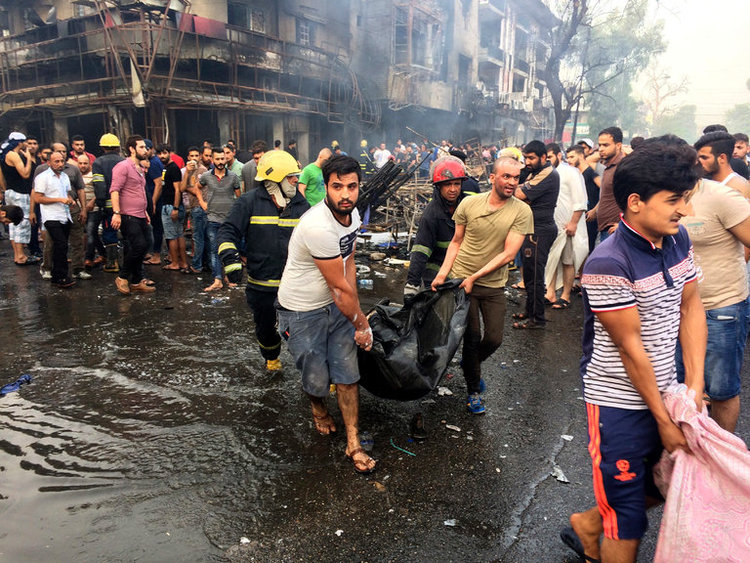
BAGHDAD. – As Iraqis gathered late on Saturday night in central Baghdad to eat, shop and just be together to celebrate one of the last evenings of the Muslim holy month of Ramadan, a huge bomb exploded and killed at least 123 people, the third mass slaughter of civilians in three countries carried out by the Islamic State in recent days. The attack, which occurred shortly after midnight in the middle-class neighbourhood of Karrada, a busy area of cafes, shops and hotels, was the deadliest single attack in Baghdad this year and was the first major assault in the capital since Iraqi forces retook Falluja from the Islamic State late last month.
Falluja had been in the hands of the Islamic State for two-and-a-half years, longer than any other in Iraq or Syria, and many Iraqis had feared that after its liberation, the Islamic State would strike back with more terror attacks in Baghdad.
The Sunni extremists of the Islamic State almost immediately claimed responsibility for the bombing, saying it had killed a gathering of Shiite Muslims. But Karrada is a mixed area where Iraqis of all identities gather to do ordinary things: mainly to shop and eat.
The bombing came just after the Islamic State, also known as ISIS or ISIL, took responsibility for an attack on a restaurant in Bangladesh that left 20 people dead, some of them hacked apart by swords and knives.
And it followed by a few days the co-ordinated suicide attack on Istanbul’s main airport that killed more than 40 people, for which Turkish authorities blamed the Islamic State, although the terrorist group itself did not claim responsibility. By daybreak yesterday in Baghdad, fires were still burning at the bombing site, while hospitals tended to the wounded, and mourners prepared for funerals.
Some bodies were believed to be still buried in the rubble of a shopping mall. Along with the deaths, at least 140 people were injured, officials said yesterday afternoon. Baghdad Operations Command, which is in charge of security in the capital, was quick to announce that it had arrested a terrorist “cell” in the city that was linked to the bombing.
Many of the victims were children.
The explosion struck near a three-story complex of cafes and shops where families were celebrating a successful end of the school year, residents said, and on Sunday dozens of people were still unaccounted for. One man named Omar Adil said that his two brothers, Ghaith and Mustafa, were missing.
Five people from a single family in Sadr City, a large and poor Shiite neighbourhood in eastern Baghdad, were also missing. The scenes were another brutal illustration of the paradox Iraq faces as its security forces, backed by American airstrikes, make gains against the Islamic State.
As more territory is won back, the group is reverting to its roots as a guerrilla insurgency, turning Baghdad once again into an urban killing field. The bombing was an abrupt ending to the brief victory lap that Iraq’s beleaguered prime minister, Haider al-Abadi, was enjoying following the recapture of Falluja. — New York Times.


 Online Reporter